


Vaccine-induced cellular responses control simian immunodeficiency virus replication after heterologous challenge
- PMID: 19403685
- PMCID: PMC2698536
- DOI: 10.1128/JVI.00272-09
Vaccine-induced cellular responses control simian immunodeficiency virus replication after heterologous challenge
Abstract
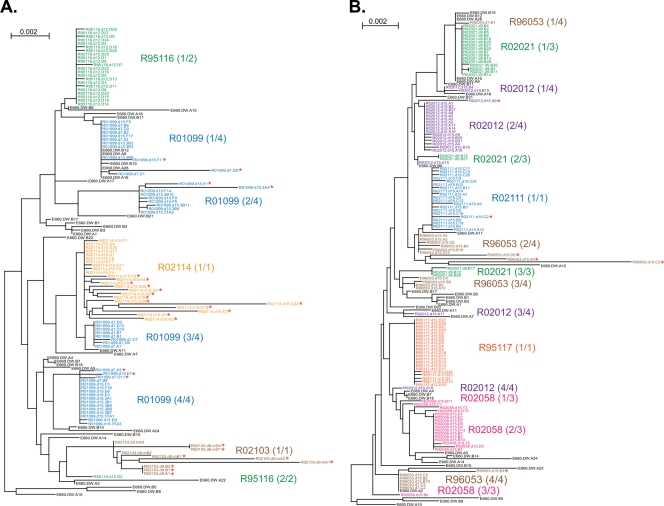
All human immunodeficiency virus (HIV) vaccine efficacy trials to date have ended in failure. Structural features of the Env glycoprotein and its enormous variability have frustrated efforts to induce broadly reactive neutralizing antibodies. To explore the extent to which vaccine-induced cellular immune responses, in the absence of neutralizing antibodies, can control replication of a heterologous, mucosal viral challenge, we vaccinated eight macaques with a DNA/Ad5 regimen expressing all of the proteins of SIVmac239 except Env. Vaccinees mounted high-frequency T-cell responses against 11 to 34 epitopes. We challenged the vaccinees and eight naïve animals with the heterologous biological isolate SIVsmE660, using a regimen intended to mimic typical HIV exposures resulting in infection. Viral loads in the vaccinees were significantly less at both the peak (1.9-log reduction; P < 0.03) and at the set point (2.6-log reduction; P < 0.006) than those in control naïve animals. Five of eight vaccinated macaques controlled acute peak viral replication to less than 80,000 viral RNA (vRNA) copy eq/ml and to less than 100 vRNA copy eq/ml in the chronic phase. Our results demonstrate that broad vaccine-induced cellular immune responses can effectively control replication of a pathogenic, heterologous AIDS virus, suggesting that T-cell-based vaccines may have greater potential than previously appreciated.
Figures



References
-
- Abdel-Motal, U. M., J. Gillis, K. Manson, M. Wyand, D. Montefiori, K. Stefano-Cole, R. C. Montelaro, J. D. Altman, and R. P. Johnson. 2005. Kinetics of expansion of SIV Gag-specific CD8+ T lymphocytes following challenge of vaccinated macaques. Virology 333226-238. - PubMed
-
- Allen, T. M., P. Jing, B. Calore, H. Horton, D. H. O'Connor, T. Hanke, M. Piekarczyk, R. Ruddersdorf, B. R. Mothe, C. Emerson, N. Wilson, J. D. Lifson, I. M. Belyakov, J. A. Berzofsky, C. Wang, D. B. Allison, D. C. Montefiori, R. C. Desrosiers, S. Wolinsky, K. J. Kunstman, J. D. Altman, A. Sette, A. J. McMichael, and D. I. Watkins. 2002. Effects of cytotoxic T lymphocytes (CTL) directed against a single simian immunodeficiency virus (SIV) Gag CTL epitope on the course of SIVmac239 infection. J. Virol. 7610507-10511. - PMC - PubMed
-
- Allen, T. M., L. Mortara, B. R. Mothe, M. Liebl, P. Jing, B. Calore, M. Piekarczyk, R. Ruddersdorf, D. H. O'Connor, X. Wang, C. Wang, D. B. Allison, J. D. Altman, A. Sette, R. C. Desrosiers, G. Sutter, and D. I. Watkins. 2002. Tat-vaccinated macaques do not control simian immunodeficiency virus SIVmac239 replication. J. Virol. 764108-4112. - PMC - PubMed
-
- Allen, T. M., T. U. Vogel, D. H. Fuller, B. R. Mothe, S. Steffen, J. E. Boyson, T. Shipley, J. Fuller, T. Hanke, A. Sette, J. D. Altman, B. Moss, A. J. McMichael, and D. I. Watkins. 2000. Induction of AIDS virus-specific CTL activity in fresh, unstimulated peripheral blood lymphocytes from rhesus macaques vaccinated with a DNA prime/modified vaccinia virus Ankara boost regimen. J. Immunol. 1644968-4978. - PubMed
-
- Amara, R. R., F. Villinger, J. D. Altman, S. L. Lydy, S. P. O'Neil, S. I. Staprans, D. C. Montefiori, Y. Xu, J. G. Herndon, L. S. Wyatt, M. A. Candido, N. L. Kozyr, P. L. Earl, J. M. Smith, H. L. Ma, B. D. Grimm, M. L. Hulsey, J. Miller, H. M. McClure, J. M. McNicholl, B. Moss, and H. L. Robinson. 2001. Control of a mucosal challenge and prevention of AIDS by a multiprotein DNA/MVA vaccine. Science 29269-74. - PubMed
Publication types
MeSH terms
Substances
Grants and funding
- HHSN266200400088C/PHS HHS/United States
- R37 AI052056/AI/NIAID NIH HHS/United States
- RR020141-01/RR/NCRR NIH HHS/United States
- R24 RR016038/RR/NCRR NIH HHS/United States
- R21 AI077472/AI/NIAID NIH HHS/United States
- R24 RR015371/RR/NCRR NIH HHS/United States
- C06 RR020141/RR/NCRR NIH HHS/United States
- C06 RR015459/RR/NCRR NIH HHS/United States
- P51 RR000167/RR/NCRR NIH HHS/United States
- RR15459-01/RR/NCRR NIH HHS/United States
- R01 AI076114/AI/NIAID NIH HHS/United States
- R01 AI049120/AI/NIAID NIH HHS/United States
LinkOut - more resources
Full Text Sources
Other Literature Sources
