Comparison of a variable-number tandem-repeat (VNTR) method for typing Mycobacterium avium with mycobacterial interspersed repetitive-unit-VNTR and IS1245 restriction fragment length polymorphism typing
- PMID: 19403768
- PMCID: PMC2708485
- DOI: 10.1128/JCM.02373-08
Comparison of a variable-number tandem-repeat (VNTR) method for typing Mycobacterium avium with mycobacterial interspersed repetitive-unit-VNTR and IS1245 restriction fragment length polymorphism typing
Abstract
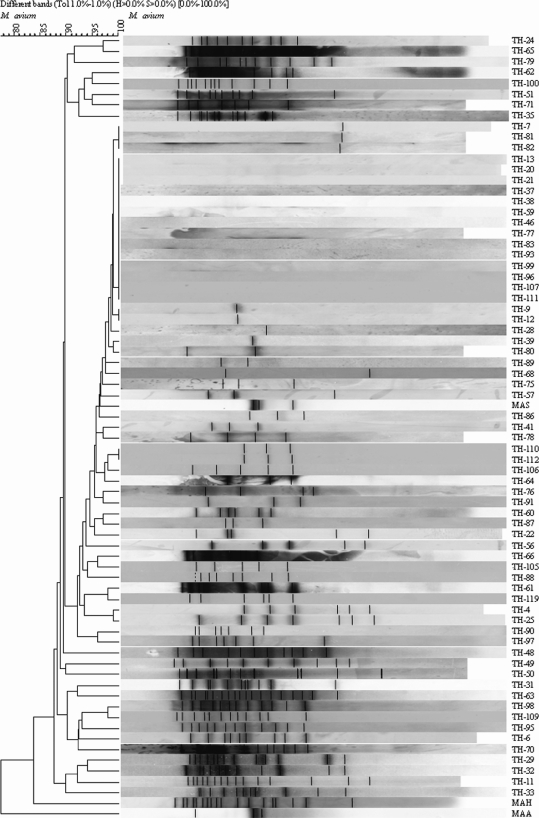
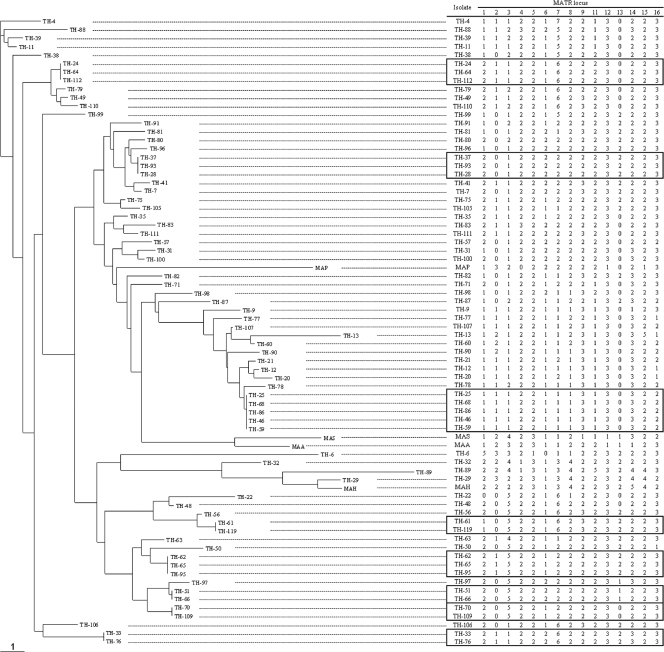
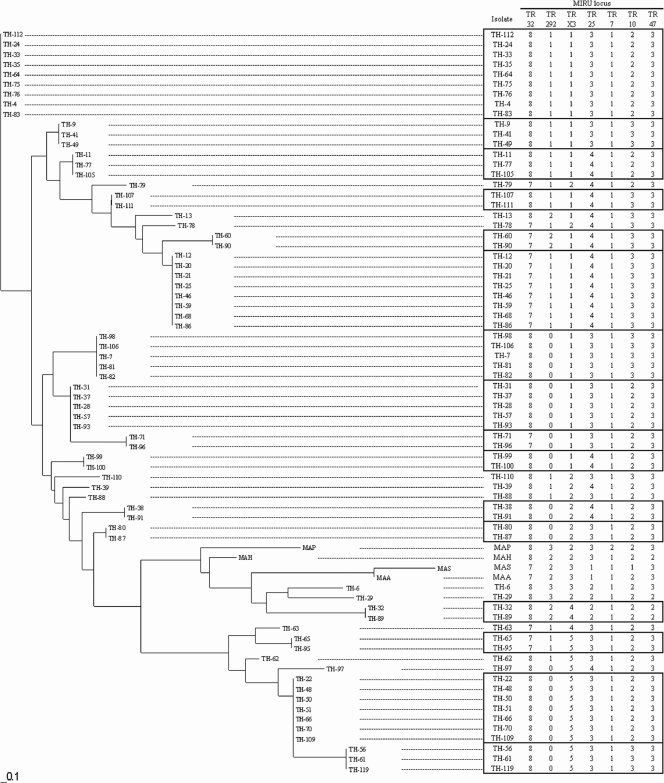
Mycobacterium avium complex (MAC) infections are increasing annually in various countries, including Japan, but the route of transmission and pathophysiology of the infection remain unclear. Currently, a variable-number tandem-repeat (VNTR) typing method using the Mycobacterium avium tandem repeat (MATR) loci (MATR-VNTR) is employed in Japan for epidemiological studies using clinical isolates of M. avium. In this study, the usefulness of this MATR-VNTR typing method was compared with that of the IS1245-restriction fragment length polymorphism (IS1245-RFLP) typing method and a mycobacterial interspersed repetitive-unit (MIRU)-VNTR typing method reported previously (V. C. Thibault, M. Grayon, M. L. Boschiroli, C. Hubbans, P. Overduin, K. Stevenson, M. C. Gutierrez, P. Supply, and F. Biet, J. Clin. Microbiol. 45:2404-2410, 2007). Seventy clinical isolates identified as M. avium from human immunodeficiency virus-negative patients with MAC infections were used. MATR-VNTR typing using 15 loci distinguished 56 patterns of different allele profiles, yielding a Hunter-Gaston discriminatory index (HGDI) of 0.990. However, IS1245-RFLP and MIRU-VNTR typing yielded HGDIs of 0.960 and 0.949, respectively, indicating that MATR-VNTR has an excellent discriminatory power compared with MIRU-VNTR and IS1245-RFLP typing. Moreover, concomitant use of the MATR-VNTR method and IS1245-RFLP typing increased the HGDI to 0.999. MATR-VNTR typing is inexpensive and easy to perform and could thus be useful in establishing a digital multifacility database that will greatly contribute to the clarification of the transmission route and pathophysiology of M. avium infections.
Figures
References
-
- Bull, T. J., K. Sidi-Boumedine, E. J. McMinn, K. Stevenson, R. Pickup, and J. Hermon-Taylor. 2003. Mycobacterial interspersed repetitive units (MIRU) differentiate Mycobacterium avium subspecies paratuberculosis from other species of the Mycobacterium avium complex. Mol. Cell. Probes 17157-164. - PubMed
-
- Griffith, D. E., T. Aksamit, B. A. Brown-Elliott, A. Catanzaro, C. Daley, F. Gordin, S. M. Holland, R. Horsburgh, G. Huitt, M. F. Iademarco, M. Iseman, K. Olivier, S. Ruoss, C. F. von Reyn, R. J. Wallace, Jr., and K. Winthrop. 2007. An official ATS/IDSA statement: diagnosis, treatment, and prevention of nontuberculous mycobacterial diseases. Am. J. Respir. Crit. Care Med. 175367-416. - PubMed
Publication types
MeSH terms
Substances
LinkOut - more resources
Full Text Sources
Molecular Biology Databases