


The effects of repeated opioid administration on locomotor activity: II. Unidirectional cross-sensitization to cocaine
- PMID: 19403852
- PMCID: PMC2713084
- DOI: 10.1124/jpet.108.150037
The effects of repeated opioid administration on locomotor activity: II. Unidirectional cross-sensitization to cocaine
Abstract
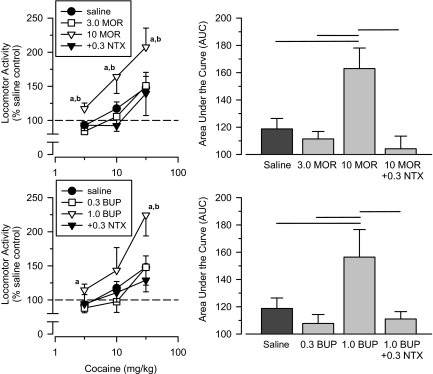
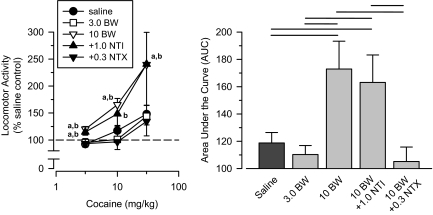
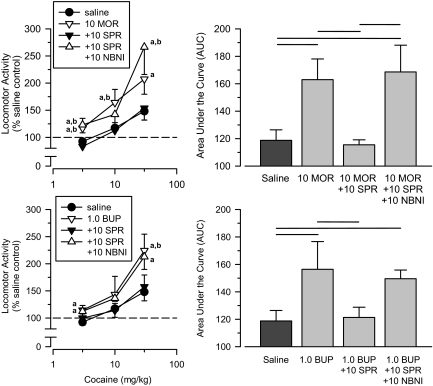
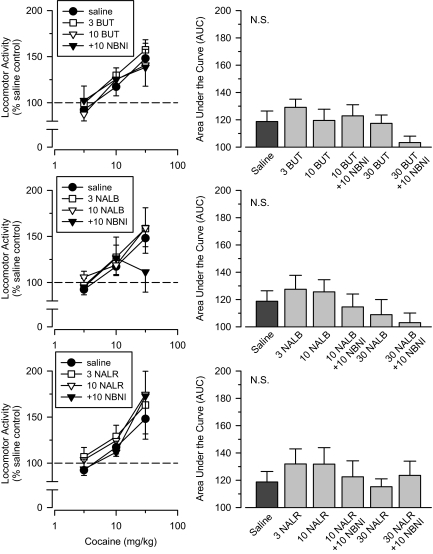
Sensitization refers to an increase in sensitivity to the effects of a drug and is believed to play a role in the etiology of substance use disorders. Cross-sensitization has been observed between drugs from different pharmacological classes and may play a role in the escalation of drug use in polydrug-abusing populations. The purpose of this study was to examine cross-sensitization between opioids and cocaine and to determine the extent to which cross-sensitization is mediated by an opioid's selectivity for mu, kappa, and delta receptors. Separate groups of rats were treated with opioid receptor agonists and antagonists every other day for 10 days, and the locomotor effects of cocaine were tested 8 days later. The mu agonists, morphine and buprenorphine, and the delta agonist, BW373U86 [(+/-)-4-[(R(*))-[(2S(*),5R(*))-2,5-dimethyl-4-(2-propenyl)-1-piperazinyl]-(3-hydroxyphenyl)methyl]-N,N-diethylbenzamide hydrochloride], produced cross-sensitization to cocaine, such that repeated administration of these drugs over a 10-day period significantly enhanced cocaine's locomotor effects when tested later. Coadministration of the opioid antagonist naltrexone prevented morphine and buprenorphine from producing cross-sensitization. Coadministration of naltrexone, but not the delta antagonist naltrindole, also prevented BW373U86 from producing cross-sensitization. The kappa agonist spiradoline failed to produce cross-sensitization, but coadministration of spiradoline prevented morphine and buprenorphine from producing cross-sensitization. The ability of spiradoline to block cross-sensitization was itself blocked by the kappa antagonist nor-binaltorphimine. The mixed mu/kappa opioids butorphanol, nalbuphine, and nalorphine did not produce cross-sensitization under any condition examined. These data indicate that agonist activity at mu receptors positively modulates cross-sensitization between opioids and cocaine, whereas agonist activity at kappa receptors negatively modulates this effect.
Figures
References
-
- Beyer CE and Steketee JD (2001) Characterization of the role of medial prefrontal cortex dopamine receptors in cocaine-induced locomotor activity. Behav Neurosci 115 1093-1100. - PubMed
-
- Bowen CA, Negus SS, Zong R, Neumeyer JL, Bidlack JM, and Mello NK (2003) Effects of mixed-action kappa/mu opioids on cocaine self-administration and cocaine discrimination by rhesus monkeys. Neuropsychopharmacology 28 1125-1139. - PubMed
-
- Chang KJ, Rigdon GC, Howard JL, and McNutt RW (1993) A novel, potent and selective nonpeptidic delta opioid receptor agonist BW373U86. J Pharmacol Exp Ther 267 852-857. - PubMed
-
- Crombag HS, Jedynak JP, Redmond K, Robinson TE, and Hope BT (2002) Locomotor sensitization to cocaine is associated with increased Fos expression in the accumbens, but not in the caudate. Behav Brain Res 136 455-462. - PubMed
-
- Cunningham ST, Finn M, and Kelley AE (1997) Sensitization of the locomotor response to psychostimulants after repeated opiate exposure: role of the nucleus accumbens. Neuropsychopharmacology 16 147-155. - PubMed
Publication types
MeSH terms
Substances
Grants and funding
LinkOut - more resources
Full Text Sources
Research Materials
