


Low-Sodium DASH reduces oxidative stress and improves vascular function in salt-sensitive humans
- PMID: 19404315
- PMCID: PMC2783838
- DOI: 10.1038/jhh.2009.32
Low-Sodium DASH reduces oxidative stress and improves vascular function in salt-sensitive humans
Abstract
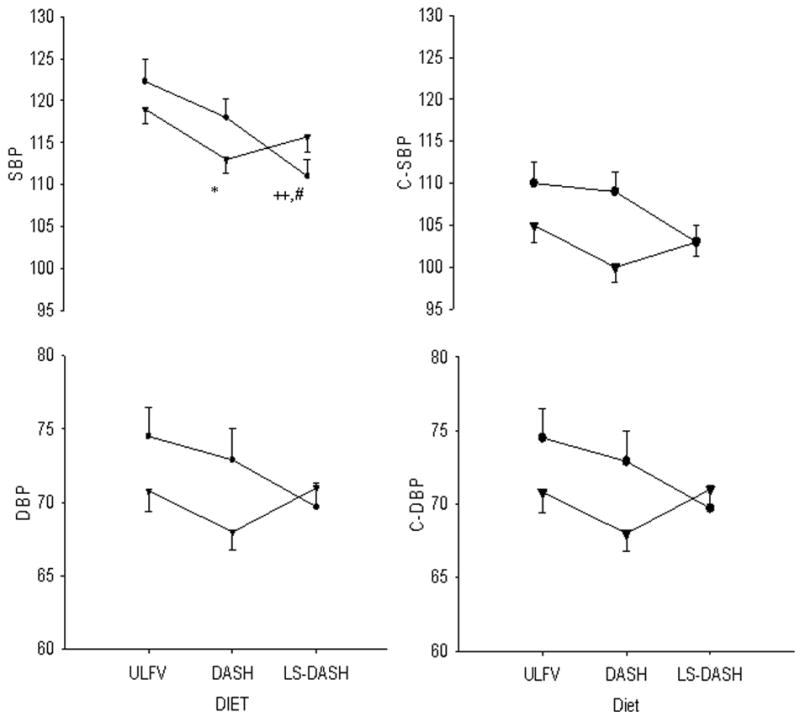
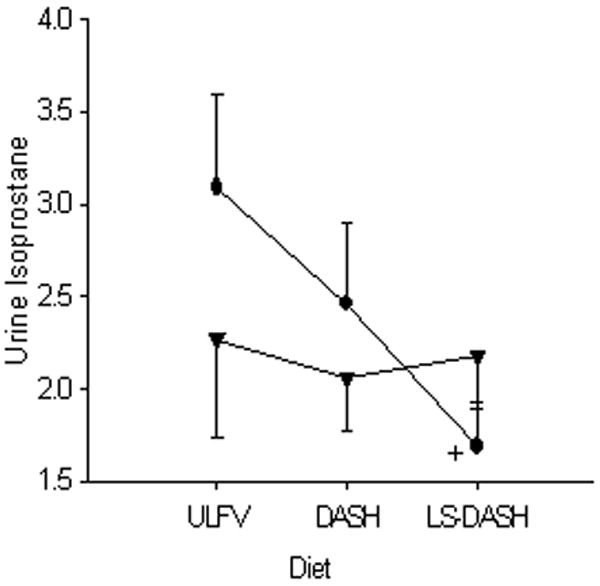
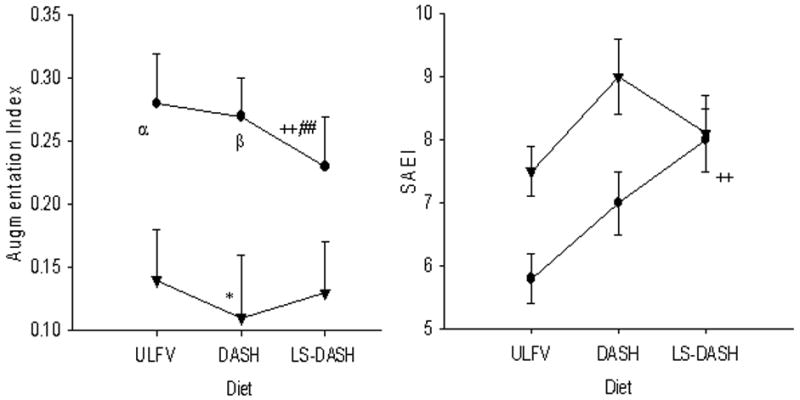
Salt induces oxidative stress in salt-sensitive (SS) animals and man. It is not known whether in SS subjects the low-sodium dietary approaches to stop hypertension (LS-DASH) reduces oxidative stress more than DASH, which is high in antioxidants. To assess the effects of DASH and LS-DASH on oxidative stress, 19 volunteers were studied after 3 weeks of a standardized usual low fruits and vegetables diet (ULFV), followed by 3 weeks on DASH (both diets approximately 120 mmol Na(+) per day), then 3 weeks on LS-DASH (60 mmol Na(+) per day). SS was defined as systolic blood pressure >or=5 mm Hg lower on LS-DASH than DASH. In SS subjects (N=9), systolic blood pressure was lower on LS-DASH (111.0+/-2.0 mm Hg) than DASH (118.0+/-2.2, P<0.01) and ULFV (122.3+/-2.7, P=0.002). In salt-resistant (SR) volunteers (N=10), systolic blood pressure was lower on DASH (113.0+/-1.6) than ULFV (119.0+/-1.8, P<0.05) but not LS-DASH (115.7+/-1.8). Urine F2-isoprostanes, a marker of oxidative stress, were lower in SS subjects on LS-DASH (1.69+/-0.24) than ULFV (3.09+/-0.50, P<0.05) and marginally lower than DASH (2.46+/-0.44, P<0.20). F2-isoprostanes were not different among the three diets in SR volunteers (2.18+/-0.29, 2.06+/-0.29, 2.27+/-0.53, respectively). Aortic augmentation index, a measure of vascular stiffness, was lower in SS subjects on LS-DASH than either DASH or ULFV, and lower on DASH than ULFV in SR volunteers. In SS but not SR subjects, LS-DASH is associated with lower values for F2-isoprostanes and the aortic augmentation index. The results suggest that LS-DASH decreases oxidative stress, improves vascular function and lowers blood pressure in SS but not SR volunteers.
Figures
References
-
- Muntzel M, Drüeke T. A comprehensive review of the salt and blood pressure relationship. Am J Hypertens. 1992;5:1S–42S. - PubMed
-
- Campese VM. Salt sensitivity in hypertension: renal and cardiovascular implications. Hypertension. 1994;23:531–550. - PubMed
-
- Weinberger MH. Salt sensitivity of blood pressure in humans. Hypertension. 1996;27:481–490. - PubMed
-
- Russo C, Olivieri O, Girelli D, Faccini G, Zenari ML, Lombardi S, Corrocher R. Anti-oxidant status and lipid peroxidation in patients with essential hypertension. J Hypertens. 1998;16:1267–1271. - PubMed
-
- Lacy F, O'Connor DT, Schmid-Schonbein GW. Plasma hydrogen peroxide production in hypertensives and normotensive subjects at genetic risk of hypertension. J Hypertens. 1998;16(3):291–303. - PubMed
Publication types
MeSH terms
Substances
Grants and funding
- DK48831/DK/NIDDK NIH HHS/United States
- P60 MD000267/MD/NIMHD NIH HHS/United States
- K24 HL004290/HL/NHLBI NIH HHS/United States
- GM15431/GM/NIGMS NIH HHS/United States
- MD00267/MD/NIMHD NIH HHS/United States
- R01 DK048831/DK/NIDDK NIH HHS/United States
- RR-01070/RR/NCRR NIH HHS/United States
- P01 GM015431/GM/NIGMS NIH HHS/United States
- P50 GM015431/GM/NIGMS NIH HHS/United States
- R01 HL058794/HL/NHLBI NIH HHS/United States
- M01 RR001070/RR/NCRR NIH HHS/United States
- HL58794/HL/NHLBI NIH HHS/United States
- HL04290/HL/NHLBI NIH HHS/United States
LinkOut - more resources
Full Text Sources
Medical
Research Materials
Miscellaneous
