


doi: 10.2976/1.2896331.
Epub 2008 Mar 19.
From DNA nanotechnology to synthetic biology
Affiliations
- PMID: 19404476
- PMCID: PMC2645571
- DOI: 10.2976/1.2896331
Item in Clipboard
From DNA nanotechnology to synthetic biology
HFSP J.
2008 Apr.
Abstract
Attempts to construct artificial systems from biological molecules such as DNA and RNA by self-assembly are compatible with the recent development of synthetic biology. Genetic mechanisms can be used to produce or control artificial structures made from DNA and RNA, and these structures can in turn be used as artificial gene regulatory elements, in vitro as well as in vivo. Artificial biochemical circuits can be incorporated into cell-like reaction compartments, which opens up the possibility to operate them permanently out of equilibrium. In small systems, stochastic effects become noticeable and will have to be accounted for in the design of future systems.
Figures
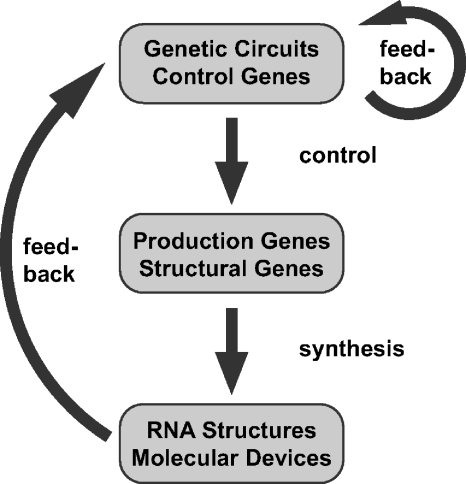
As discussed in the text, artificial “production” genes may be used to produce nanostructures, whereas “control genes” may be used to decide or control, when or which nanostructure is produced or operated (cf. Fig. 3). Synthetic control networks may be produced with RNA regulators alone (see Fig. 2), and nucleic acid nanodevices may feed back on the control circuits. The circuit diagram may be implemented either in vitro or in vivo.
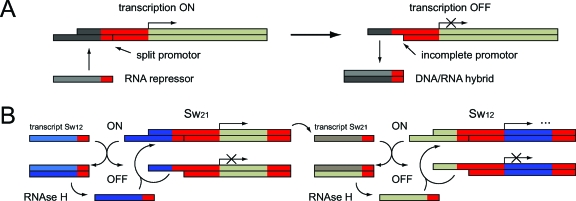
A: The basic switching principle is based on a promotor region, in which one of the gene strands contains a nick in the promotor region. Removal of one part of the promotor using strand displacement by an RNA regulator molecule leaves the gene with an incomplete promotor region. In this state, transcription is turned OFF. B: Using feedback, this switching principle can be used to realize a simple bistable reaction network: The RNA molecules transcribed from gene Sw21 can switch off gene Sw12, and RNA transcribed from Sw12 can switch off Sw21. RNA molecules in DNA∕RNA hybrid intermediates are degraded by RNAse H. The total network has two stable states: either all of the genes Sw21 are ON and all of the Sw12 are OFF, or vice versa.
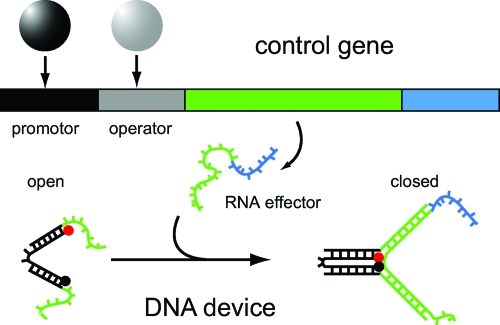
The gene contains the code for RNA effector strands, which are able to close a DNA tweezers device (Yurke et al., 2000) by hybridization. The promotor itself is under control of an operator, which can be used to make the operation of the nanodevice dependent on an environmental stimulus.
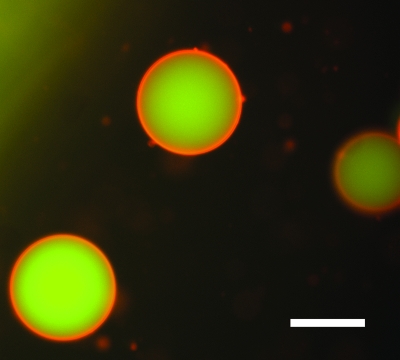
Shown is a fluorescence microscopic image of giant unilamellar vesicles (GUVs, lipids labeled red) filled with fluorescently labeled DNA (green). The GUVs were formed from a lipid mixture containing 90% DPhPC (1,2-diphytanoyl-sn-glycero-3-phosphocholine) and 10% cholesterol by electroswelling using an AC voltage of 1V at 5 Hz for 2 h. The lipids contained 0.1 mol% lipids with a BODIPY label. DNA labeled with Rhodamine Green were incorporated during the electroswelling process. The scale bar is 50 μm.
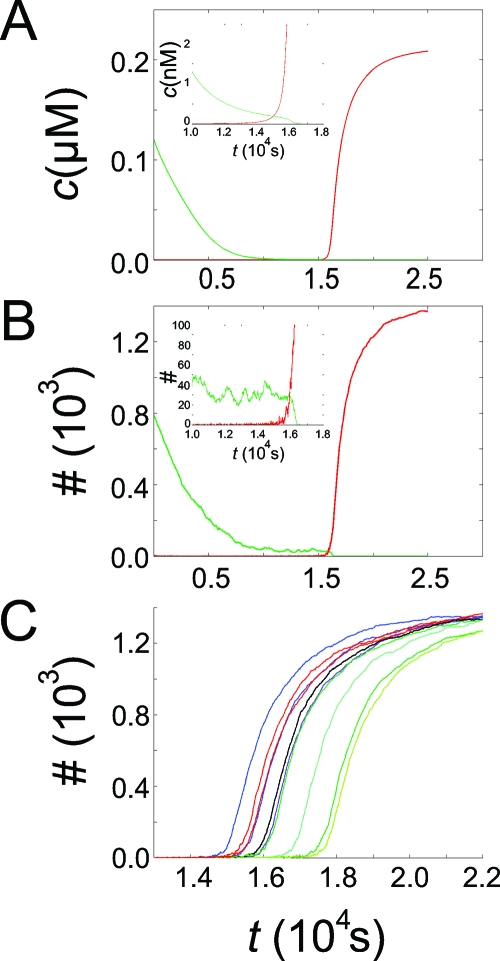
A: deterministic simulation based on rate equations, B: stochastic simulation based on the Gillespie algorithm. Shown is the temporal evolution of concentrations∕numbers of genes Sw12 (green) and Sw21 (red) in the “ON” state. The initial conditions for the simulation are chosen in the region of attraction of the state (Sw12 OFF, Sw21 ON). At roughly t=15 000 s in the simulations, all of the genes Sw21 turn ON and genes Sw12 turn OFF. The insets show a zoom of the same simulation runs close to the switching time. In the stochastic case, there is considerable noise in the number of genes in the different states, which is more noticeable in the insets. In part C of the figure, the result of ten consecutive stochastic simulations of the switching event is shown. The switching times vary considerably over a range of 3000 s.
References
LinkOut - more resources
Full Text Sources