


A longitudinal study of childhood depression and anxiety in relation to weight gain
- PMID: 19404733
- PMCID: PMC2918233
- DOI: 10.1007/s10578-009-0141-1
A longitudinal study of childhood depression and anxiety in relation to weight gain
Abstract
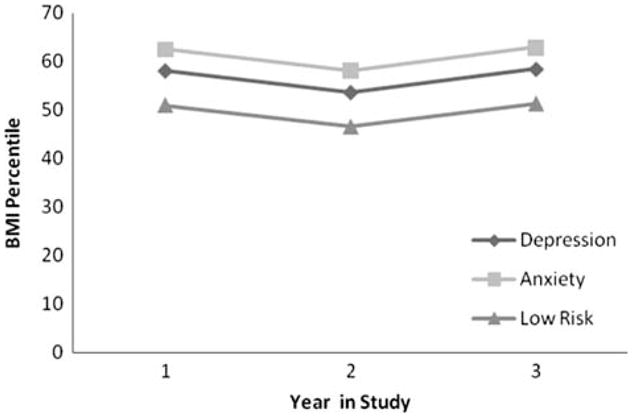
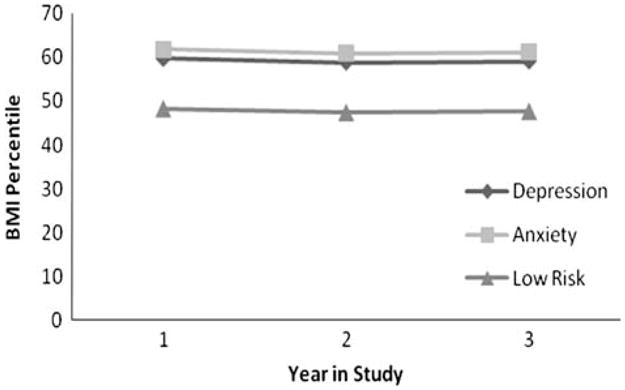
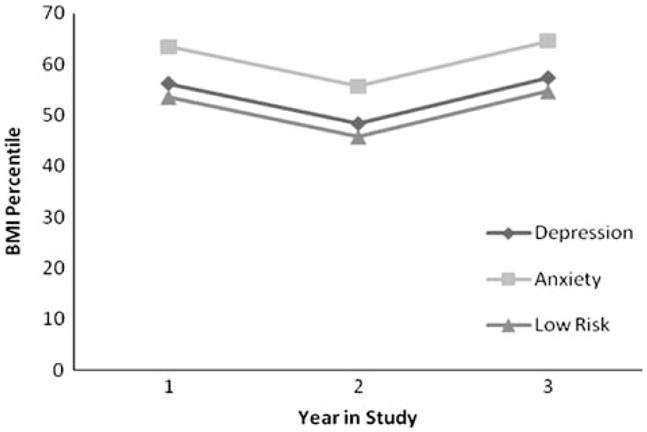
Adult mood disturbances are highly correlated with obesity, although little is known about the developmental relationship between mood disorders and weight. This study investigated the relationship between childhood psychopathology and weight over the course of 3 years. Body Mass Index (BMI) percentiles and demographic data of children (ages 8-18) with depression (n = 143) or anxiety (n = 43) were compared to healthy controls (n = 99). Both childhood depression (chi(2) = 4.6, p = 0.03) and anxiety (chi(2) = 6.0, p = 0.01) were associated with increased BMI percentiles. Compared to controls, BMI percentiles of depressed females over the course of the study differed profoundly (chi(2) = 7.0, p = 0.01) and BMI percentiles of anxious females approached significance (chi(2) = 3.7, p = 0.06). Males with anxiety showed a greater trend towards overweight (chi(2) = 3.3, p = 0.07) in comparison to controls. The major finding that depression and anxiety are associated with increased BMI percentiles in a non-obese sample suggests that childhood psychopathology is an important factor that should be carefully monitored.
Figures
References
-
- Institute of Medicine. Preventing childhood obesity. National Academy of Science; Washington, DC: 2004.
-
- Center for Disease Control. Prevalence of overweight and obesity among adults. U.S. Department of Health and Human Services; Hyattsville: 2003.
-
- Faith MS, Allison DB, Geliebter A. Emotional eating and obesity: theoretical considerations and practical recommendations. In: Dalton S, editor. Obesity and weight control: the health professional’s guide to understanding and practice. Aspen; Gaithersburg: 1997. pp. 439–465.
