. 2009 Aug;159(2):277-87.
doi: 10.1016/j.jviromet.2009.04.022. Epub 2009 May 3.

Broadly targeted multiprobe QPCR for detection of coronaviruses: Coronavirus is common among mallard ducks (Anas platyrhynchos)

Affiliations

Broadly targeted multiprobe QPCR for detection of coronaviruses: Coronavirus is common among mallard ducks (Anas platyrhynchos)

Shaman Muradrasoli et al. J Virol Methods. 2009 Aug.

Abstract

Coronaviruses (CoVs) can cause trivial or fatal disease in humans and in animals. Detection methods for a wide range of CoVs are needed, to understand viral evolution, host range, transmission and maintenance in reservoirs. A new concept, "Multiprobe QPCR", which uses a balanced mixture of competing discrete non- or moderately degenerated nuclease degradable (TaqMan) probes was employed. It provides a broadly targeted and rational single tube real-time reverse transcription PCR ("NQPCR") for the generic detection and discovery of CoV. Degenerate primers, previously published, and the new probes, were from a conserved stretch of open reading frame 1b, encoding the replicase. This multiprobe design reduced the degree of probe degeneration, which otherwise decreases the sensitivity, and allowed a preliminary classification of the amplified sequence directly from the QPCR trace. The split probe strategy allowed detection of down to 10 viral nucleic acid equivalents of CoV from all known CoV groups. Evaluation was with reference CoV strains, synthetic targets, human respiratory samples and avian fecal samples. Infectious-Bronchitis-Virus (IBV)-related variants were found in 7 of 35 sample pools, from 100 wild mallards (Anas platyrhynchos). Ducks may spread and harbour CoVs. NQPCR can detect a wide range of CoVs, as illustrated for humans and ducks.


Figures

Fig. 1
Fig. 1
(a) Alignment of the triple-probes with sequences from reference strains of CoV. Conserved regions are black. The most frequent variants are shown in gray. Variable positions have no background. The three probe sequences with IUPAC ambiguity codes are shown at the bottom, LNA positions are underlined. (b) Predicted hybridization of amplimer stretches from a broad range of coronaviruses to the three probes. An amplimer sequence from the Ottenby duck samples, with an IBV-like sequence (Ottenby 67433, obtained from a mallard. It was not mentioned in Section 2. It was however identical to the Ottenby spring 3 sample in 120 of 130 positions) was used as query in a BLAST search for similar nucleotide sequences in GenBank. The figure lists the BLAST hits in order of decreasing similarity to the query. The stretches corresponding to the query found by the BLAST search were subjected to analysis with the Visual OMP (VOMP) software, which can predict the degree of interaction (shown as an absolute ΔG value) of an oligonucleotide with another. VOMP automatically removes all identical sequences, which meant that some reference sequences were removed from the hit list. For example, the OC43 sequence was removed. It was identical to the human enteric CoV sequence. Remaining reference sequences are shown in bold. All variants of each of the three probes were tested against all BLAST hit sequences. For each probe, the average absolute ΔG of the three variants predicted to hybridize best to the respective target sequences is shown. The three lines depict the predicted binding of probe_I (229E-derived; dark blue), probe_II (SARS-derived; red) and probe_III (NL63-derived, yellow), respectively. The columns show the average of the predicted probe absolute ΔG values, to indicate whether the triple-probe system would be able to detect that target sequence. (c) Differential fluorescence signal obtained with the three separately labeled probes. CoV, either RNA from reference strains, or synthetic target oligonucleotides from published CoV strains, were run in NQPCR. Results were colour coded as in (b). For further explanation of strain names, see Table 1. TCoV: Turkey CoV; CoV-cons-synth: synthetic oligonucleotide made from a consensus sequence of the PCR amplimer stretch (see Section 2). (For interpretation of the references to color in this figure legend, the reader is referred to the web version of the article.)
Fig. 2
Fig. 2
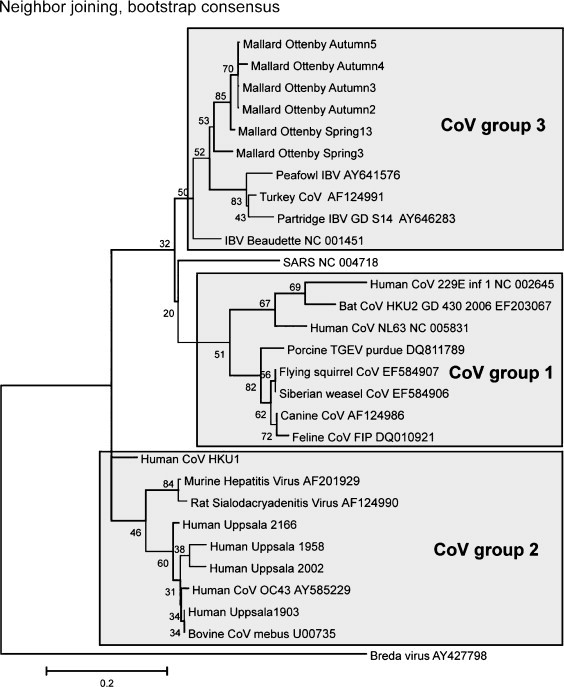
Neighbour-joining bootstrap consensus tree, based on the short (179 bp) amplicon stretch. The bootstrap percentage of 500 trees is shown for most branches. The number of informative sites is low in this conserved portion of the RNA polymerase gene. Therefore, the branching pattern cannot be expected to precisely reflect the phylogeny and classification of Coronaviridae. The tree is intended to approximately represent the observed CoV sequences in a context of most similar reference sequences. The major CoV groups, and reference sequences belonging to them, are shown as boxes. Seven CoV positive human samples were sequenced (“Human Uppsala” plus sample number), and aligned with reference sequences. Four of them, which clustered with CoV group 2 strains, are shown in the tree. Sequences from three CoV positive samples were incomplete. Six of seven sequenced amplicons from mallards (“Mallard Ottenby spring/autumn” plus pool number) are also shown (see Suppl. Info, alignment in Fig. S1a and b, and two trees, Fig. S2a and b, made with other techniques, for further information). A more exact classification of the observed sequences will require sequencing of a longer stretch, which was out of scope for this methodological paper.
Fig. 3
Fig. 3
(a) Amplification plot and standard curve, describing sensitivity tests. Primers 11-FW/13-RV were used in combination with FAM-labeled probes_I, II and III. The curves represent, from left to right, 107–100 copies of synthetic corona consensus 130 oligonucleotide, with an efficiency of 0.93 and R2 0.99. No signals were obtained in the negative control. (b) Amplification plot and standard curve, describing an amplification efficiency test. Primers 11-FW/13-RV were used in combination with FAM-labeled probes_I, II and III, and run on 10-fold serial dilutions of BCov RNA, with an efficiency of 0.83 and R2 = 0.99. Thus, amplifying from CoV RNA gave a similar, but somewhat lower, efficiency.

References

    1. Adzhar A.B., Shaw K., Britton P., Cavanagh D. Avian infectious bronchitis virus: differences between 793/B and other strains. Vet. Rec. 1995;136:548. - PubMed
    1. Andersson A.C., Yun Z., Sperber G.O., Larsson E., Blomberg J. ERV3 and related sequences in humans: structure and RNA expression. J. Virol. 2005;79:9270–9284. - PMC - PubMed
    1. Barr D.A., Reece R.L., O’Rourke D., Button C., Faragher J.T. Isolation of infectious bronchitis virus from a flock of racing pigeons. Aust. Vet. J. 1988;65:228. - PMC - PubMed
    1. Bohl E.H., Gupta R.K., McCloskey L.W., Saif L. Immunology of transmissible gastroenteritis. J. Am. Vet. Med. Assoc. 1972;160:543–549. - PubMed
    1. Brian D.A., Baric R.S. Coronavirus genome structure and replication. Curr. Top. Microbiol. Immunol. 2005;287:1–30. - PMC - PubMed

Publication types

LinkOut - more resources