In vivo interaction of steroid receptor coactivator (SRC)-1 and the activation function-2 domain of the thyroid hormone receptor (TR) beta in TRbeta E457A knock-in and SRC-1 knockout mice
- PMID: 19406944
- PMCID: PMC2717870
- DOI: 10.1210/en.2009-0093
In vivo interaction of steroid receptor coactivator (SRC)-1 and the activation function-2 domain of the thyroid hormone receptor (TR) beta in TRbeta E457A knock-in and SRC-1 knockout mice
Abstract
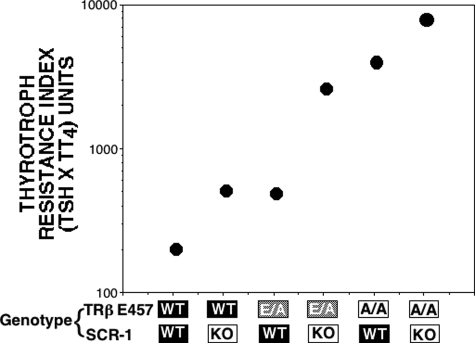
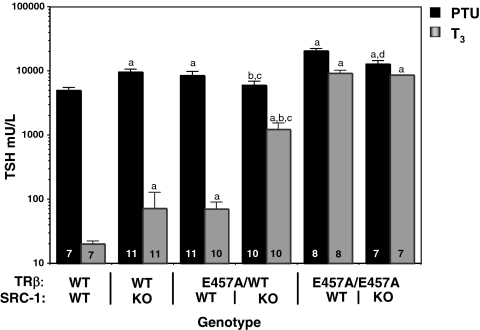
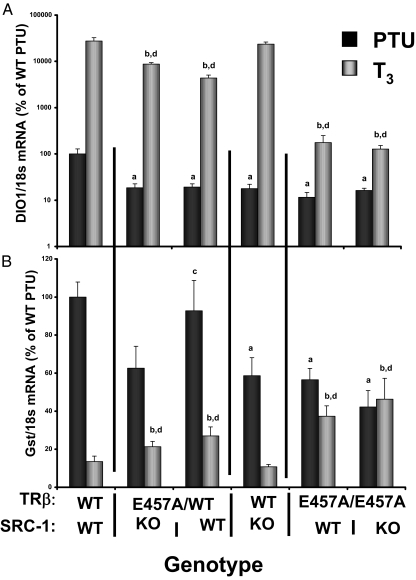
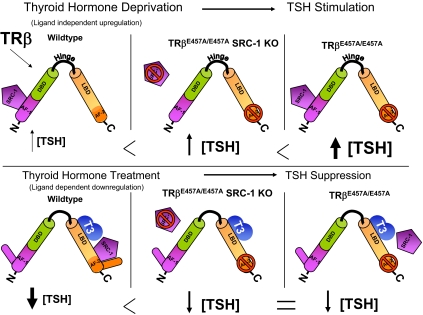
The activation function-2 (AF-2) domain of the thyroid hormone (TH) receptor (TR)-beta is a TH-dependent binding site for nuclear coactivators (NCoA), which modulate TH-dependent gene transcription. In contrast, the putative AF-1 domain is a TH-independent region interacting with NCoA. We determined the specificity of the AF-2 domain and NCoA interaction by evaluating thyroid function in mice with combined disruption of the AF-2 domain in TRbeta, due to a point mutation (E457A), and deletion of one of the NCoAs, steroid receptor coactivator (SRC)-1. The E457A mutation was chosen because it abolishes NCoA recruitment in vitro while preserving normal TH binding and corepressor interactions resulting in resistance to TH. At baseline, disruption of SRC-1 in the homozygous knock-in (TRbeta(E457A/E457A)) mice worsened the degree of resistance to TH, resulting in increased serum T(4) and TSH. During TH deprivation, disruption of AF-2 and SRC-1 resulted in a TSH rise 50% of what was seen when AF-2 alone was removed, suggesting that SRC-1 was interacting outside of the AF-2 domain. Therefore, 1) during TH deprivation, SRC-1 is necessary for activating the hypothalamic-pituitary-thyroid axis; 2) ligand-dependent repression of TSH requires an intact AF-2; and 3) SRC-1 may interact with the another region of the TRbeta or the TRalpha to regulate TH action in the pituitary. This report demonstrates the dual interaction of NCoA in vivo: the TH-independent up-regulation possibly through another domain and TH-dependent down-regulation through the AF-2 domain.
Figures
References
-
- Lazar MA 1993 Thyroid hormone receptors: multiple forms, multiple possibilities. Endocr Rev 14:184–193 - PubMed
-
- Yen PM 2001 Physiological and molecular basis of thyroid hormone action. Physiol Rev 81:1097–1142 - PubMed
-
- Bodenner DL, Mroczynski MA, Weintraub BD, Radovick S, Wondisford FE 1991 A detailed functional and structural analysis of a major thyroid hormone inhibitory element in the human thyrotropin β-subunit gene. J Biol Chem 266:21666–21673 - PubMed
-
- Hollenberg AN, Monden T, Wondisford FE 1995 Ligand-independent and -dependent functions of thyroid hormone receptor isoforms depend upon their distinct amino termini. J Biol Chem 270:14274–14280 - PubMed
Publication types
MeSH terms
Substances
Grants and funding
LinkOut - more resources
Full Text Sources
Molecular Biology Databases
Miscellaneous