Association of CKD and cancer risk in older people
- PMID: 19406977
- PMCID: PMC2689896
- DOI: 10.1681/ASN.2008090998
Association of CKD and cancer risk in older people
Abstract
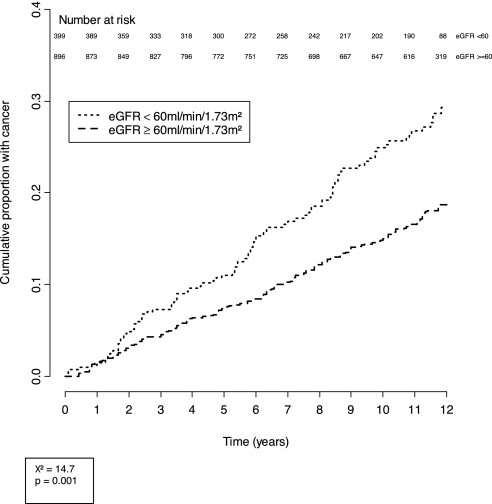
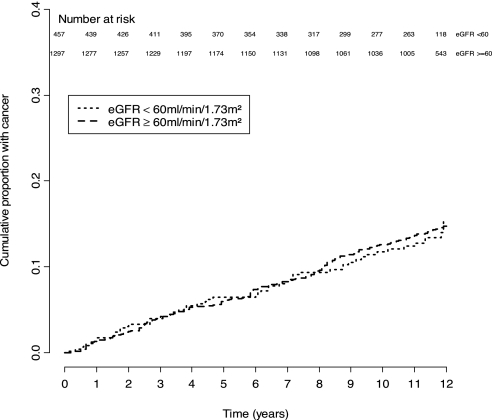
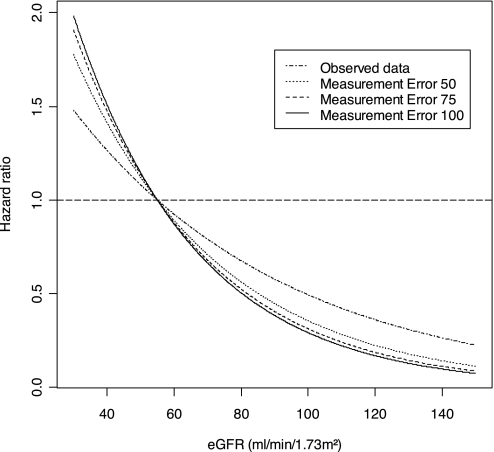
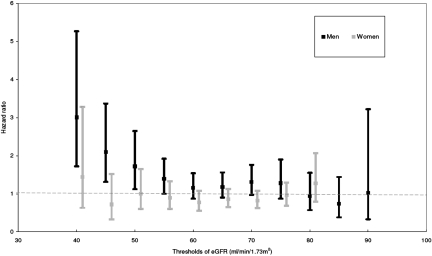
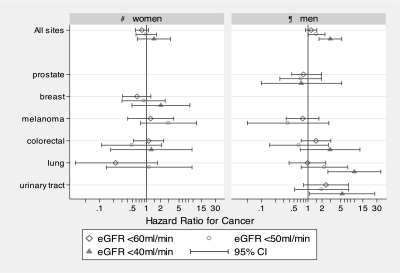
People with ESRD are at increased risk for cancer, but it is uncertain when this increased risk begins in the spectrum of chronic kidney disease (CKD). The aim of our study was to determine whether moderate CKD increases the risk for cancer among older people. We linked the Blue Mountains Eye Study, a prospective population-based cohort study of 3654 residents aged 49 to 97 yr, and the New South Wales Cancer Registry. During a mean follow-up of 10.1 yr, 711 (19.5%) cancers occurred in 3654 participants. Men but not women with at least stage 3 CKD had a significantly increased risk for cancer (test of interaction for gender P = 0.004). For men, the excess risk began at an estimated GFR (eGFR) of 55 ml/min per 1.73 m2 (adjusted hazard ratio [HR] 1.39; 95% confidence interval [CI] 1.00 to 1.92) and increased linearly as GFR declined. For every 10-ml/min decrement in eGFR, the risk for cancer increased by 29% (adjusted HR 1.29; 95% CI 1.10 to 1.53), with the greatest risk at an eGFR <40 ml/min per 1.73 m2 (adjusted HR 3.01; 95% CI 1.72 to 5.27). The risk for lung and urinary tract cancers but not prostate was higher among men with CKD. In conclusion, moderate CKD (stage 3) may be an independent risk factor for the development of cancer among older men but not women, and the effect of CKD on risk may vary for different types of cancer.
Figures
References
-
- The burden of chronic kidney disease. In: Chronic Kidney Disease in Australia 2005, Canberra, Australian Institute of Health and Welfare, 2005
-
- Coresh J, Selvin E, Stevens LA, Manzi J, Kusek JW, Eggers P, Van Lente F, Levey AS: Prevalence of chronic kidney disease in the United States. JAMA 298: 2038–2047, 2007 - PubMed
-
- Fried LF, Shlipak MG, Crump C, Bleyer AJ, Gottdiener JS, Kronmal RA, Kuller LH, Newman AB: Renal insufficiency as a predictor of cardiovascular outcomes and mortality in elderly individuals. J Am Coll Cardiol 41: 1364–1372, 2003 - PubMed
-
- Shlipak MG, Simon JA, Grady D, Lin F, Wenger NK, Furberg CD, Heart and Estrogen/progestin Replacement Study (HERS) Investigators: Renal insufficiency and cardiovascular events in postmenopausal women with coronary heart disease. J Am Coll Cardiol 38: 705–711, 2001 - PubMed
-
- Mann JF, Gerstein HC, Pogue J, Bosch J, Yusuf S: Renal insufficiency as a predictor of cardiovascular outcomes and the impact of ramipril: The HOPE randomized trial. Ann Intern Med 134: 629–636, 2001 - PubMed
Publication types
MeSH terms
LinkOut - more resources
Full Text Sources
Medical
Molecular Biology Databases
Research Materials
Miscellaneous