


A brief bout of exercise alters gene expression and distinct gene pathways in peripheral blood mononuclear cells of early- and late-pubertal females
- PMID: 19407257
- PMCID: PMC2711785
- DOI: 10.1152/japplphysiol.00121.2009
A brief bout of exercise alters gene expression and distinct gene pathways in peripheral blood mononuclear cells of early- and late-pubertal females
Abstract
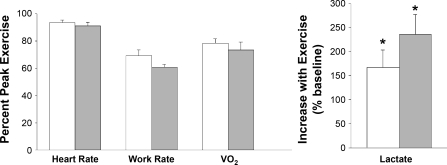
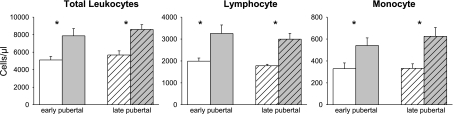
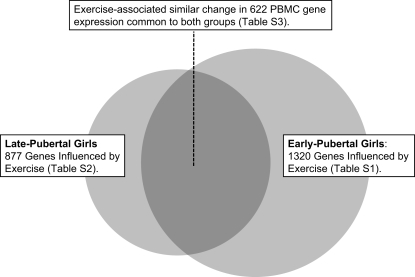
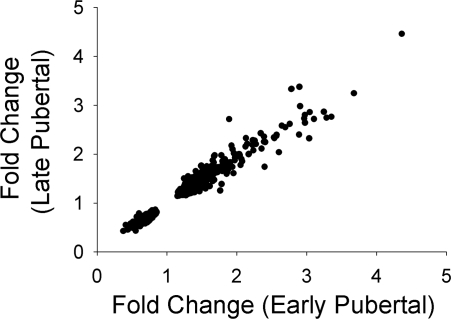
Recent studies show that brief exercise alters circulating neutrophil and peripheral blood mononuclear cell (PBMC) gene expression, ranging from cell growth to both pro-and anti-inflammatory processes. These initial observations were made solely in males, but whether PBMC gene expression is altered by exercise in females is not known. Ten early-pubertal girls (8-11 yr old) and 10 late-pubertal girls (15-17 yr old) performed ten 2-min bouts of cycle ergometry ( approximately 90% peak heart rate) interspersed with 1-min rest intervals. Blood was obtained at rest and after exercise, and microarrays were performed in each individual subject. RNA was hybridized to Affymetrix U133+2.0 Arrays. Exercise induced significant changes in PBMC gene expression in early (1,320 genes)- and late (877 genes)-pubertal girls. The expression of 622 genes changed similarly in both groups. Exercise influenced a variety of established gene pathways (EASE < 0.04) in both older (6 pathways) and younger girls (11 pathways). Five pathways were the same in both groups and were functionally related to inflammation, stress, and apoptosis, such as natural killer cell-mediated cytotoxicity, antigen processing and presentation, B cell receptor signaling, and apoptosis. In summary, brief exercise alters PBMC gene expression in early- and late-pubertal girls. The pattern of change involves diverse genetic pathways, consistent with a global danger-type response, perhaps readying PBMCs for a range of physiological functions from inflammation to tissue repair that would be useful following a bout of physical activity.
Figures
References
-
- Bailey RC, Olson J, Pepper SL, Barstow TJ, Porszsasz J, Cooper DM. The level and tempo of children's physical activities: an observational study. Med Sci Sports Exerc 27: 1033–1041, 1995. - PubMed
-
- Buttner P, Mosig S, Lechtermann A, Funke H, Mooren FC. Exercise affects the gene expression profiles of human white blood cells. J Appl Physiol 102: 26–36, 2007. - PubMed
-
- Calderwood SK, Mambula SS, Gray PJ Jr. Extracellular heat shock proteins in cell signaling and immunity. Ann NY Acad Sci 1113: 28–39, 2007. - PubMed
-
- Connolly PH, Caiozzo VJ, Zaldivar F, Nemet D, Larson J, Hung SP, Heck JD, Hatfield GW, Cooper DM. Effects of exercise on gene expression in human peripheral blood mononuclear cells. J Appl Physiol 97: 1461–1469, 2004. - PubMed
-
- Cooper DM, Weiler-Ravell D, Whipp BJ, Wasserman K. Aerobic parameters of exercise as a function of body size during growth in children. J Appl Physiol 56: 628–634, 1984. - PubMed
Publication types
MeSH terms
Substances
Grants and funding
LinkOut - more resources
Full Text Sources
Medical
Molecular Biology Databases
