. 2009 Jul;10(7):748-54.
doi: 10.1038/embor.2009.86. Epub 2009 May 1.

MAPL is a new mitochondrial SUMO E3 ligase that regulates mitochondrial fission

Affiliations

MAPL is a new mitochondrial SUMO E3 ligase that regulates mitochondrial fission

Emélie Braschi et al. EMBO Rep. 2009 Jul.

Abstract

The modification of proteins by the small ubiquitin-like modifier (SUMO) is known to regulate an increasing array of cellular processes. SUMOylation of the mitochondrial fission GTPase dynamin-related protein 1 (DRP1) stimulates mitochondrial fission, suggesting that SUMOylation has an important function in mitochondrial dynamics. The conjugation of SUMO to its substrates requires a regulatory SUMO E3 ligase; however, so far, none has been functionally associated with the mitochondria. By using biochemical assays, overexpression and RNA interference experiments, we characterized the mitochondrial-anchored protein ligase (MAPL) as the first mitochondrial-anchored SUMO E3 ligase. Furthermore, we show that DRP1 is a substrate for MAPL, providing a direct link between MAPL and the fission machinery. Importantly, the large number of unidentified mitochondrial SUMO targets suggests a global role for SUMOylation in mitochondrial function, placing MAPL as a crucial component in the regulation of multiple conjugation events.


Conflict of interest statement

The authors declare that they have no conflict of interest.

Figures
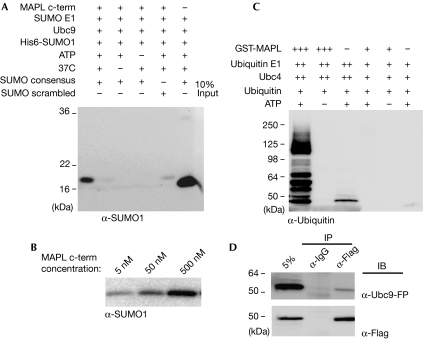
Figure 1
Figure 1
MAPL has SUMO E3 ligase activity in vitro. (A) Biotinylated peptide was incubated in the indicated conditions. After the reaction, the peptide was isolated and the isolates probed for SUMO1. (B) The same reaction conditions were used as in lane 1 (A) but with increasing amounts of MAPL(257−352). (C) GST-MAPL(257−352) was used in an in vitro auto-ubiquitination assay. In the presence of 30 μM GST-MAPL(257−352), 0.5 μM of ubiquitin E1, 5 μM of Ubc4 and 10 μM ubiquitin, the RING domain of MAPL facilitates the conjugation of ubiquitin. In the presence of 500 nM GST-MAPL(257−352), 50 nM of ubiquitin E1, 250 nM of Ubc4 and 10 μM ubiquitin, the RING domain of MAPL does not facilitate the conjugation of ubiquitin. (D) After the transfection of HeLa cells with MAPL-Flag and Ubc9-YFP, cell lysates were immunoprecipitated (IP) with either anti-Flag coupled resin or mouse IgG, as indicated. GST, glutathione S-transferase; IB, immunoblotting; MAPL, mitochondrial-anchored protein ligase; SUMO, small ubiquitin-like modifier; Ubc9, ubiquitin-like protein SUMO-1 conjugating enzyme 9; YFP, yellow fluorescent protein.
Figure 2
Figure 2
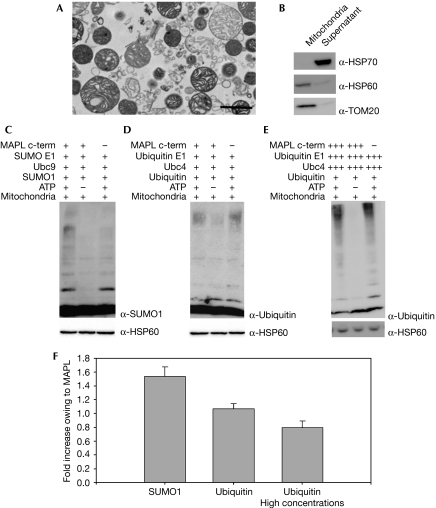
MAPL SUMOylates native mitochondrial substrates. The purity of isolated bovine heart mitochondria was visualized by (A) electron microscopy (scale bar, 10 μM) and (B) Western blot analysis. (C) Isolated mitochondria from bovine heart were incubated with 50 nM SUMO E1, 250 nM Ubc9 and 10 μM his-SUMO1 under the conditions indicated; the addition of 500 nM MAPL(257−352) is indicated. (D) Isolated mitochondria from bovine heart were incubated in the presence of 50 nM ubiquitin E1, 250 nM Ubc4 and 10 μM ubiquitin under the conditions indicated; the addition of 500 nM MAPL(257−352) is indicated. (E) Isolated mitochondria from bovine heart were incubated in the presence of 0.5 μM ubiquitin E1, 5 μM Ubc4 and 10 μM ubiquitin under the conditions indicated; the addition of 30 μM MAPL(257−352) is indicated. (F) Quantification of the increase in the SUMOylation/ubiquitination reactions owing to the addition of exogenous MAPL (lanes 1 versus 3 in C, D and E); standard errors are represented. HSP, heat-shock protein; MAPL, mitochondrial-anchored protein ligase; SUMO, small ubiquitin-like modifier; TOM, translocase of the mitochondrial outer membrane; Ubc, ubiquitin-conjugating enzyme.
Figure 3
Figure 3
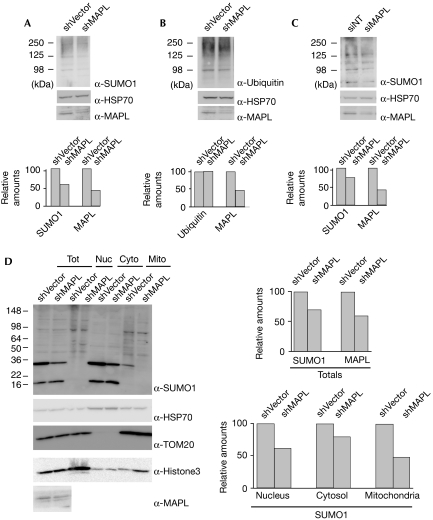
Silencing of MAPL reduces total SUMO1 conjugates. (A) HeLa cells were stably transfected with either shRNA vector alone (shVector) or with MAPL-specific shRNA (shMAPL). Total lysates were probed for SUMO1. (B) As in (A), but the extracts were probed with anti-ubiquitin antibodies. (C) HeLa cells were transfected with either a pooled siRNA mixture directed against MAPL or a control siRNA. Total lysates were probed for SUMO1. (AC) The graphs represent the average of three independent experiments. (D) Isolation of the nuclear (Nuc), cytosolic (Cyto) and mitochondrial (Mito) fractions of HeLa cells stably transfected with an shRNA directed against MAPL or a control shRNA. A 40% reduction in the expression of MAPL leads to a 30% reduction in total SUMO1 conjugates, 38% reduction in nuclear SUMO1 conjugates, 20% reduction in cytosolic SUMO1 conjugates and a 53% reduction in mitochondrial SUMO1 conjugates. HSP, heat-shock protein; MAPL, mitochondrial-anchored protein ligase; NT, non-targeted; shRNA, short hairpin RNA; siRNA, short interfering RNA; SUMO, small ubiquitin-like modifier; TOM, translocase of the mitochondrial outer membrane; Tot, total.
Figure 4
Figure 4
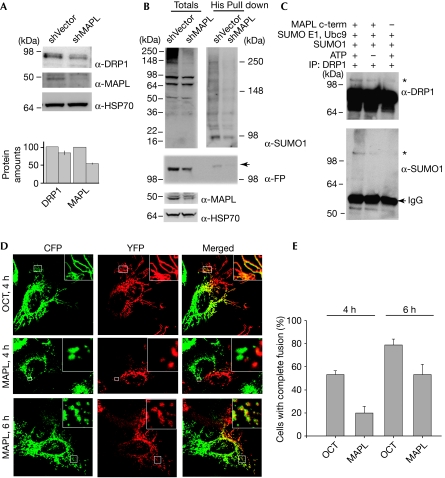
MAPL SUMOylates dynamin-related protein 1 and modulates mitochondrial dynamics. (A) HeLa cells were stably transfected with either shRNA vector alone (shVector) or MAPL-specific shRNA (shMAPL). Total lysates were analysed by Western blots with the indicated antibodies. The graph represents the quantification from four independent experiments; standard errors are represented. (B) Vector or shMAPL-expressing HeLa cells were transfected with DRP1-YFP and His6-SUMO1, harvested and SUMO1 conjugates were isolated using nickel nitrilotriacetic acid (Ni-NTA)-agarose. Western blots of SUMO1, DRP1-FP and controls are indicated. SUMO conjugates in the totals were separated using a 4–20% SDS–PAGE gradient (left), and the His6-SUMO1 isolates were separated on a 6% SDS–PAGE gel (right). (C) Endogenous DRP1 was immunoprecipitated (IP) from HeLa cells and used as the substrate in an in vitro SUMO assay. (D) HeLa cells transfected with the indicated constructs were seeded. Images of both fluorophores were taken from cells fixed after 4 and 6 h of PEG addition. (E) Quantification of the percentage of heterokaryons with complete fusion. Ten heterokaryons were analysed for each condition in three independent experiments. CFP, cyan fluorescent protein; DRP1, dynamin-related protein 1; FP, fluorescent protein; HSP, heat-shock protein; MAPL, mitochondrial-anchored protein ligase; OCT, ornithine carbamyl transferase (amino acids 1–32); PEG, polyethylene glycol; SDS, sodium dodecyl sulphate; shRNA, short hairpin RNA; SUMO, small ubiquitin-like modifier; YFP, yellow fluorescent protein.

References

    1. Bischof O, Schwamborn K, Martin N, Werner A, Sustmann C, Grosschedl R, Dejean A (2006) The E3 SUMO ligase PIASy is a regulator of cellular senescence and apoptosis. Mol Cell 22: 783–794 - PubMed
    1. Dadke S et al. (2007) Regulation of protein tyrosine phosphatase 1B by sumoylation. Nat Cell Biol 9: 80–85 - PubMed
    1. Geiss-Friedlander R, Melchior F (2007) Concepts in sumoylation: a decade on. Nat Rev Mol Cell Biol 8: 947–956 - PubMed
    1. Harder Z, Zunino R, McBride H (2004) Sumo1 conjugates mitochondrial substrates and participates in mitochondrial fission. Curr Biol 14: 340–345 - PubMed
    1. Ivanov AV et al. (2007) PHD domain-mediated E3 ligase activity directs intramolecular sumoylation of an adjacent bromodomain required for gene silencing. Mol Cell 28: 823–837 - PMC - PubMed

Publication types