


The orbitofrontal cortex and ventral tegmental area are necessary for learning from unexpected outcomes
- PMID: 19409271
- PMCID: PMC2693075
- DOI: 10.1016/j.neuron.2009.03.005
The orbitofrontal cortex and ventral tegmental area are necessary for learning from unexpected outcomes
Abstract
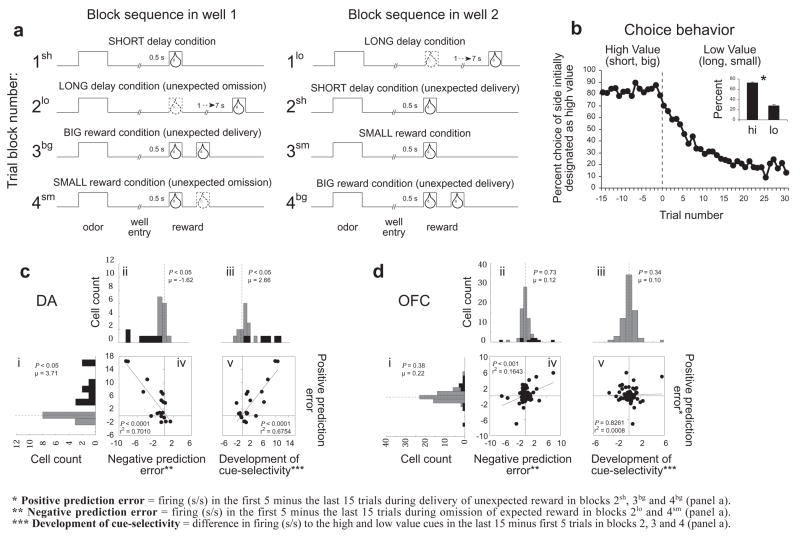
Humans and other animals change their behavior in response to unexpected outcomes. The orbitofrontal cortex (OFC) is implicated in such adaptive responding, based on evidence from reversal tasks. Yet these tasks confound using information about expected outcomes with learning when those expectations are violated. OFC is critical for the former function; here we show it is also critical for the latter. In a Pavlovian overexpectation task, inactivation of OFC prevented learning driven by unexpected outcomes, even when performance was assessed later. We propose this reflects a critical contribution of outcome signaling by OFC to encoding of reward prediction errors elsewhere. In accord with this proposal, we report that signaling of reward predictions by OFC neurons was related to signaling of prediction errors by dopamine neurons in ventral tegmental area (VTA). Furthermore, bilateral inactivation of VTA or contralateral inactivation of VTA and OFC disrupted learning driven by unexpected outcomes.
Figures



References
-
- Brown VJ, McAlonan K. Orbital prefrontal cortex mediates reversal learning and not attentional set shifting in the rat. Behavioral Brain Research. 2003;146:97–130. - PubMed
-
- Chudasama Y, Kralik JD, Murray EA. Rhesus monkeys with orbital prefrontal cortex lesions can learn to inhibit prepotent responses in the reversed reward contingency task. Cerebral Cortex. 2007;17:1154–1159. - PubMed
Publication types
MeSH terms
Substances
Grants and funding
LinkOut - more resources
Full Text Sources
