


Total brain volume and corpus callosum size in medication-naïve adolescents and young adults with autism spectrum disorder
- PMID: 19409535
- PMCID: PMC3299337
- DOI: 10.1016/j.biopsych.2009.03.011
Total brain volume and corpus callosum size in medication-naïve adolescents and young adults with autism spectrum disorder
Abstract
Background: Increased total brain volume (TBV) has been reported for children with autism spectrum disorder (ASD) but studies in older ASD subjects have been contradictory. Similarly, studies of corpus callosum (CC) area in ASD differ with regard to inclusion criteria, age, and IQ.
Methods: In the present study, TBV, gray matter (GM), and white matter (WM) volume as well as midsagittal CC area were compared between 15 medication-naïve, high-functioning adolescent and young adult ASD subjects and 15 healthy control individuals, and correlations with visuomotor coordination and imitation abilities were explored. In addition, computational surface-based methods were implemented to encode callosal thickness at high spatial resolution.
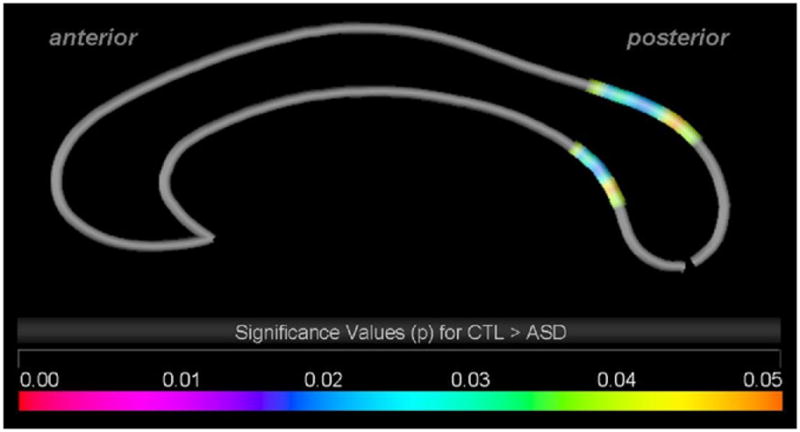
Results: Total brain volume, GM, and WM were increased and CC area was decreased in ASD subjects, a finding that was predominantly due to ASD subjects with lower IQ. Positive correlations of IQ with volume measures were observed only in control subjects. Autism spectrum disorder subjects showed reduced thickness in the posterior part of the CC. White matter volume showed a trend for negative correlation with dynamic balance and imitation abilities across groups.
Conclusions: This study replicates previous structural magnetic resonance imaging (MRI) findings in ASD, emphasizes the role of IQ differences, and adds some evidence for functional implications of structural findings.
Conflict of interest statement
The authors report no biomedical financial interests or potential conflicts of interest.
Figures
Comment in
-
Increased brain size in autism--what it will take to solve a mystery.Biol Psychiatry. 2009 Aug 15;66(4):313-5. doi: 10.1016/j.biopsych.2009.06.013. Biol Psychiatry. 2009. PMID: 19643218 Free PMC article. No abstract available.
References
-
- Stanfield AC, McIntosh AM, Spencer MD, Philip R, Gaur S, Lawrie SM. Towards a neuroanatomy of autism: A systematic review and meta-analysis of structural magnetic resonance imaging studies. Eur Psychiatry. 2008;23:289 –299. - PubMed
-
- Courchesne E, Carper R, Akshoomoff N. Evidence of brain overgrowth in the first year of life in autism. JAMA. 2003;290:337–344. - PubMed
-
- Hazlett HC, Poe MD, Gerig G, Smith RG, Piven J. Cortical gray and white brain tissue volume in adolescents and adults with autism. Biol Psychiatry. 2006;59:1–6. - PubMed
-
- Redcay E, Courchesne E. When is the brain enlarged in autism? A meta-analysis of all brain size reports. Biol Psychiatry. 2005;58:1–9. - PubMed
-
- Herbert MR, Ziegler DA, Makris N, Filipek PA, Kemper TL, Normandin JJ, et al. Localization of white matter volume increase in autism and developmental language disorder. Ann Neurol. 2004;55:530–540. - PubMed
Publication types
MeSH terms
Grants and funding
LinkOut - more resources
Full Text Sources
