


Synergistic neuroprotective effects of C3a and C5a receptor blockade following intracerebral hemorrhage
- PMID: 19410563
- PMCID: PMC2760685
- DOI: 10.1016/j.brainres.2009.04.047
Synergistic neuroprotective effects of C3a and C5a receptor blockade following intracerebral hemorrhage
Abstract
Background: Intracerebral hemorrhage (ICH) is associated with neurological injury that may be ameliorated by a neuroprotective strategy targeting the complement cascade. We investigated the role of C5a-receptor antagonist (C5aRA) solely and in combination with C3a-receptor antagonist (C3aRA) following ICH in mice.
Methods: Adult male C57BL/6J mice were randomized to receive vehicle, C5aRA alone or C3aRA and C5aRA 6 and 12 h after ICH, and every 12 h thereafter. A double injection technique was used to infuse 30 microL of autologous whole blood into the right striatum. A final group of mice received a sham procedure consisting only of needle insertion followed by vehicle injections. Brain water content and flow cytometry analysis for leukocyte and microglia infiltration and activation in both hemispheres were measured on day 3 post ICH. Neurological dysfunction was assessed using a Morris water-maze (MWM), a 28-point scale, and a corner test at 6, 12, 24, 48 and 72 h after ICH induction.
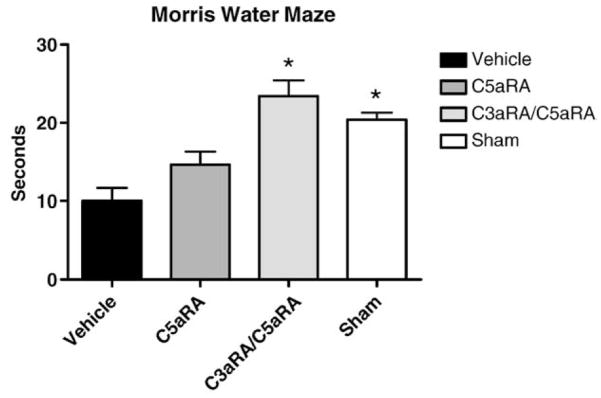
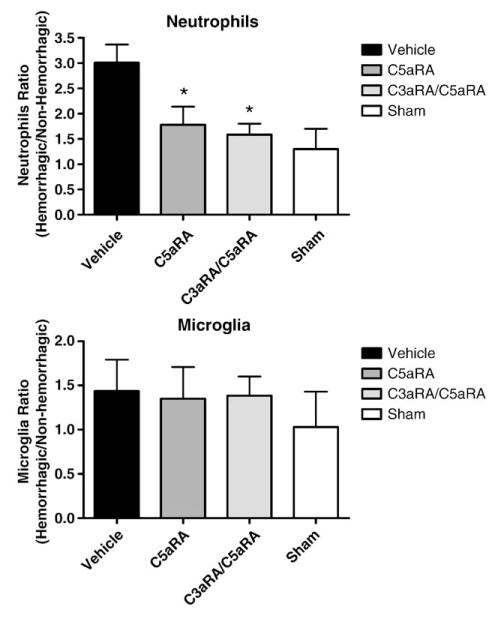
Results: Neurological deficits were present and comparable in all three cohorts 6 h after ICH. Animals treated with C5aRA and animals treated with combined C3aRA/C5aRA demonstrated significant improvements in neurological function assessed by both the corner turn test and a 28-point neurological scale at 24, 48 and 72 h relative to vehicle-treated animals. Similarly, C5aRA and C3aRA/C5aRA-treated mice demonstrated better spatial memory retention in the Morris water-maze test compared with vehicle-treated animals (C3aRA/C5aRA: 23.4+/-2.0 s p< or =0.0001 versus vehicle: 10.0+/-1.7 s). Relative to vehicle-treated mice, the brain water content in C3aRA/C5aRA-treated mice was significantly decreased in the ipsilateral cortex and ipsilateral striatum (ipsilateral cortex: C3aRA/C5aRA: 0.755403+/-0.008 versus 0.773327+/-0.003 p=0.01 striatum: 0.752273+/-0.007 versus 0.771163+/-0.0036 p=0.02). C5aRA-treated mice and C3aRA/C5aRA-treated mice had a decreased ratio of granulocytes (CD45(+)/CD11b(+)/Ly-6G(+)) in the hemorrhagic versus non-hemorrhagic hemispheres relative to vehicle-treated animals (C5aRA: 1.78+/-0.36 p=0.02 C3aRA/C5aRA: 1.59+/-0.22 p=0.005 versus vehicle: 3.01).
Conclusions: While administration of C5aRA alone provided neuroprotection, combined C3aRA/C5aRA therapy led to synergistic improvements in neurofunctional outcome while reducing inflammatory cell infiltration and brain edema. The results of this study indicate that simultaneous blockade of the C3a and C5a receptors represents a promising neuroprotective strategy in hemorrhagic stroke.
Figures



References
-
- Akita N, Nakase H, Kaido T, Kanemoto Y, Sakaki T. Protective effect of c1 esterase inhibitor on reperfusion injury in the rat middle cerebral artery occlusion model. Neurosurgery. 2003;52:395–400. discussion 400–391. - PubMed
-
- Ames RS, Li Y, Sarau HM, Nuthulaganti P, Foley JJ, Ellis C, Zeng Z, Su K, Jurewicz AJ, Hertzberg RP, Bergsma DJ, Kumar C. Molecular cloning and characterization of the human anaphylatoxin c3a receptor. J Biol Chem. 1996;271:20231–20234. - PubMed
-
- Aronowski J, Hall CE. New horizons for primary intracerebral hemorrhage treatment: experience from preclinical studies. Neurol Res. 2005;27:268–279. - PubMed
-
- Belayev L, Saul I, Curbelo K, Busto R, Belayev A, Zhang Y, Riyamongkol P, Zhao W, Ginsberg MD. Experimental intracerebral hemorrhage in the mouse: histological, behavioral, and hemodynamic characterization of a double-injection model. Stroke. 2003;34:2221–2227. - PubMed
-
- Bouet V, Freret T, Toutain J, Divoux D, Boulouard M, Schumann-Bard P. Sensorimotor and cognitive deficits after transient middle cerebral artery occlusion in the mouse. Exp Neurol. 2007;203:555–567. - PubMed
Publication types
MeSH terms
Substances
Grants and funding
LinkOut - more resources
Full Text Sources
Other Literature Sources
Research Materials
Miscellaneous
