. 2008 May;40(1):157-174.
doi: 10.1016/j.bej.2007.12.003.

Dynamics of Positional Enrichment: Theoretical Development and Application to Carbon Labeling in Zymomonas mobilis

Affiliations

Dynamics of Positional Enrichment: Theoretical Development and Application to Carbon Labeling in Zymomonas mobilis

Fernando Alvarez-Vasquez et al. Biochem Eng J. 2008 May.

Abstract

Positional enrichment analysis has become an important technique for assessing detailed flux distributions and the fates of specific atoms in metabolic pathway systems. The typical approach to positional enrichment analysis is performed by supplying specifically labeled substrate to a cell system, letting the system reach steady state, and measuring where label had arrived and accumulated. The data are then evaluated mathematically with the help of a linear stoichiometric flux distribution model. While this procedure has proven to yield new and valuable insights, it does not address the transient dynamics between providing label and its ultimate steady-state distribution, which is often of great interest to the experimentalist (pulse labeling experiments). We show here that an extension of a recent mathematical method for dynamic labeling analysis is able to shed light on these transitions, thereby revealing insights not obtained with traditional positional enrichment analyses. The method traces the dynamics of one or more carbons through fully regulated metabolic pathways, which, in principle, may be arbitrarily complex. After a brief review of the earlier method and description of the theoretical extension, we illustrate the method with an analysis of the pentose phosphate pathway in Zymomonas mobilis, which has been used for traditional positional enrichment analyses in the past. We show how different labeling schemes result in distinctly different transients, which nevertheless eventually lead to a steady-state labeling profile that coincides exactly with the corresponding profile from traditional analysis. Thus, over the domain of commonality, the proposed method leads to results equivalent to those from state-of-the-art existing methods. However, these steady-state results constitute only a small portion of the insights obtainable with the proposed method. Our method can also be used as an "inverse" technique for elucidating the topology and regulation of pathway systems, if appropriate time series data are available. While such dynamic data are still rather rare, they are now being generated with increasing frequency and we believe it is desirable, and indeed necessary, to accompany this trend with an adequate, rigorous method of analysis.


Figures
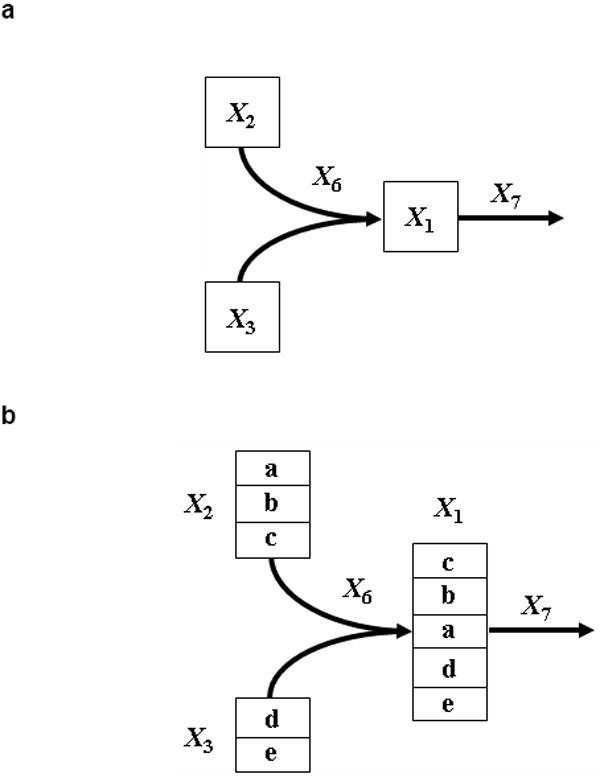
Fig 1
Fig 1
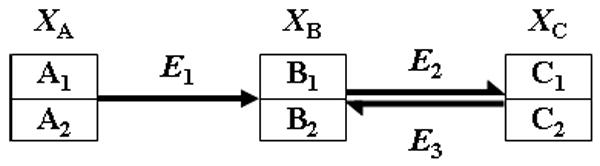
1a. Generic enzyme catalyzed reaction with two substrates. 1b. Bimolecular reaction with explicit description of the fate of each atom.
Fig 2
Fig 2
Generic reversible reaction with indication of differently positioned atoms.
Fig 3
Fig 3
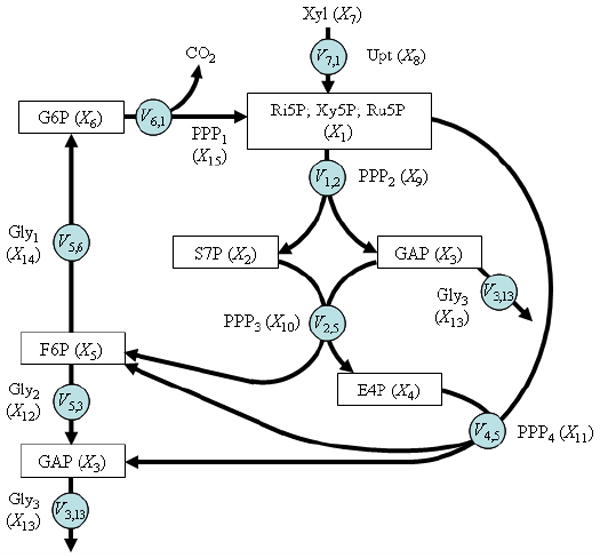
Cyclic pentose phosphate pathway in a mutant strain of Zymomonas mobilis. Redrawn from Wiechert and de Graaf (1997) [35]. Boxes indicate dependent system variables; other variables, indicating input, uptake, and enzyme catalyzed reactions, are independent. Fluxes are presented in circles. Symbol names Xi correspond to the representation in the GMA model. Note that GAP (X3) is represented in two locations for clarity. Abbreviations: Dependent variables: Ri5P, Ribose-5-phosphate; Xy5P, Xylulose-5-phosphate; Ru5P, Ribulose-5-phosphate; S7P, Sedoheptulose 7-phosphate; GAP, Glyceraldehyde 3-phosphate; E4P, Erythrose 4-phosphate; F6P, Fructose-6-Phosphate; G6P, 6-Phosphogluconate and Glucose-6-Phosphate; Independent variables: Xyl, Xylose; Upt, Xylose Uptake; PPP2, Transketolase-a; PPP3, Transaldolase; PPP4, Transketolase-b; Gly2, Transaldolase; Gly3, Glyceraldehyde-3-Phosphate Dehydrogenase; Gly1, Phosphoglucose isomerase; PPP1, 6-phosphogluconate dehydrogenase.
Fig. 4
Fig. 4
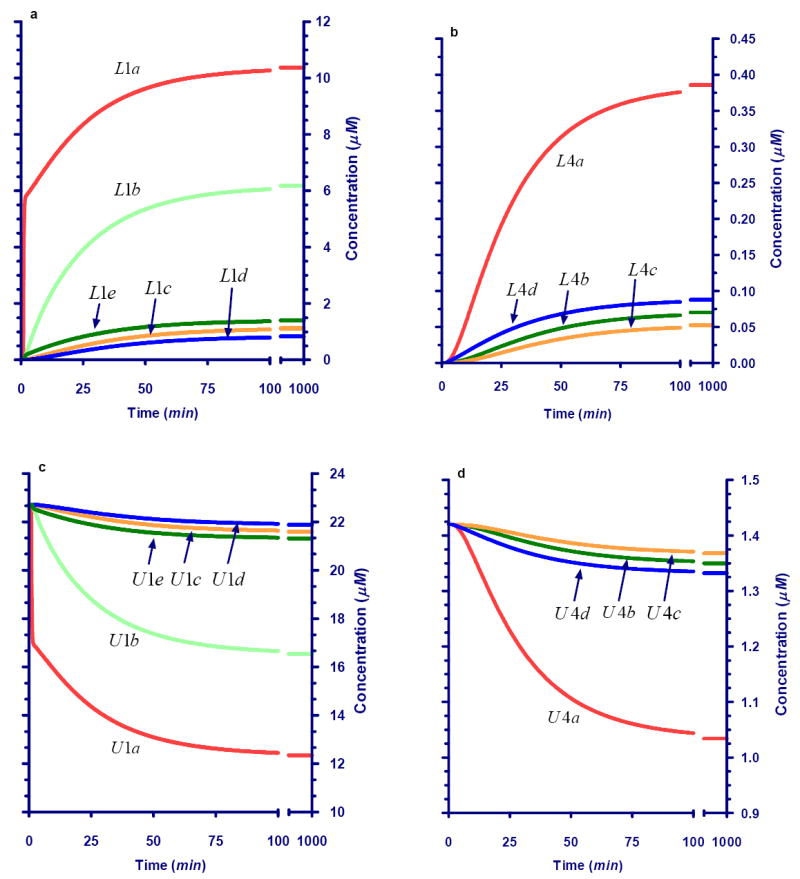
Dynamics for Ri5P, Xy5P, and Ru5P pool (X1) isotopes in response to sustained availability of xylose labeled in #A position under conditions of isomolarity. Panel a: Dynamics of carbon isotopes of Ri5P, Xy5P, and Ru5P labeled in #A position (L1 pool). Panel b: Dynamics of carbon isotopes of Ri5P, Xy5P, and Ru5P not labeled in #A position (U1 pool).
Fig 5
Fig 5
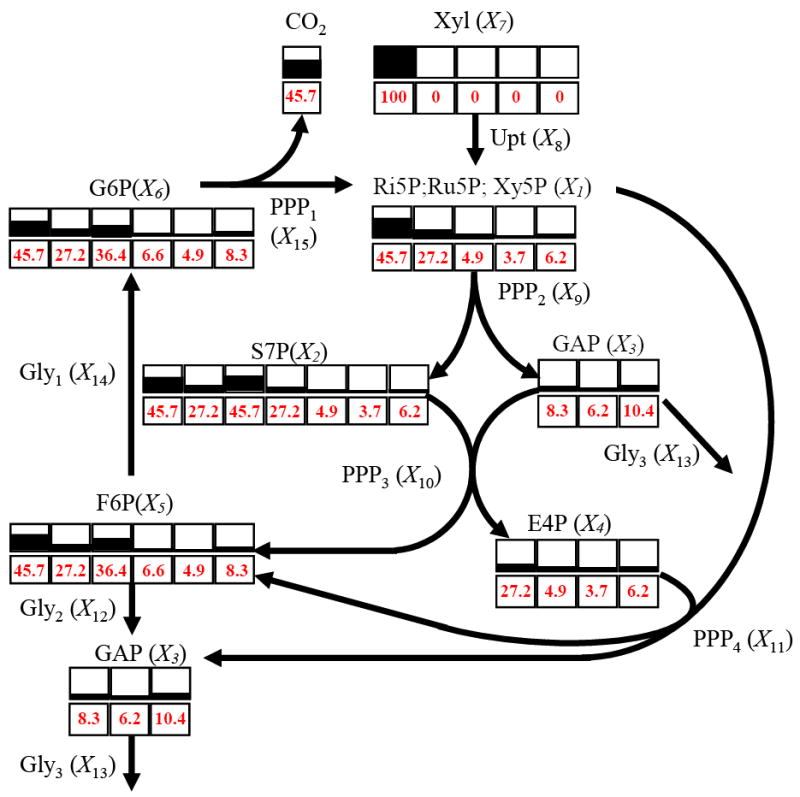
Atom positional enrichment in the dynamic model reaches the same steady state as obtained with the method of Wiechert and de Graf [35]. In this simulation, the input consisted of xylose labeled in #A position (L7a). Partially shaded blocks are redrawn from Wiechert and de Graf. Numbers in boxes are steady-state percentages of label in each position, computed with the method proposed here.
Fig 6
Fig 6
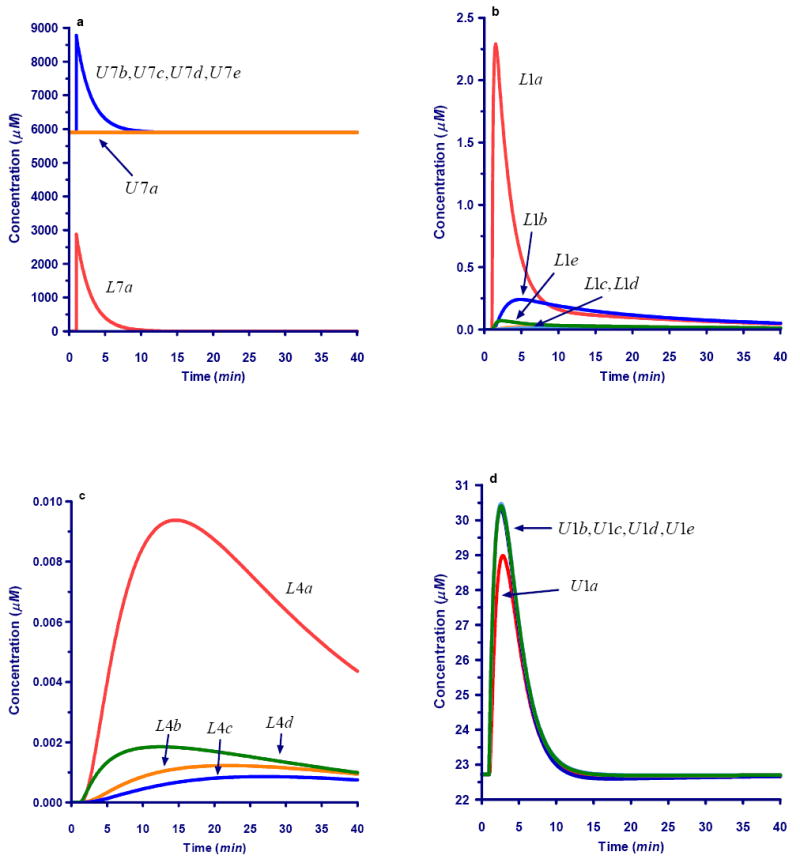
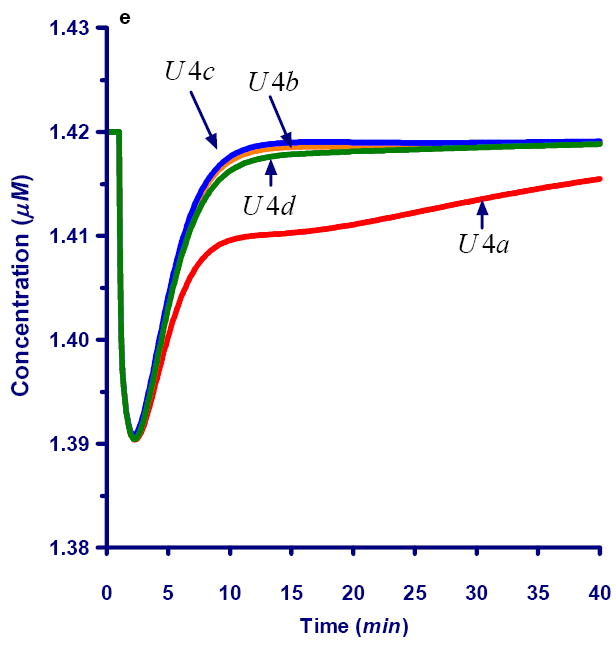
Dynamics of selected carbons after a bolus perturbation of xylose labeled in #A position. 6a. Decrease in external xylose after perturbation with label in #A position. Yellow: Unlabeled carbon #A (U7a); Red: Labeled carbon #A (L7a). Green: Unlabeled carbon in other positions (U7b, U7c, U7d, and U7e). Total carbon pools (X7b, X7c, X7d, and X7e) for the various positions are equivalent to U7b to U7e profiles (not shown). 6b. Dynamics of labeled carbons for the combined Ri5P, Xy5P, and Ru5P pool (L1). 6c. Dynamics of labeled carbons within the E4P pool (L4) 6d. Dynamics of unlabeled carbons for the combined Ri5P, Xy5P, and Ru5P pool (U1) 6e. Dynamics of unlabeled carbons within the E4P pool (U4)
Fig 6
Fig 6
Dynamics of selected carbons after a bolus perturbation of xylose labeled in #A position. 6a. Decrease in external xylose after perturbation with label in #A position. Yellow: Unlabeled carbon #A (U7a); Red: Labeled carbon #A (L7a). Green: Unlabeled carbon in other positions (U7b, U7c, U7d, and U7e). Total carbon pools (X7b, X7c, X7d, and X7e) for the various positions are equivalent to U7b to U7e profiles (not shown). 6b. Dynamics of labeled carbons for the combined Ri5P, Xy5P, and Ru5P pool (L1). 6c. Dynamics of labeled carbons within the E4P pool (L4) 6d. Dynamics of unlabeled carbons for the combined Ri5P, Xy5P, and Ru5P pool (U1) 6e. Dynamics of unlabeled carbons within the E4P pool (U4)
Fig. 7
Fig. 7
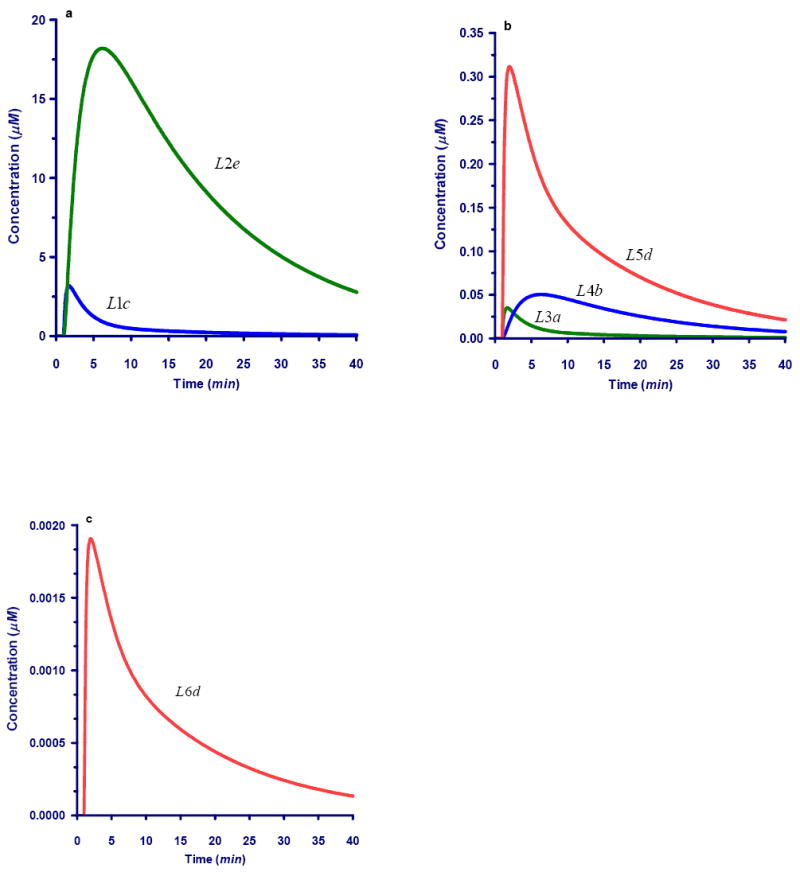
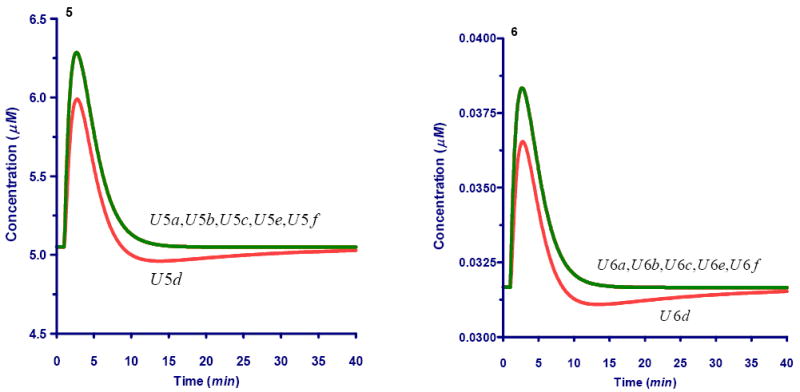
Dynamics for selected carbons following a bolus perturbation with xylose labeled in #C position. Carbons not shown are not affected by the perturbation. Compare time courses with Figure 6. The dynamics of unlabeled carbons is shown in Fig. A of the Appendix. 7a. Dynamics of #C and #E within the xylose-P pool and sedoheptulose-7- phosphate (L1c and L2e, respectively). 7b. Labeling dynamics for #A within the GAP pool (L3a), #B within the E4P pool (L4b), and #D within the F6P pool (L5d). 7c. Dynamics for C4 within the G6P pool (L6d).
Fig. A
Fig. A
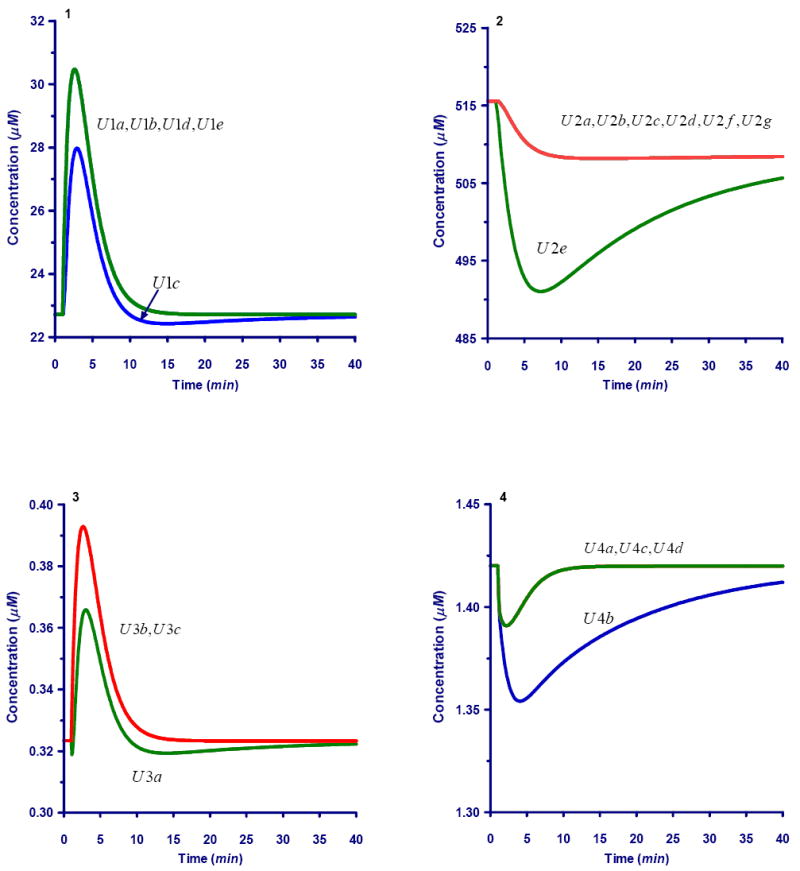
Dynamics for Ri5P unlabeled carbons following a bolus perturbation at #C of external xylose. The label carbon dynamics is show in Fig. 7 A1. Dynamics of unlabeled carbons within the pentose phsophate pool (X1) A2. Dynamics of unlabeled carbons within the sedoheptulose-7-phosphate pool (X2) A3. Dynamics of unlabeled carbons within the glyceraldehyde-3-phosphate pool (X3) A4. Dynamics of unlabeled carbons within the erythrose-4-phosphate pool (X4) A5. Dynamics of unlabeled carbons within the fructose-6-phosphate pool (X5) A6. Dynamics of unlabeled carbons within the 6-phosphogluconate pool (X6)
Fig. A
Fig. A
Dynamics for Ri5P unlabeled carbons following a bolus perturbation at #C of external xylose. The label carbon dynamics is show in Fig. 7 A1. Dynamics of unlabeled carbons within the pentose phsophate pool (X1) A2. Dynamics of unlabeled carbons within the sedoheptulose-7-phosphate pool (X2) A3. Dynamics of unlabeled carbons within the glyceraldehyde-3-phosphate pool (X3) A4. Dynamics of unlabeled carbons within the erythrose-4-phosphate pool (X4) A5. Dynamics of unlabeled carbons within the fructose-6-phosphate pool (X5) A6. Dynamics of unlabeled carbons within the 6-phosphogluconate pool (X6)

References

    1. Wiechert W. 13C metabolic flux analysis. Metab Eng. 2001;3:195–206. - PubMed
    1. Wiechert W, Mollney M, Petersen S, de Graaf AA. A universal framework for 13C metabolic flux analysis. Metab Eng. 2001;3:265–83. - PubMed
    1. Zupke C, S G. Modeling of Isotope Distributions and Intracellular Fluxes in Metabolic Networks Using Atom Mapping Matrixes. Biotechnology Progress. 1994;10:489–498.
    1. Eisenreich W, Bacher A. Elucidation of biosynthetic pathways by retrodictive/predictive comparison of isotopomer patterns determined by NMR spectroscopy. Genet Eng (N Y) 2000;22:121–53. - PubMed
    1. Wittmann C. Metabolic flux analysis using mass spectrometry. Adv Biochem Eng Biotechnol. 2002;74:39–64. - PubMed

LinkOut - more resources