


Review
doi: 10.1111/j.1476-5381.2009.00250.x.
Molecular and biochemical pharmacology of the histamine H4 receptor
Affiliations
- PMID: 19413568
- PMCID: PMC2697796
- DOI: 10.1111/j.1476-5381.2009.00250.x
Item in Clipboard
Review
Molecular and biochemical pharmacology of the histamine H4 receptor
Br J Pharmacol.
2009 May.
Abstract
The elucidation of the human genome has had a major impact on histamine receptor research. The identification of the human H4 receptor by several groups has been instrumental for a new appreciation of the role of histamine in the modulation of immune function. In this review, we summarize the historical developments and the molecular and biochemical pharmacology of the H4 receptor.
Figures
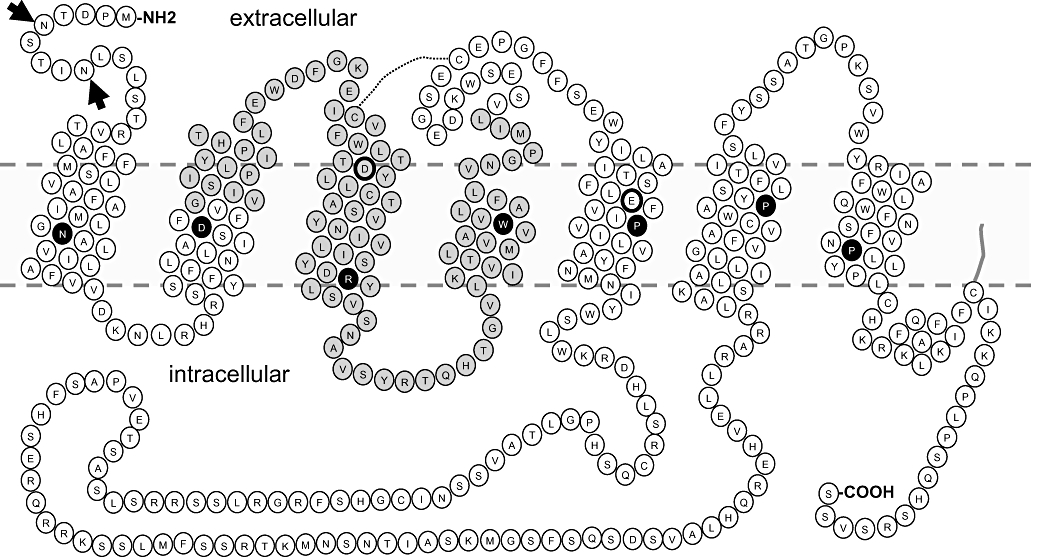
Snake plot of the human histamine H4 receptor. The full-length receptor consists of 390 amino acids, which form seven transmembrane helices, three extracellular loops and three intracellular loops, with an extracellular N-terminal and an intracellular C-terminal peptide; the dotted line represents the putative disulfide bridge that links the cysteines in the third transmembrane and second extracellular loop. Residues Asp3.32 and Glu5.46 that play important roles in histamine binding are marked with bold border. The H4R67 isoform only contains the first 67 N-terminal residues (marked in white), while the H4R302 lacks the residues marked in grey. The conserved residues in the family A of G protein-coupled receptors are depicted in black circles, while the putative glycosylation sites (Asn5 and Asn9) are indicated with arrows. A potential palmitoylation site (Cys374) at the C-terminal tail is suggested to be close to the membrane following membrane insertion of a putative attached palmitic acid.
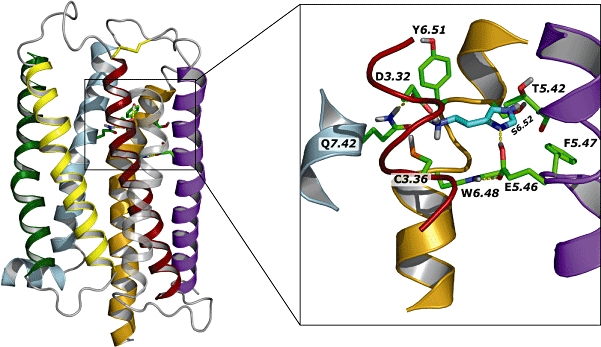
Schematic representation of a homology model of the human histamine H4 receptor. The figure shows the seven transmembrane domains and the position of the ligand binding site. In the box details of the histamine binding site, as determined using ab initio calculations is shown (reproduced with permission from Jongejan et al., 2008).
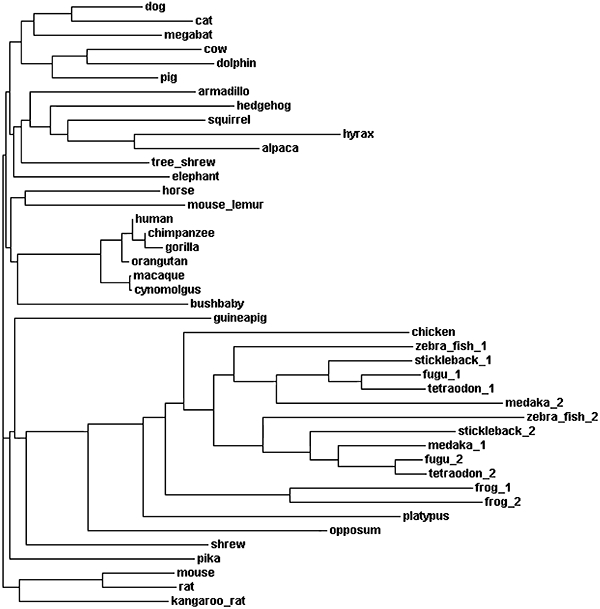
Phylogenetic tree of H4 receptor orthologues. The sequences are obtained from http://www.ensembl.org and the phylogram was created with ClustalW.
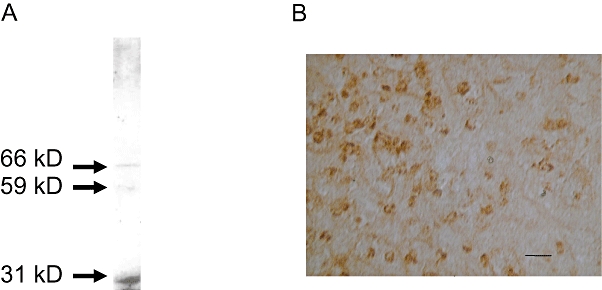
Anti-hH4(374–390) receptor antibody reacts with human H4 receptor protein in spleen tissue lysate and sections. (A) Immunoblot of human spleen lysate (10 µg). Anti-H4(374–390) antibodies were used at 2 µg·mL−1, incubated overnight at 4°C and developed as described in van Rijn et al. (2006). In addition to the putative monomer at Mw 31 kDa, two higher molecular weight species were detected at 59 and 66 kDa. (B) Immunostaining of human spleen slice (bar = 50 µm) using anti-H4(374–390) at 1 µg·mL−1 using an immunohistochemical protocol described in Chazot et al. (2001).
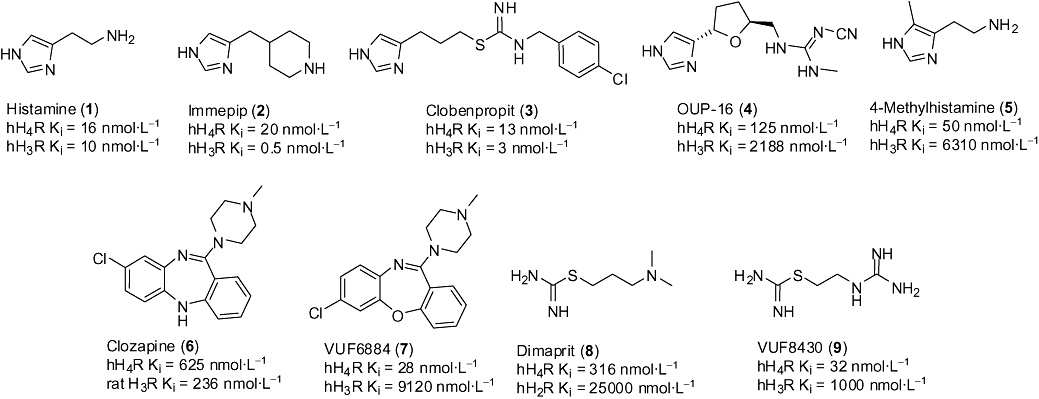
First and second generation H4 receptor agonists with different selectivity profiles.
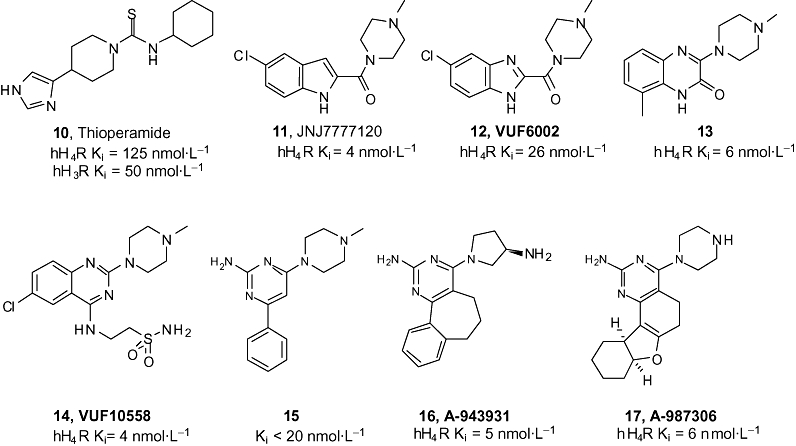
First and second generation H4 receptor antagonists. Except for thioperamide (10) the antagonists display at least a 100-fold selectivity for the histamine H4 receptor over the histamine H3 receptor.
References
-
- Arrang JM, Garbarg M, Schwartz JC. Auto-inhibition of brain histamine release mediated by a novel class H3 of histamine receptor. Nature. 1983;302:832–837. - PubMed
-
- Bakker RA, Lozada AF, van Marle A, Shenton FC, Drutel G, Karlstedt K, et al. Discovery of naturally occurring splice variants of the rat histamine H3 receptor that act as dominant-negative isoforms. Mol Pharmacol. 2006;69:1194–1206. - PubMed
-
- Ballesteros JA, Weinstein H. Integrated methods for the construction of three-dimensional models and computational probing of structure-function relations in G protein-coupled receptors. Methods Neurosci. 1995;25:366–428.
-
- Barnard R, Barnard A, Salmon G, Liu W, Sreckovic S. Histamine-induced actin polymerization in human eosinophils: an imaging approach for histamine H4 receptor. Cytometry. 2008;73:299–304. - PubMed
Publication types
MeSH terms
Substances
LinkOut - more resources
Full Text Sources
Other Literature Sources
