. 2009 Jul 2;114(1):105-8.
doi: 10.1182/blood-2009-03-211029. Epub 2009 May 4.

Early defects in human T-cell development severely affect distribution and maturation of thymic stromal cells: possible implications for the pathophysiology of Omenn syndrome

Affiliations

Early defects in human T-cell development severely affect distribution and maturation of thymic stromal cells: possible implications for the pathophysiology of Omenn syndrome

Pietro Luigi Poliani et al. Blood. .

Abstract

Thymocytes and thymic epithelial cell (TEC) cross-talk is crucial to preserve thymic architecture and function, including maturation of TECs and dendritic cells, and induction of mechanisms of central tolerance. We have analyzed thymic maturation and organization in 9 infants with various genetic defects leading to complete or partial block in T-cell development. Profound abnormalities of TEC differentiation (with lack of AIRE expression) and severe reduction of thymic dendritic cells were identified in patients with T-negative severe combined immunodeficiency, reticular dysgenesis, and Omenn syndrome. The latter also showed virtual absence of thymic Foxp3(+) T cells. In contrast, an IL2RG-R222C hypomorphic mutation permissive for T-cell development allowed for TEC maturation, AIRE expression, and Foxp3(+) T cells. Our data provide evidence that severe defects of thymopoiesis impinge on TEC homeostasis and may affect deletional and nondeletional mechanisms of central tolerance, thus favoring immune dysreactive manifestations, as in Omenn syndrome.


Figures
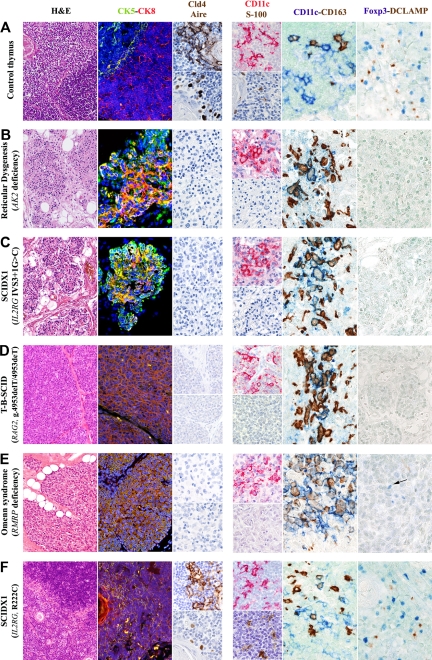
Figure 1
Figure 1
Thymic compartmentalization and maturation of mTECs, DCs, and nTregs is abrogated in patients with severe defects in T-cell development but is preserved in a patient whose genetic defects are largely permissive for T-cell development. Detailed analysis of the thymic biopsy from a representative normal thymus (A) shows defined CMD (hematoxylin and eosin staining) with normal compartmentalization of CK8+CK5 cTECs (CK8, red staining) and CK8CK5+ mTECs (CK5, green staining). Mature mTECs express Cld4 and Aire (brown staining, top and bottom images, respectively). In contrast, mutations that abrogate T-cell development (reticular dysgenesis, B; γc-null SCIDX1, C; RAG2-null TBSCID, D) or that are only partially permissive for T-cell development (Omenn syndrome associated with RMRP mutations, E), are associated with profound atrophy and loss of CMD (hematoxylin and eosin staining), highlighted by the presence of a diffuse epithelial network mostly composed of CK5 and CK8 double-positive immature TECs (yellow staining). No expression of claudin-4 (Cld4) and Aire was detected in these samples. In contrast, as shown in panel F, the biopsy from the patient carrying a hypomorphic R222C mutation in the IL2RG gene, permissive for T-cell development, shows normal thymic architecture with CMD (hematoxylin and eosin staining), normal distribution of CK8+CK5 cTECs (CK8, red) and CK8CK5+ mTECs (CK5, green), and expression of Cld4 and Aire (brown staining, top and bottom images, respectively). In the normal thymus (A), CD11c+ (top image, red staining) and S-100+ (bottom image, brown staining) DCs are distributed in the medullary areas. Combined CD11c and CD163 staining differentially marks CD11c+ DCs in the medullary region and CD163+ macrophages, which are primarily distributed into the cortex, with only rare CD11c and CD163 double-positive cells. Conversely, severe depletion of DCs is present in the thymic biopsies of all patients whose genetic defects severely compromise T-cell development. (B-E) Absence of S-100+ cells in all patients. In addition, CD11c+cells, although present in good number, largely coexpress CD163, indicating a macrophage phenotype. Rare CD11c+CD163 DCs have been observed in the patient with Omenn syndrome (E). In the control thymus, Foxp3+ nTreg clusters around mature activated CD208+ (DC-LAMP) DCs, as highlighted by double-staining procedures (A). In contrast, thymic biopsies from patients with genetic defects that are nonpermissive for T-cell development show absence of mature activated CD208+ (DC-LAMP) DCs and Foxp3+ nTregs (B-D). The thymic biopsy from the Omenn syndrome patient (E) shows absence of CD208+ (DC-LAMP) DCs but focal expression of rare Foxp3+ cells (E). In contrast, the thymus from the patient with hypomorphic R222C mutation in the IL2RG gene demonstrates normal distribution of both S-100+ and CD11c+ DCs (F, CD11c+ top image, red staining; S-100+ bottom image, brown staining) along with the evidence of Foxp3+ nTreg interacting with mature activated CD208+ (DC-LAMP) DCs (F). Hematoxylin and eosin staining, original magnification ×10; immunofluorescence stainings, original magnification ×20: CK5 (green), CK8 (red), nuclei (blue), merge (yellow). Single immunohistochemical stainings, original magnification ×40: Cld4, Aire, S-100 (brown) and CD11c (red); double immunohistochemical stainings, original magnification ×40: CD11c (blue) and CD163 (brown); Foxp3 (blue) and DCLAMP (CD208; brown).

References

    1. Fischer A. Human primary immunodeficiency diseases. Immunity. 2007;27:835–845. - PubMed
    1. Signorini S, Imberti L, Pirovano S, et al. Intrathymic restriction and peripheral expansion of the T-cell repertoire in Omenn syndrome. Blood. 1999;94:3468–3478. - PubMed
    1. Villa A, Santagata S, Bozzi F, et al. Partial V(D)J recombination activity leads to Omenn syndrome. Cell. 1998;93:885–896. - PubMed
    1. Villa A, Notarangelo LD, Roifman CM. Omenn syndrome: inflammation in leaky severe combined immunodeficiency. J Allergy Clin Immunol. 2008;122:1082–1086. - PubMed
    1. Cavadini P, Vermi W, Facchetti F, et al. AIRE deficiency in thymus of 2 patients with Omenn syndrome. J Clin Invest. 2005;115:728–732. - PMC - PubMed

Publication types

MeSH terms
