Australia's dengue risk driven by human adaptation to climate change
- PMID: 19415109
- PMCID: PMC2671609
- DOI: 10.1371/journal.pntd.0000429
Australia's dengue risk driven by human adaptation to climate change
Abstract
Background: The reduced rainfall in southeast Australia has placed this region's urban and rural communities on escalating water restrictions, with anthropogenic climate change forecasts suggesting that this drying trend will continue. To mitigate the stress this may place on domestic water supply, governments have encouraged the installation of large domestic water tanks in towns and cities throughout this region. These prospective stable mosquito larval sites create the possibility of the reintroduction of Ae. aegypti from Queensland, where it remains endemic, back into New South Wales and other populated centres in Australia, along with the associated emerging and re-emerging dengue risk if the virus was to be introduced.
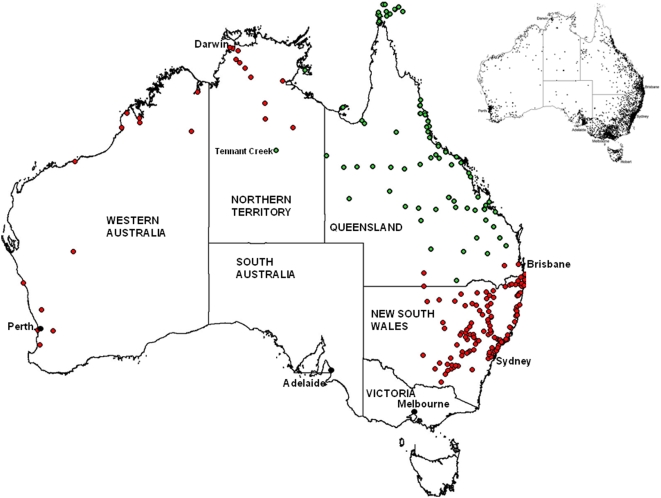
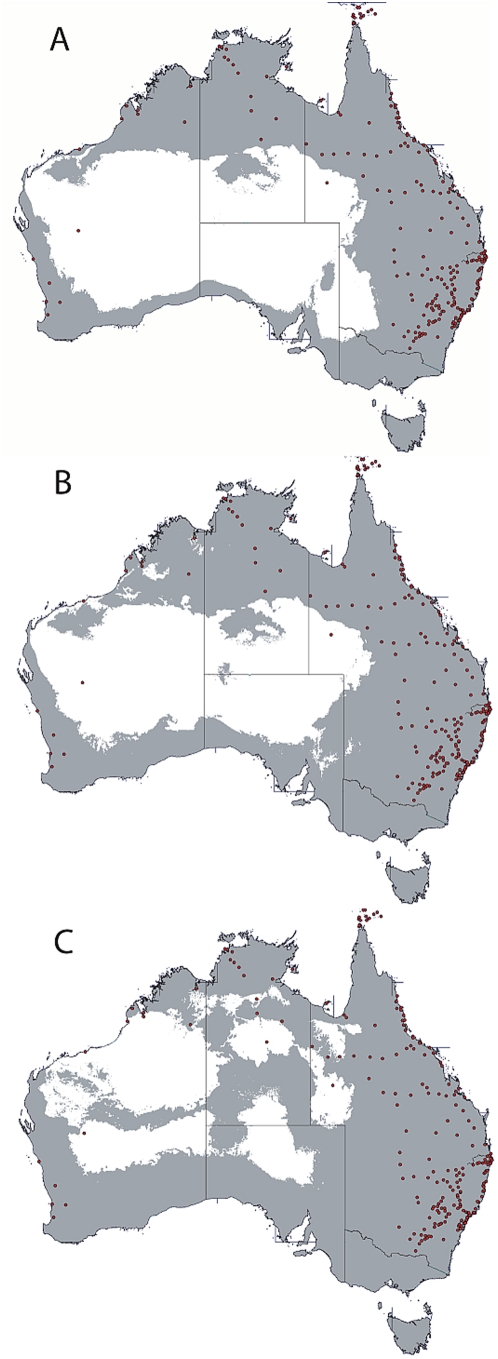
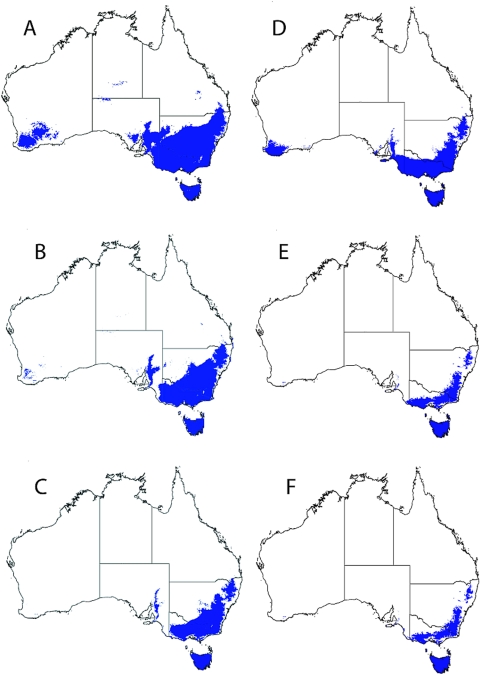
Methodology/principal findings: Having collated the known distribution of Ae. aegypti in Australia, we built distributional models using a genetic algorithm to project Ae. aegypti's distribution under today's climate and under climate change scenarios for 2030 and 2050 and compared the outputs to published theoretical temperature limits. Incongruence identified between the models and theoretical temperature limits highlighted the difficulty of using point occurrence data to study a species whose distribution is mediated more by human activity than by climate. Synthesis of this data with dengue transmission climate limits in Australia derived from historical dengue epidemics suggested that a proliferation of domestic water storage tanks in Australia could result in another range expansion of Ae. aegypti which would present a risk of dengue transmission in most major cities during their warm summer months.
Conclusions/significance: In the debate of the role climate change will play in the future range of dengue in Australia, we conclude that the increased risk of an Ae. aegypti range expansion in Australia would be due not directly to climate change but rather to human adaptation to the current and forecasted regional drying through the installation of large domestic water storing containers. The expansion of this efficient dengue vector presents both an emerging and re-emerging disease risk to Australia. Therefore, if the installation and maintenance of domestic water storage tanks is not tightly controlled, Ae. aegypti could expand its range again and cohabit with the majority of Australia's population, presenting a high potential dengue transmission risk during our warm summers.
Conflict of interest statement
The authors have declared that no competing interests exist.
Figures

References
-
- Reiter P, Amador MA, Anderson RA, Clark GG. Short report: dispersal of Aedes aegypti in an urban area after blood feeding as demonstrated by rubidium-marked eggs. Am J Trop Med Hyg. 1995;52:177–179. - PubMed
-
- Russell RC, Webb CE, Williams CR, Ritchie SA. Mark-release-recapture study to measure dispersal of the mosquito Aedes aegypti in Cairns, Queensland, Australia. Med Vet Entomol. 2005;19:451–457. - PubMed
-
- Mackenzie JS, Gubler DJ, Petersen LR. Emerging flaviviruses: the spread and resurgence of Japanese encephalitis, West Nile and dengue viruses. Nat Med. 2004;10:S98–S109. - PubMed
-
- Christophers R. Aedes aegypti (L.), The Yellow Fever Mosquito. Cambridge: Cambridge University Press; 1960.
Publication types
MeSH terms
LinkOut - more resources
Full Text Sources
Medical