


Fitting the HIV epidemic in Zambia: a two-sex micro-simulation model
- PMID: 19415113
- PMCID: PMC2673026
- DOI: 10.1371/journal.pone.0005439
Fitting the HIV epidemic in Zambia: a two-sex micro-simulation model
Abstract
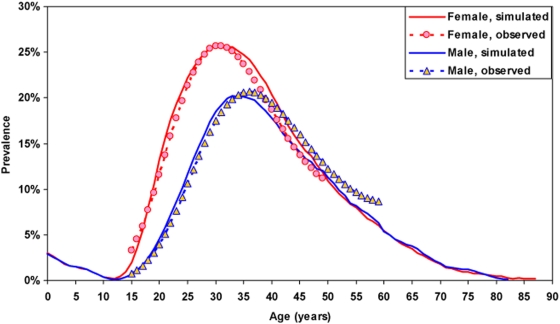
Background: In describing and understanding how the HIV epidemic spreads in African countries, previous studies have not taken into account the detailed periods at risk. This study is based on a micro-simulation model (individual-based) of the spread of the HIV epidemic in the population of Zambia, where women tend to marry early and where divorces are not frequent. The main target of the model was to fit the HIV seroprevalence profiles by age and sex observed at the Demographic and Health Survey conducted in 2001.
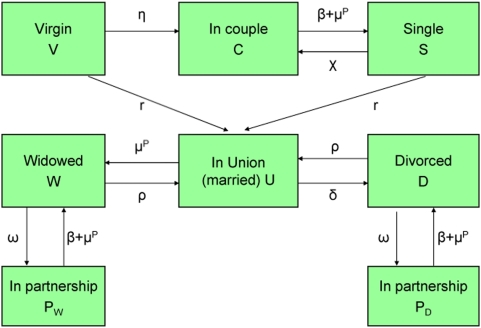
Methods and findings: A two-sex micro-simulation model of HIV transmission was developed. Particular attention was paid to precise age-specific estimates of exposure to risk through the modelling of the formation and dissolution of relationships: marriage (stable union), casual partnership, and commercial sex. HIV transmission was exclusively heterosexual for adults or vertical (mother-to-child) for children. Three stages of HIV infection were taken into account. All parameters were derived from empirical population-based data. Results show that basic parameters could not explain the dynamics of the HIV epidemic in Zambia. In order to fit the age and sex patterns, several assumptions were made: differential susceptibility of young women to HIV infection, differential susceptibility or larger number of encounters for male clients of commercial sex workers, and higher transmission rate. The model allowed to quantify the role of each type of relationship in HIV transmission, the proportion of infections occurring at each stage of disease progression, and the net reproduction rate of the epidemic (R(0) = 1.95).
Conclusions: The simulation model reproduced the dynamics of the HIV epidemic in Zambia, and fitted the age and sex pattern of HIV seroprevalence in 2001. The same model could be used to measure the effect of changing behaviour in the future.
Conflict of interest statement
Figures
References
-
- UNAIDS. Report on the global AIDS epidemic. 2006
-
- Sewankambo NK, Carswell JW, Mugerwa RD, Lloyd G, Kataaha P, et al. HIV infection through normal heterosexual contact in Uganda. Aids. 1987;1:113–116. - PubMed
-
- Leclerc PM, Garenne M. Inconsistencies in age profiles of HIV prevalence: A dynamic model applied to Zambia. Demographic Research. 2007;16:121–140.
-
- Gregson S, Nyamukapa CA, Garnett GP, Mason PR, Zhuwau T, et al. Sexual mixing patterns and sex-differentials in teenage exposure to HIV infection in rural Zimbabwe. Lancet. 2002;359:1896–1903. - PubMed
Publication types
MeSH terms
LinkOut - more resources
Full Text Sources
Medical
