


Steroids are required for epidermal cell fate establishment in Arabidopsis roots
- PMID: 19416891
- PMCID: PMC2683123
- DOI: 10.1073/pnas.0811633106
Steroids are required for epidermal cell fate establishment in Arabidopsis roots
Abstract
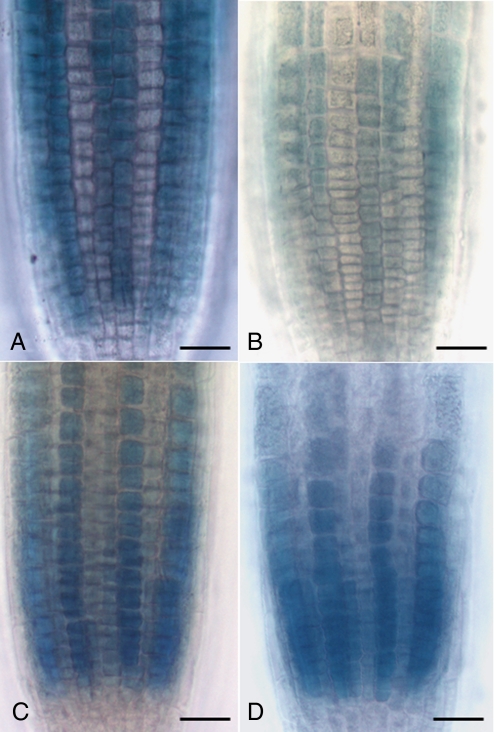
The simple structure of Arabidopsis roots provides an excellent model system to study epidermal cell fate specification. Epidermal cells in contact with 2 underlying cortical cells differentiate into hair cells (H cells; trichoblasts), whereas cells that contact only a single cortical cell differentiate into mature hairless cells (N cells; atrichoblasts). This position-dependent patterning, in combination with the constrained orientation of cell divisions, results in hair and nonhair cell files running longitudinally along the root epidermis. Here, we present strong evidence that steroid hormones called brassinosteroids (BRs) are required to maintain position-dependent fate specification in roots. We show that BRs are required for normal expression levels and patterns of WEREWOLF (WER) and GLABRA2 (GL2), master regulators of epidermal patterning. Loss of BR signaling results in loss of hair cells in H positions, likely as a consequence of reduced expression of CAPRICE (CPC), a direct downstream target of WER. Our observations demonstrate that in addition to their well-known role in cell expansion, BRs play an essential role in directing cell fate.
Conflict of interest statement
The authors declare no conflict of interest.
Figures


References
-
- Dolan L. Positional information and mobile transcriptional regulators determine cell pattern in the Arabidopsis root epidermis. J Exp Bot. 2006;57:51–54. - PubMed
-
- Larkin JC, Brown ML, Schiefelbein J. How do cells know what they want to be when they grow up? Lessons from epidermal patterning in Arabidopsis. Annu Rev Plant Biol. 2003;54:403–430. - PubMed
-
- Ishida T, Kurata T, Okada K, Wada T. A genetic regulatory network in the development of trichomes and root hairs. Annu Rev Plant Biol. 2008;59:365–386. - PubMed
Publication types
MeSH terms
Substances
LinkOut - more resources
Full Text Sources
Molecular Biology Databases
