


Voluntary wheel running restores endothelial function in conduit arteries of old mice: direct evidence for reduced oxidative stress, increased superoxide dismutase activity and down-regulation of NADPH oxidase
- PMID: 19417091
- PMCID: PMC2727036
- DOI: 10.1113/jphysiol.2009.169771
Voluntary wheel running restores endothelial function in conduit arteries of old mice: direct evidence for reduced oxidative stress, increased superoxide dismutase activity and down-regulation of NADPH oxidase
Abstract
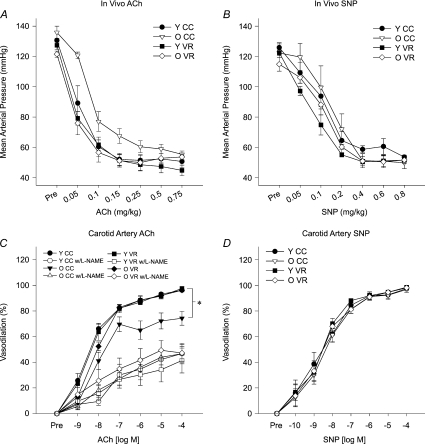
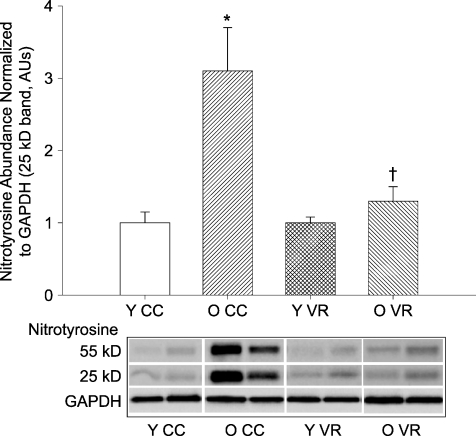
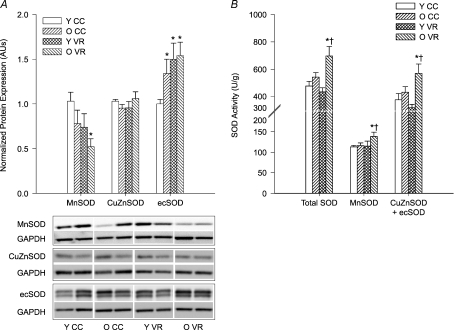
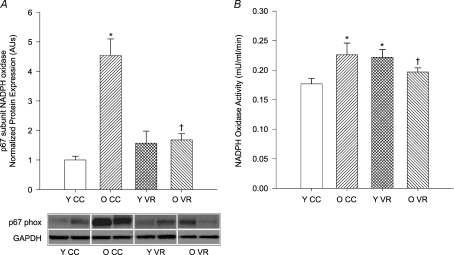
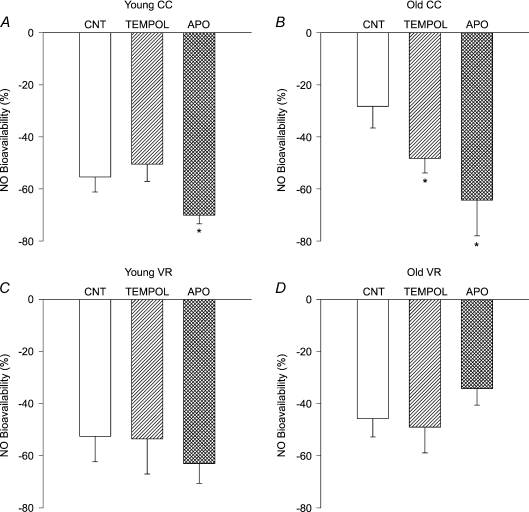
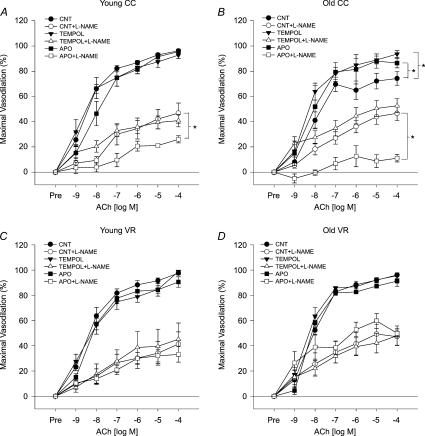
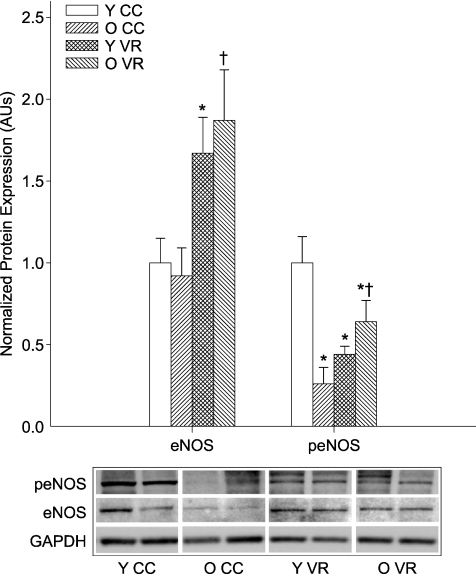
Habitual aerobic exercise is associated with enhanced endothelium-dependent dilatation (EDD) in older humans, possibly by increasing nitric oxide bioavailability and reducing oxidative stress. However, the mechanisms involved are incompletely understood. EDD was measured in young (6-8 months) and old (29-32 months) cage control and voluntary wheel running (VR) B6D2F1 mice. Age-related reductions in maximal carotid artery EDD to acetylcholine (74 vs. 96%, P < 0.01) and the nitric oxide (NO) component of EDD (maximum dilatation with ACh and l-NAME minus that with ACh alone was -28% vs. -55%, P < 0.01) were restored in old VR (EDD: 96%, NO: -46%). Nitrotyrosine, a marker of oxidative stress, was increased in aorta with age, but was markedly lower in old VR (P < 0.05). Aortic superoxide dismutase (SOD) activity was greater (P < 0.01), whereas NADPH oxidase protein expression (P < 0.01) and activity (P = 0.05) were lower in old VR vs. old cage control. Increasing SOD (with 4-hydroxy-2,2,6,6-tetramethylpiperidine 1-oxyl) and inhibition of NADPH oxidase (with apocynin) improved EDD and its NO component in old cage control, but not old VR mice. VR increased endothelial NO synthase (eNOS) protein expression (P < 0.05) and activation (Ser1177 phosphorylation) (P < 0.05) in old mice. VR did not affect EDD in young mice. Our results show that voluntary aerobic exercise restores the age-associated loss of EDD by suppression of oxidative stress via stimulation of SOD antioxidant activity and inhibition of NADPH oxidase superoxide production. Increased eNOS protein and activation also may contribute to exercise-mediated preservation of NO bioavailability and EDD with ageing.
Figures
Comment in
-
Reduced oxidant stress, increased NO-dependent vasodilatation, and improved endothelial function with voluntary exercise in old mice: another excuse for long walks on the beach.J Physiol. 2009 Jul 1;587(Pt 13):3059. doi: 10.1113/jphysiol.2009.175117. J Physiol. 2009. PMID: 19567741 Free PMC article. No abstract available.
-
Run for your life: exercise, oxidative stress and the ageing endothelium.J Physiol. 2009 Sep 1;587(Pt 17):4137-8. doi: 10.1113/jphysiol.2009.178624. J Physiol. 2009. PMID: 19720852 Free PMC article. No abstract available.
References
-
- Bauer PM, Fulton D, Boo YC, Sorescu GP, Kemp BE, Jo H, Sessa WC. Compensatory phosphorylation and protein-protein interactions revealed by loss of function and gain of function mutants of multiple serine phosphorylation sites in endothelial nitric-oxide synthase. J Biol Chem. 2003;278:14841–14849. - PubMed
-
- Bedard K, Krause K-H. The NOX family of ROS-generating NADPH oxidases: Physiology and pathophysiology. Physiol Rev. 2007;87:245–313. - PubMed
-
- Blackwell KA, Sorenson JP, Richardson DM, Smith LA, Suda O, Nath K, Katusic ZS. Mechanisms of aging-induced impairment of endothelium-dependent relaxation: Role of tetrahydrobiopterin. Am J Physiol Heart Circ Physiol. 2004;287:H2448–2453. - PubMed
-
- Bonetti P, Lerman L, Lerman A. Endothelial dysfunction: A marker of atherosclerotic risk. Arterioscler Thromb Vasc Biol. 2003;23:168–175. - PubMed
-
- Bonthu S, Heistad DD, Chappell DA, Lamping KG, Faraci FM. Atherosclerosis, vascular remodeling, and impairment of endothelium-dependent relaxation in genetically altered hyperlipidemic mice. Arterioscler Thromb Vasc Biol. 1997;17:2333–2340. - PubMed
Publication types
MeSH terms
Substances
Grants and funding
LinkOut - more resources
Full Text Sources
Medical
