


Diversity of pneumococcal surface protein A (PspA) among prevalent clones in Spain
- PMID: 19419534
- PMCID: PMC2684541
- DOI: 10.1186/1471-2180-9-80
Diversity of pneumococcal surface protein A (PspA) among prevalent clones in Spain
Abstract
Background: PspA is recognized as a major pneumococcal virulence factor and a possible vaccine candidate. The aim of this study was to analyze the PspA family and clade distribution among 112 Spanish pneumococci representatives of dominant clones among patients with invasive disease (n = 66) and nasopharyngeal healthy carriage in children (n = 46).
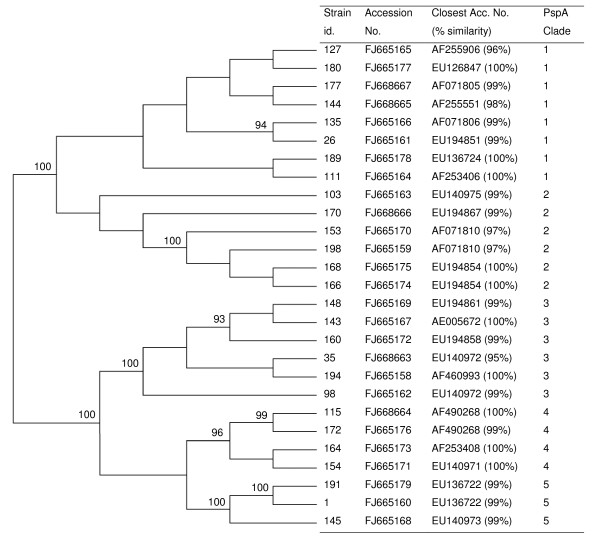
Results: PspA family 2 was predominant among invasive (63.6%) and carriage (54.3%) pneumococcal isolates. No PspA family 3 isolates were detected and only one strain was PspA negative. Although four clonal complexes contained strains of different clades, a clear association between clade and multi locus sequence typing results was found. Clades 1, 3 and 4 were associated with a wide variety of sequence types (ST) related to multiresistant and antibiotic-susceptible worldwide-disseminated clones. Clade 1 was associated with Spain 6B-ST90, Spain 14-ST18, Colombia 5-ST289, Sweden 1-ST306, Denmark 14-ST230 and Sweden 1-ST304 clones. Clade 3 was associated with Spain 23F-ST81, Spain 9V-ST156, Tennessee 14-ST67, Netherlands 3-ST180 and Netherlands 7F-ST191 clones. Clade 4 was related to Sweden 15A-ST63, Netherlands 18C-ST113 and Greece 21-ST193 clones. In contrast, PspA clade was not related to serotype, age or clinical origin of the isolates.
Conclusion: PspA clades were associated with genotypes. PspA family 2 and family 1 were dominant among major Spanish pneumococcal clones isolated from patients with invasive disease and nasopharyngeal carriage in children.
Figures
References
-
- Musher DM. Infections caused by Streptococcus pneumoniae: clinical spectrum, pathogenesis, immunity and treatment. Clin Infect Dis. 1992;14:801–807. - PubMed
-
- Mato R, Sanches IS, Simas C, Nunes S, Carriço JA, Souza NG, Frazão N, Saldanha J, Brito-Avô A, Almeida JS, Lencastre HD. Natural history of drug-resistant clones of Streptococcus pneumoniae colonizing healthy children in Portugal. Microb Drug Resist. 2005;11:309–322. doi: 10.1089/mdr.2005.11.309. - DOI - PubMed
Publication types
MeSH terms
Substances
LinkOut - more resources
Full Text Sources
Other Literature Sources
