


Same-sex social behavior in meadow voles: Multiple and rapid formation of attachments
- PMID: 19419672
- PMCID: PMC2798739
- DOI: 10.1016/j.physbeh.2009.01.020
Same-sex social behavior in meadow voles: Multiple and rapid formation of attachments
Abstract
Adult meadow voles (Microtus pennsylvanicus) are solitary in the spring-summer reproductive season, but during winter months, females and males are socially tolerant and aggregate in groups. This behavioral difference is triggered by day length: female meadow voles housed in short, winter-like day lengths form same-sex partner preferences, whereas those housed in long, summer-like day lengths are less social. The present study demonstrates that same-sex social attachments in short day lengths are not exclusive; females formed concurrent attachments with more than one individual, and with non-kin as well as siblings. Partner preferences between females were established within one day of cohousing and did not intensify with greater durations of cohabitation. Males also formed same-sex social attachments, but unlike female affiliative behavior, male partner preferences were not significantly affected by day length. These data are discussed in the context of field behavior and the physiological mechanisms supporting social behavior in voles.
Figures
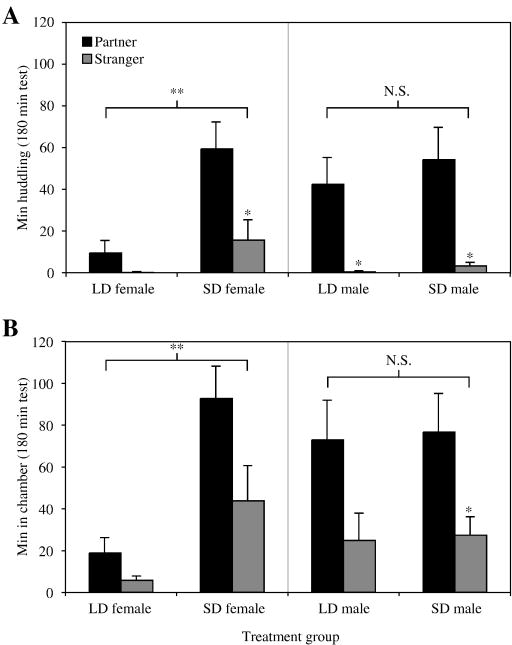
 ) during a 3 h test. (B) Mean time focal voles spent in the same chamber as the partner or the stranger during a 3 h test. Asterisks above the grey bars denote significant within-group differences in time spent with partners versus strangers. Asterisks above the brackets denote significant differences in total huddling or chamber time between bracketed groups. Males in both long and short day lengths exhibited significant partner preferences, and male behavior did not differ between day lengths although SD males were somewhat more likely than LD males to huddle with strangers (p < 0.06). n = 10/group, *: p < 0.05, **: p < 0.01, N.S.: not significant.
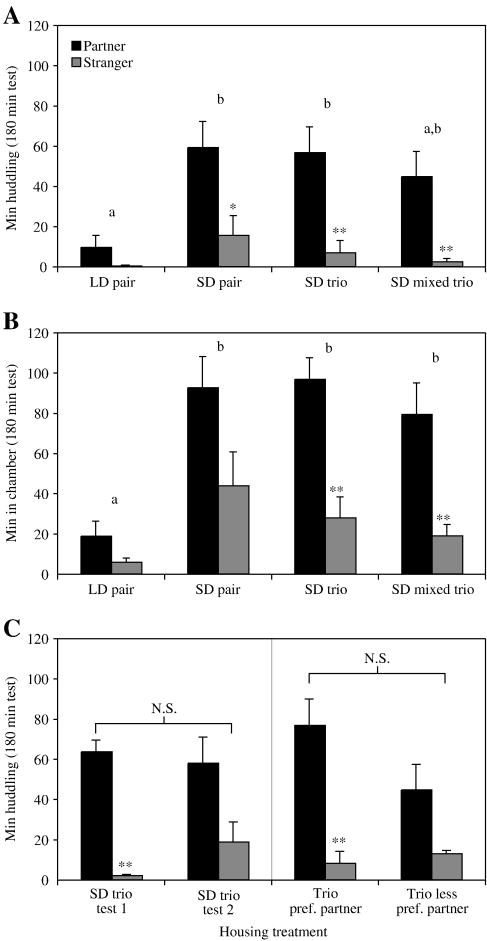 ) during a 3 h test. Focal voles from both same-litter and mixed-litter trios displayed significant partner preferences for a randomly selected cage-mate. (B) Mean time focal females spent in the same chamber as the partner or the stranger during a 3 h test. Time spent in occupied chambers by voles of both trio types was indistinguishable from the behavior of SD pairs, and significantly different from LD pairs. (C) Focal voles from 7 trios were tested one week after the initial test (test 1) but with the second cage mate (test 2). The left panel displays huddling data from these voles in tests 1 and 2. Total huddling and partner specific huddling did not differ between tests 1 and 2, although voles displayed a non-significant tendency to huddle with the stranger more during the second test (p = 0.19). The right panel displays the same 14 tests divided into groups based on whether the test was the one in which a given focal vole huddled with its partner more (Trio pref. partner) or less (Trio less pref. partner) than in the other test for that focal vole. Even after sorting of paired tests, no significant difference in preference for the two partners was detectable. Asterisks denote significant differences within groups (between partners and strangers). Letters denote differences between treatment groups — groups with the same letter are not statistically different (ANOVA followed by Tukey’s HSD). The letters N.S above a bracket indicate no significant differences in total huddling times between groups. *: p < 0.05, **: p < 0.01.
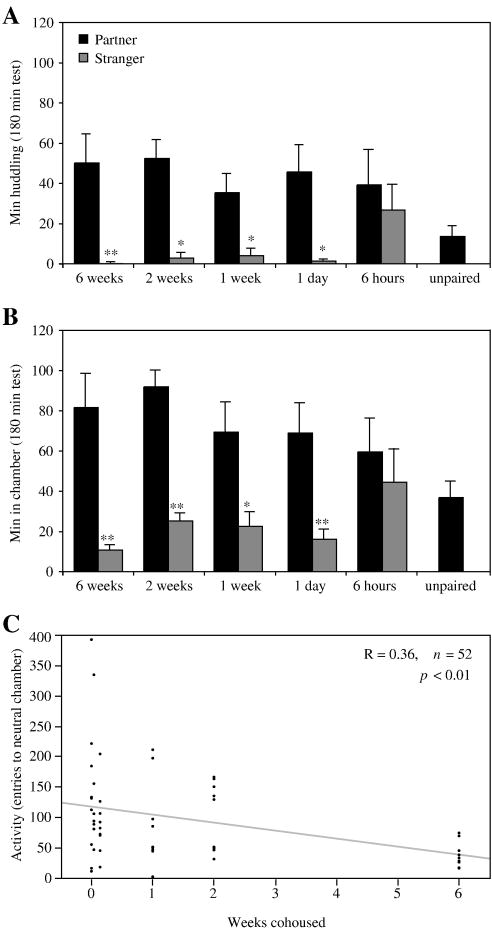 ) during a 3 h test. Unpaired voles were presented with two strangers and the mean huddling time is displayed. (B) Mean time focal voles spent in the same chamber as the partner or the stranger during a 3 h test. Asterisks above the grey bars denote significant differences within groups (between partners and strangers). All cohousing durations of 1 day or longer resulted in significant partner preference formation. Voles cohoused for 6 hours spent significantly more total time huddling than unpaired voles (p < 0.05, t-test). (C) Activity was quantified by the number of times the focal vole entered the central neutral empty chamber from either side chamber that contained a tethered vole. Focal voles were most active in tests after shorter cohousing durations (p < 0.01, linear regression). Activity continued to decrease with longer cohousing periods, despite the lack of change in overall huddling times. *: p < 0.05, **: p < 0.01.
References
-
- Boonstra R, Krebs CJ, Gaines MS, Johnson ML, Craine ITM. Natal philopatry and breeding systems in voles (Microtus spp) J Anim Ecol. 1987;56:655–673.
-
- Getz LL. Social structure and aggressive behavior in a population of Microtus pennsylvanicus. J Mammal. 1972;53:310–317.
-
- Ophir AG, Phelps SM, Sorin AB, Wolff JO. Social but not genetic monogamy is associated with greater breeding success in prairie voles. Anim Behav. 2008;75:1143–1154.
-
- Madison DM. Space use and social structure in meadow voles, Microtus pennsylvanicus. Behav Ecol Sociobiol. 1980;7:65–71.
-
- Boonstra R, Xia X, Pavone L. Mating system of the meadow vole, Microtus pennsylvanicus. Behav Ecol. 1993;4:83–89.
Publication types
MeSH terms
Grants and funding
LinkOut - more resources
Full Text Sources
