. 2009 May 19;106(20):8157-62.
doi: 10.1073/pnas.0901931106. Epub 2009 May 6.

Proteomics analyses reveal the evolutionary conservation and divergence of N-terminal acetyltransferases from yeast and humans

Affiliations

Proteomics analyses reveal the evolutionary conservation and divergence of N-terminal acetyltransferases from yeast and humans

Thomas Arnesen et al. Proc Natl Acad Sci U S A. .

Abstract

N(alpha)-terminal acetylation is one of the most common protein modifications in eukaryotes. The COmbined FRActional DIagonal Chromatography (COFRADIC) proteomics technology that can be specifically used to isolate N-terminal peptides was used to determine the N-terminal acetylation status of 742 human and 379 yeast protein N termini, representing the largest eukaryotic dataset of N-terminal acetylation. The major N-terminal acetyltransferase (NAT), NatA, acts on subclasses of proteins with Ser-, Ala-, Thr-, Gly-, Cys- and Val- N termini. NatA is composed of subunits encoded by yARD1 and yNAT1 in yeast and hARD1 and hNAT1 in humans. A yeast ard1-Delta nat1-Delta strain was phenotypically complemented by hARD1 hNAT1, suggesting that yNatA and hNatA are similar. However, heterologous combinations, hARD1 yNAT1 and yARD1 hNAT1, were not functional in yeast, suggesting significant structural subunit differences between the species. Proteomics of a yeast ard1-Delta nat1-Delta strain expressing hNatA demonstrated that hNatA acts on nearly the same set of yeast proteins as yNatA, further revealing that NatA from humans and yeast have identical or nearly identical specificities. Nevertheless, all NatA substrates in yeast were only partially N-acetylated, whereas the corresponding NatA substrates in HeLa cells were mainly completely N-acetylated. Overall, we observed a higher proportion of N-terminally acetylated proteins in humans (84%) as compared with yeast (57%). N-acetylation occurred on approximately one-half of the human proteins with Met-Lys- termini, but did not occur on yeast proteins with such termini. Thus, although we revealed different N-acetylation patterns in yeast and humans, the major NAT, NatA, acetylates the same substrates in both species.


Conflict of interest statement

The authors declare no conflict of interest.

Figures
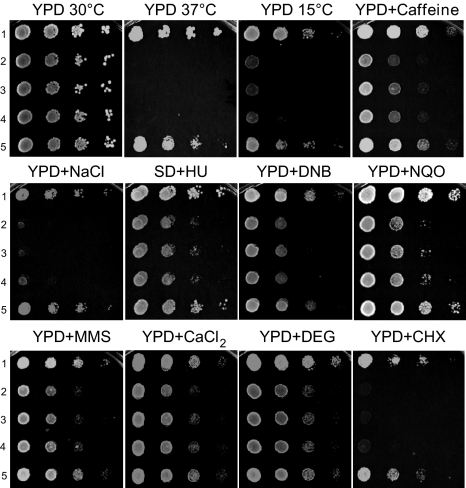
Fig. 1.
Fig. 1.
Complementation of the S. cerevisiae ard1nat1-Δ phenotypes by hARD1 and hNAT1. The following yeast strains were grown to early log phase and serial 1/10 dilutions containing the same number of cells were spotted on various media: 1, the normal strain (yNat); 2, the ard1nat1-Δ strain (yNatA-Δ); 3, the ard1nat1-Δ strain expressing hARD1 (y[hARD1]); 4, the ard1nat1-Δ strain expressing hNAT1 (y[hNAT1]); 5, the ard1nat1-Δ strain expressing hARD1 and hNAT1 (y[hNatA]). The plates containing the following media were incubated at 30 °C for 3 days unless indicated otherwise: YPD 15 °C, incubated for 6 days; YPD + caffeine, 0.1% caffeine; YPD + NaCl, 0.75 M NaCl; SD + HU, 75 mM hydroxyurea; YPD + DNB, 250 μM o-dinitrobenzene; YPD + NQO, 0.1 μg/mL 4-nitroquinoline oxide; YPD + MMS, 0.1% methyl methanesulfonate; YPD + CaCl2, 0.3 M CaCl2; YPD + DEG, 6.7% diethylenglycol; and YPD + CHX, 0.1 μg/mL cycloheximide.
Fig. 2.
Fig. 2.
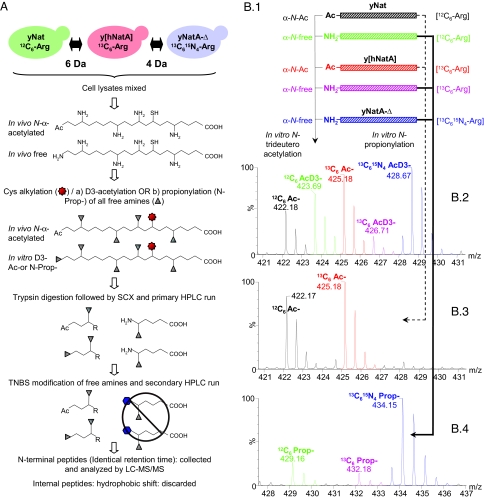
COFRADIC and mass spectrometry scheme for separating and identifying N-terminal peptides. (A) The experimental strategy used to determine N-terminal acetylation of proteins from normal yeast (yNat) or yeast expressing human NatA (y[hNatA]) by N-terminal COFRADIC is illustrated. After 2 protein modification steps (Cys alkylation and α- and ε-NH2 acetylation) and trypsin digestion, SCX enrichment (pH 3.0) for amino-blocked peptides is carried out. Two consecutive RP-HPLC runs are applied to isolate N termini after modification of trypsin-generated new α-NH2 groups with 2,4,6-trinitrobenzenesulfonic acid (indicated by a hexagon) between the 2 peptide separation steps. When combined with differential isotope labeling strategies, the exact origin of N termini can be determined. (B) Comparison of protein N-trideuteroacetylation and N-propionylation, and representative MS-spectra of isolated N-terminal peptides originating from yNatA and y[hNatA]. (1) A protein that contains in vivo free and N-acetylated termini (partially in vivo α-N-acetylated) can be modified in vitro by N-trideuteroacetylation or N-propionylation. (2) When trideuteroacetylation is used, the RP-HPLC elution profiles of the α-N-acetylated and α-N-trideuteroacetylated variants are indistinguishable and the peptide variants only segregate upon MS analysis by their 3-Da mass difference. (3 and 4) In contrast, when propionylation is used, the α-N-acetylated (3) and α-N-propionylated (4) variants segregate upon RP-HPLC, with the propionylated variant generally eluting at a later time because of increased hydrophobicity. MS spectra of doubly charged peptide ions originating from the in vivo acetylated (Ac) and/or free form of the α-N terminus from the vacuolar ATP synthase catalytic subunit A (P17255) are shown. The peptide was identified as 2AGAIENAR12. When trideutero-acetylation was applied at the protein level (2), this N terminus was found to be partially acetylated (upper MS-spectral) in the control yeast strain (43% α-N-acetylated) (12C6) and the y[hNatA] strain (82% α-N-acetylated) (13C6), whereas it was found completely free in the yNatA-Δ deficient strain (0% α-N-acetylated) (13C615N4 l-arginine). The theoretical % of α-N-acetylation was calculated by use of the MS-isotope pattern calculator (http://prospector.ucsf.edu). (3 and 4) Upon applying N-propionylation at the protein level, in vivo α-N-acetylated variants and free (in vitro α-N-propionylated) variants segregate during RP-HPLC separation. Here, in vivo acetylated (Ac) NatA substrate peptides appear as singletons in their 12C6 and 13C6 forms (3) and when partially in vivo α-N-acetylated their propionylated forms appear in all 3 setups analyzed (as shown in 4).

References

    1. Polevoda B, Sherman F. N-terminal acetyltransferases and sequence requirements for N-terminal acetylation of eukaryotic proteins. J Mol Biol. 2003;325:595–622. - PubMed
    1. Park EC, Szostak JW. ARD1 and NAT1 proteins form a complex that has N-terminal acetyltransferase activity. EMBO J. 1992;11:2087–2093. - PMC - PubMed
    1. Gautschi M, et al. The yeast Nα-acetyltransferase NatA is quantitatively anchored to the ribosome and interacts with nascent polypeptides. Mol Cell Biol. 2003;23:7403–7414. - PMC - PubMed
    1. Mullen JR, et al. Identification and characterization of genes and mutants for an N-terminal acetyltransferase from yeast. EMBO J. 1989;8:2067–2075. - PMC - PubMed
    1. Polevoda B, Norbeck J, Takakura H, Blomberg A, Sherman F. Identification and specificities of N-terminal acetyltransferases from Saccharomyces cerevisiae. EMBO J. 1999;18:6155–6168. - PMC - PubMed

Publication types