Comparative Study
. 2009 Aug;19(4):536-46.
doi: 10.1111/j.1600-0838.2009.00909.x. Epub 2009 Apr 13.

Potential roles for the small leucine-rich proteoglycans biglycan and fibromodulin in ectopic ossification of tendon induced by exercise and in modulating rotarod performance

Affiliations
Comparative Study

Potential roles for the small leucine-rich proteoglycans biglycan and fibromodulin in ectopic ossification of tendon induced by exercise and in modulating rotarod performance

T Kilts et al. Scand J Med Sci Sports. 2009 Aug.

Abstract

We present a detailed comparison of ectopic ossification (EO) found in tendons of biglycan (Bgn), fibromodulin (Fmod) single and double Bgn/Fmod-deficient (DKO) mice with aging. At 3 months, Fmod KO, Bgn KO and DKO displayed torn cruciate ligaments and EO in their quadriceps tendon, menisci and cruciate and patellar ligaments. The phenotype was the least severe in the Fmod KO, intermediate in the Bgn KO and the most severe in the DKO. This condition progressed with age in all three mouse strains and resulted in the development of large supernumerary sesmoid bones. To determine the role of exercise in the extent of EO, we subjected normal and DKO mice to a treadmill exercise 3 days a week for 4 weeks. In contrast to previous findings using more rigorous exercise regimes, the EO in moderately exercised DKO was decreased compared with unexercised DKO mice. Finally, DKO and Bgn KO mice tested using a rotarod showed a reduced ability to maintain their grip on a rotating cylinder compared with wild-type controls. In summary, we show (1) a detailed description of EO formed by Bgn, Fmod or combined depletion, (2) the role of exercise in modulating EO and (3) that Bgn and Fmod are critical in controlling motor function.


Figures
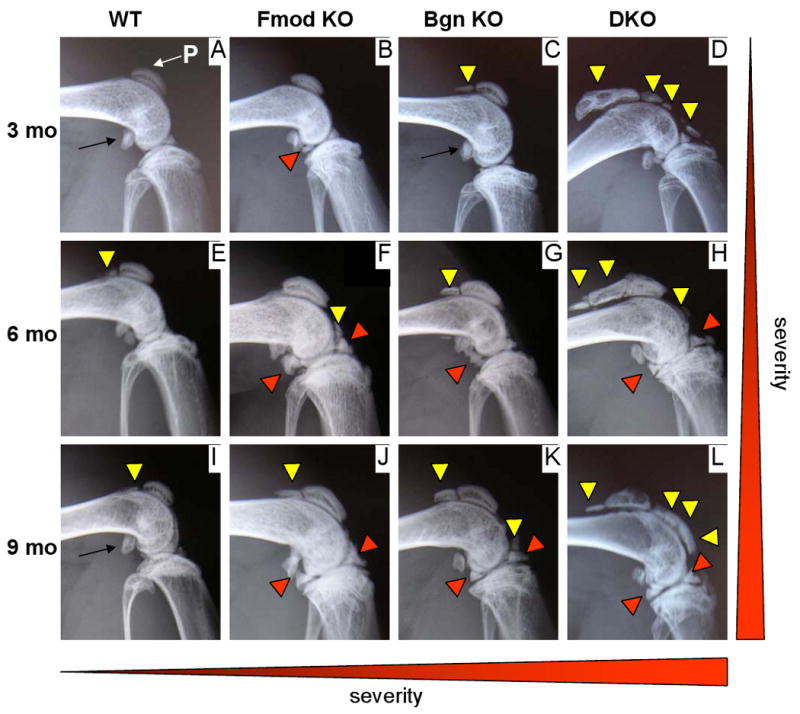
Fig. 1
Fig. 1
Radio-dense areas develop with age in biglycan and/or fibromodulin deficient knees. Sagittal radiographs from 3 (A-D), 6 (E-H) and 9 month-old (3 mo, 6 mo, 9 mo) WT, Fmod KO, Bgn KO and DKO. In comparison with WT, mutant mice display ectopic radio-dense areas along the patellar ligament and quadriceps tendons (yellow triangles). The radio-dense areas in the menisci are also larger (red triangles). The number and size of these radio-dense areas increase with age (vertical gradient on the right) and varies with the phenotype. At any age, they were more developed in the DKO knees than in both single KO knees and more developed in BgnKO knees than in Fmod KO knees (horizontal gradient at the bottom). Thin arrows point to the fabella, a sesamoid bone that in the mouse normally develops in the gastrocnemius tendon of the knee.
Fig. 2
Fig. 2
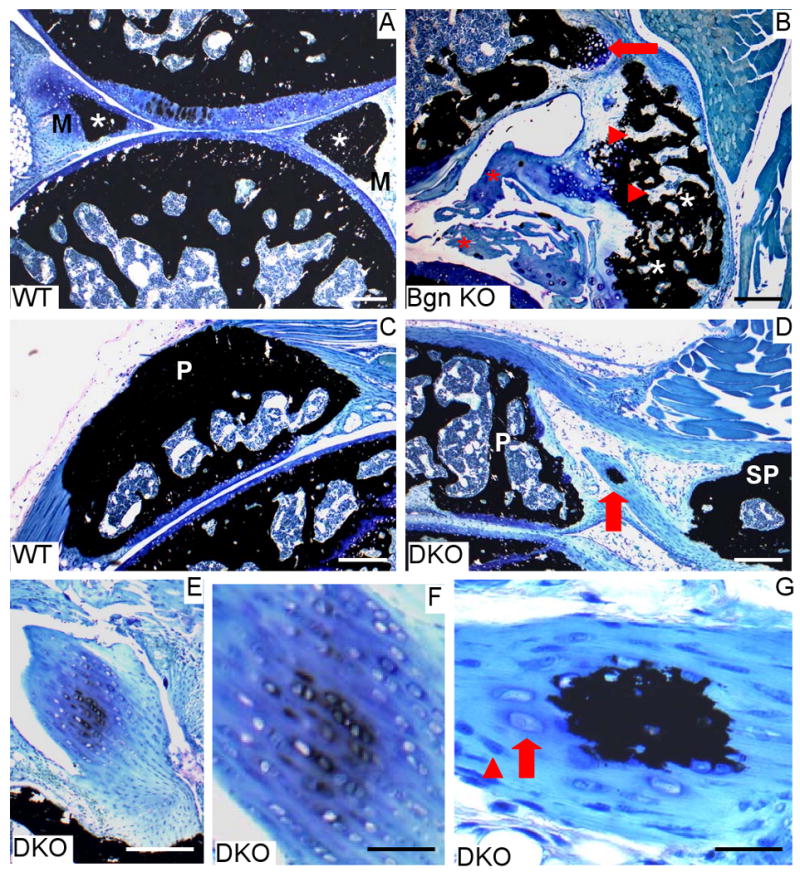
Ectopic ossification in three-month old biglycan single-deficient or biglycan/fibromodulin double-deficient knees. Knee sagittal histological sections from three month-old WT, Bgn KO and DKO. Von Kòssa staining with mineralized areas stained in black. (A) Knee from WT mouse. Note that the meniscus (M) is partly mineralized towards its most central part (asterisks). Bar= 100 μm. B) Knee from BGN-KO. A large ectopic bone with well-developed bone marrow area (triangles) is visible together with a tibial osteophyte in formation (arrow) and a damaged meniscus (asterisks). Bar= 100 μm. (C) Patella (P) in WT knee. Bar= 100 μm. (D) A large ectopic secondary patella (SP) is present along with the normal patella in this double-deficient knee. Note the presence of an early mineralization site in the tendon between the two patellae (arrow). Bar= 100 μm. (E) Cruciate ligament of double-deficient mice containing fibrocartilage undergoing mineralization. Bar= 100 μm. (F) Enlarged area of figure E. Bar= 30 μm. (G) Enlarged area of (D) depicting the early mineralization site in tendon. Note the presence of 2 morphologically distinct cell types: fibroblast-like (triangle) and chondrocyte-like (arrow). Bar= 15 μm.
Fig. 3
Fig. 3
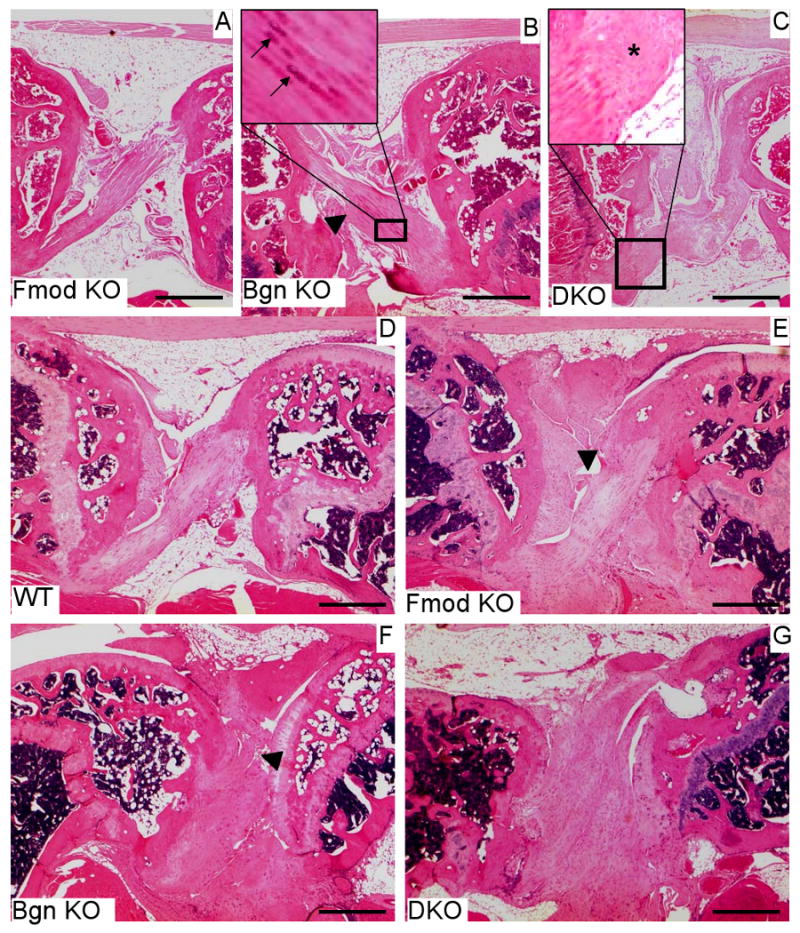
Impaired knee cruciate ligaments in 3 and 9-month old biglycan and/or fibromodulin deficient mice (A-C) Sagittal histological sections from 3 month-old knees. (A) Normal cruciate ligament in Fmod KO mice (B) Cruciate ligament in Bgn KO mice with local abnormal thickening (triangle). Some tenocytes display a chondrocyte-like phenotype (arrows in upper left panel). (C) Thickened cruciate ligament in double-deficient mice (DKO). Note the loss of the columnar arrangements of the tenocytes along the long tendon axis (asterisk in the upper left panel). (D-G) Knees from 9 month-old mice. (D) Cruciate ligament in WT mouse. (E) Slightly hypertrophic cruciate ligament in Fmod KO displaying a small partial severing (triangle). The columnar arrangement of the tenocytes along the long axis of the tendon is preserved. (F) Hypertrophic cruciate ligament in Bgn KO with almost complete separation and tearing (triangle). (G) Highly hypertrophic cruciate ligament in double deficient knee. All bars= 600 μm.
Fig. 4
Fig. 4
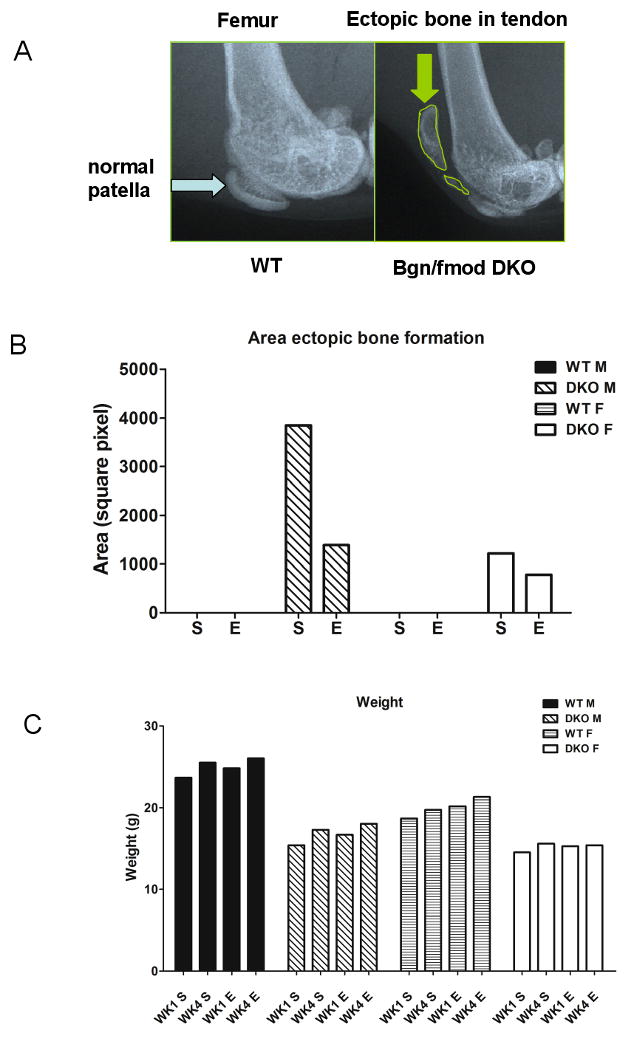
Ectopic ossification in normal and DKO mice subjected to moderate forced treadmill exercise. (A) X-ray of 3 month-old WT mice showing normal patella (blue arrow) compared to DKO which had rampant ectopic ossification (EO). The area of ectopic ossifcation was traced (see green arrow) and quantitated using NIH image J. (B) The relative amount of ectopic ossification in male (M) and female (F) mice subjected to exercise (E) or not (S=static). Male mice had more EO compared to females but both had decreased ectopic ossification after the forced moderate treadmill exercise regime. (C) Weights of WT and DKO male (M) and female (F) mice at week 1 and week 4 before and after exercise
Fig. 5
Fig. 5
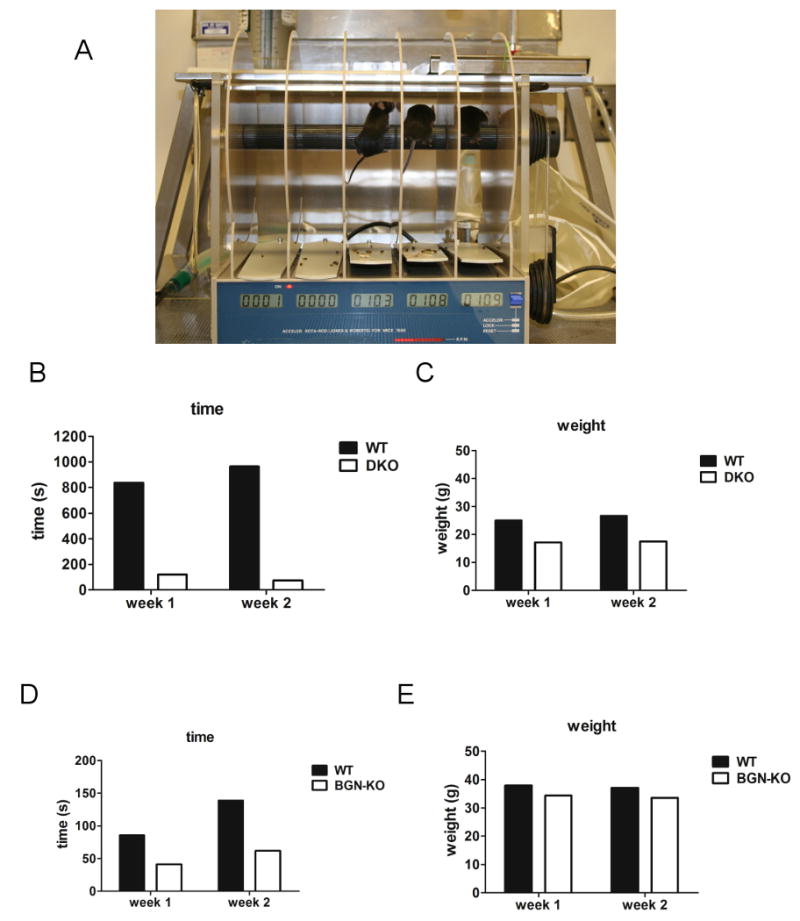
SLRP role in modulating motor skills as judged by rotarod performance. (A) WT, DKO and Bgn KO mice were tested for their ability to run on a rotating cylinder that accelerated its speed with time. Animals were tested at one and two weeks with similar results. Animals shown in (A) are WT mice. (B) DKO fell off the rotating rod sooner than the wild-type controls. The length of time was recorded in seconds (s). (C) Weights of the WT and DKO mice used in the rotarod experiment in grams (g). (D) Rotarod performance of WT and bgn KO mice. (E) Weights of WT and bgn KO mice at the time the rotarod measurements were taken. Note that older WT mice were much heavier than younger mice and fell off the rotarod quicker compared to younger WT mice.
Fig. 6
Fig. 6
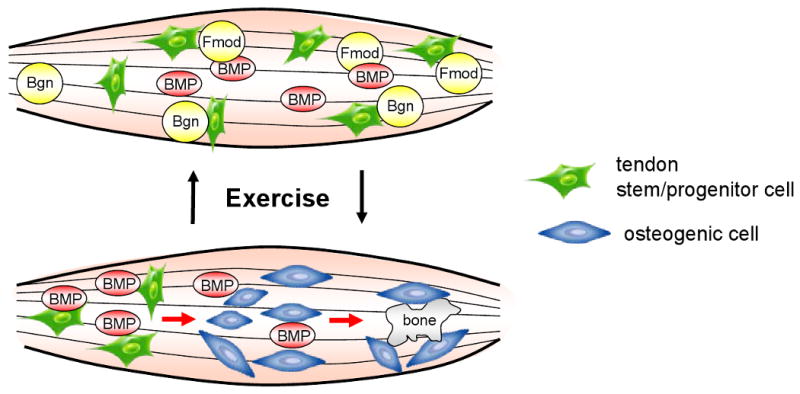
Proposed model showing the role of ECM proteoglycans bgn and fmod in controlling the fate of tendon stem/progenitor cells (TSPC). In this model Bgn and Fmod bind to growth factors such as BMP. This growth factor binding is lost when bgn or fmod is depleted and can affect the differentiation fate of TSPC by stimulating the BMP signalling pathway. In this model, the increased BMP activity causes TSPC to differentiate into osteoblasts and form bone. The normal ECM-rich niche controls this BMP activity so that TSPC can differentiate into tenocytes that form tendon. Forced treadmill exercise can either increase or decrease the differentiation of TSPC towards bone or tendon in a mechanism depending on the exercise regime.

References

    1. Ameye L, Aria D, Jepsen K, Oldberg A, Xu T, Young MF. Abnormal collagen fibrils in tendons of biglycan/fibromodulin-deficient mice lead to gait impairment, ectopic ossification, and osteoarthritis. Faseb J. 2002;16(7):673–680. - PubMed
    1. Ameye L, Young MF. Mice deficient in small leucine-rich proteoglycans: novel in vivo models for osteoporosis, osteoarthritis, Ehlers-Danlos syndrome, muscular dystrophy, and corneal diseases. Glycobiology. 2002;12(9):107R–116R. - PubMed
    1. Bellahcene A, Castronovo V, Ogbureke KU, Fisher LW, Fedarko NS. Small integrin-binding ligand N-linked glycoproteins (SIBLINGs): multifunctional proteins in cancer. Nat Rev Cancer. 2008;8(3):212–226. - PMC - PubMed
    1. Bi Y, Ehirchiou D, Kilts TM, Inkson CA, Embree MC, Sonoyama W, Li L, Leet AI, Seo BM, Zhang L, Shi S, Young MF. Identification of tendon stem/progenitor cells and the role of the extracellular matrix in their niche. Nat Med. 2007;13(10):1219–1227. - PubMed
    1. Bi Y, Stuelten CH, Kilts T, Wadhwa S, Iozzo RV, Robey PG, Chen XD, Young MF. Extracellular matrix proteoglycans control the fate of bone marrow stromal cells. J Biol Chem. 2005;280(34):30481–30489. - PubMed

Publication types