


A phylogenetic study of Laeliinae (Orchidaceae) based on combined nuclear and plastid DNA sequences
- PMID: 19423551
- PMCID: PMC2720643
- DOI: 10.1093/aob/mcp101
A phylogenetic study of Laeliinae (Orchidaceae) based on combined nuclear and plastid DNA sequences
Abstract
Background and aims: Laeliinae are a neotropical orchid subtribe with approx. 1500 species in 50 genera. In this study, an attempt is made to assess generic alliances based on molecular phylogenetic analysis of DNA sequence data.
Methods: Six DNA datasets were gathered: plastid trnL intron, trnL-F spacer, matK gene and trnK introns upstream and dowstream from matK and nuclear ITS rDNA. Data were analysed with maximum parsimony (MP) and Bayesian analysis with mixed models (BA).
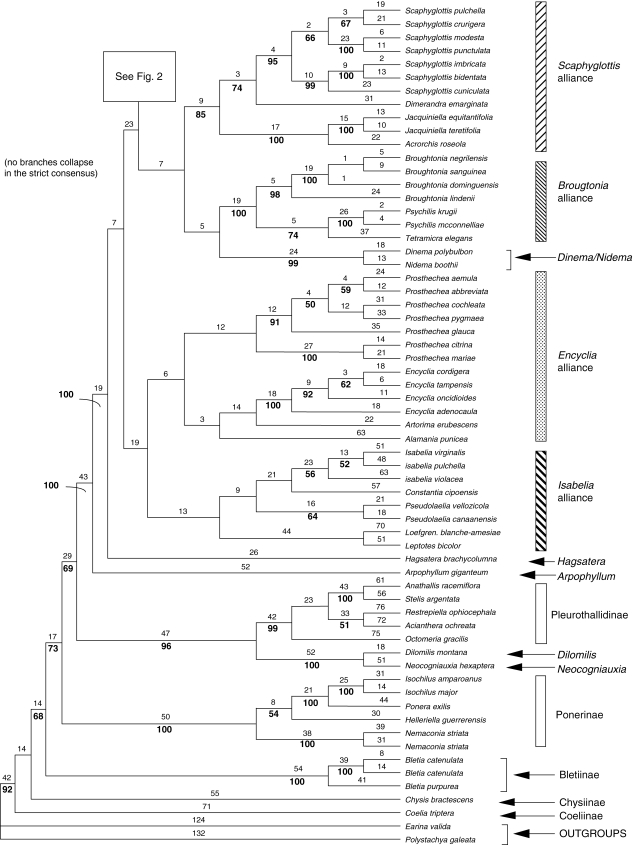
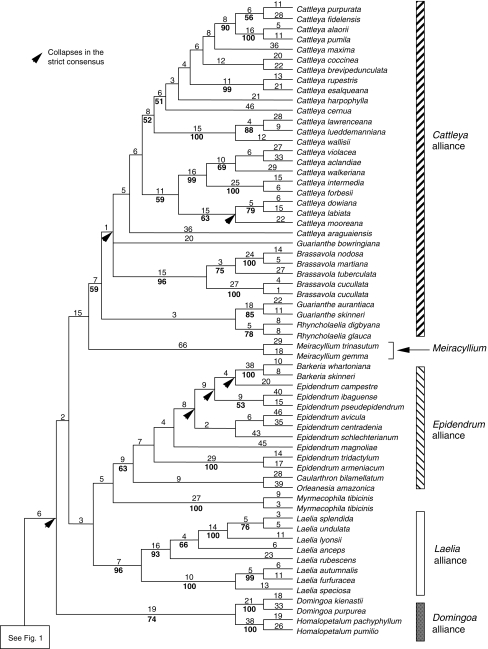
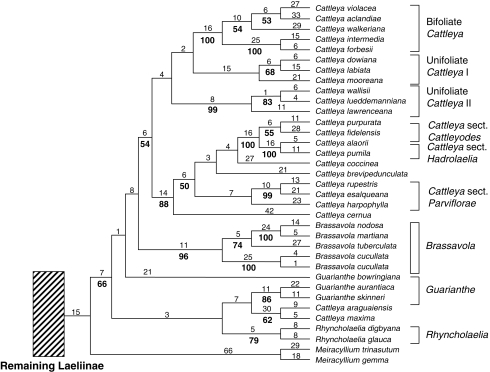
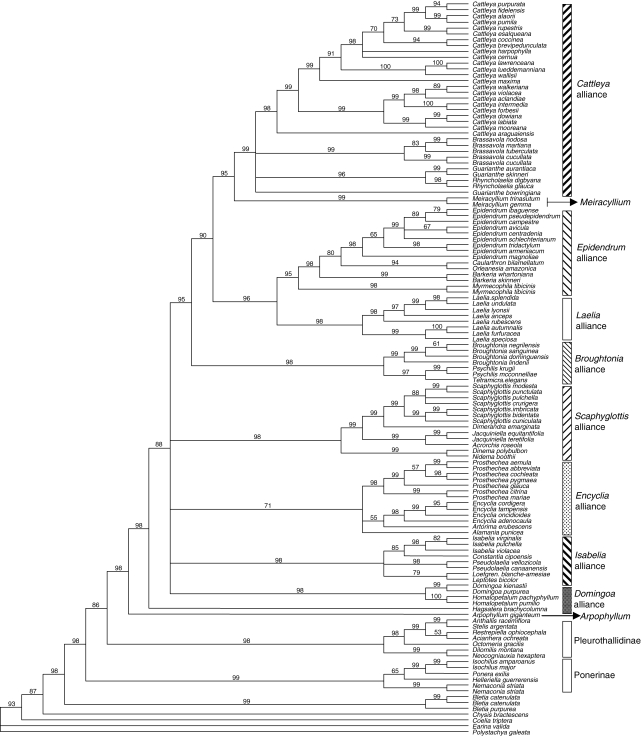
Key results: Although relationships between Laeliinae and outgroups are well supported, within the subtribe sequence variation is low considering the broad taxonomic range covered. Localized incongruence between the ITS and plastid trees was found. A combined tree followed the ITS trees more closely, but the levels of support obtained with MP were low. The Bayesian analysis recovered more well-supported nodes. The trees from combined MP and BA allowed eight generic alliances to be recognized within Laeliinae, all of which show trends in morphological characters but lack unambiguous synapomorphies.
Conclusions: By using combined plastid and nuclear DNA data in conjunction with mixed-models Bayesian inference, it is possible to delimit smaller groups within Laeliinae and discuss general patterns of pollination and hybridization compatibility. Furthermore, these small groups can now be used for further detailed studies to explain morphological evolution and diversification patterns within the subtribe.
Figures
References
-
- Adams H, Anderson E. A conspectus of hybridization in the Orchidaceae. Evolution. 1958;12:512–518.
-
- Azevedo CO, Borba EL, van den Berg C. Evidence of natural hybridization and introgression in Bulbophyllum involutum Borba, Semir & Barros and B. weddellii (Lindl.) Rchb.f. (Orchidaceae) im the Chapada Diamantina, Brazil, by using allozyme markers. Revista Brasileira de Botânica. 2006;29:415–421.
-
- Baker RK. Foliar anatomy of the Laeliinae (Orchidaceae) Washington University: St Louis; 1972. PhD Thesis.
-
- Bentham G. Notes on Orchideae. Journal of the Linnaean Society. 1881;18:281–360.
-
- van den Berg C, Chase MW. Nomenclatural notes on Laeliinae-I. Lindleyana. 2000;15:115–119.
Publication types
MeSH terms
Substances
LinkOut - more resources
Full Text Sources
Miscellaneous
