. 2009 Aug;155(Pt 8):2593-2602.
doi: 10.1099/mic.0.027284-0. Epub 2009 May 7.

Population structure of Streptococcus oralis

Affiliations

Population structure of Streptococcus oralis

Thuy Do et al. Microbiology (Reading). 2009 Aug.

Abstract

Streptococcus oralis is a member of the normal human oral microbiota, capable of opportunistic pathogenicity; like related oral streptococci, it exhibits appreciable phenotypic and genetic variation. A multilocus sequence typing (MLST) scheme for S. oralis was developed and the resultant data analysed to examine the population structure of the species. Analysis of 113 isolates, confirmed as belonging to the S. oralis/mitis group by 16S rRNA gene sequencing, characterized the population as highly diverse and undergoing inter- and intra-species recombination with a probable clonal complex structure. ClonalFrame analysis of these S. oralis isolates along with examples of Streptococcus pneumoniae, Streptococcus mitis and Streptococcus pseudopneumoniae grouped the named species into distinct, coherent populations and did not support the clustering of S. pseudopneumoniae with S. mitis as reported previously using distance-based methods. Analysis of the individual loci suggested that this discrepancy was due to the possible hybrid nature of S. pseudopneumoniae. The data are available on the public MLST website (http://pubmlst.org/soralis/).


Figures
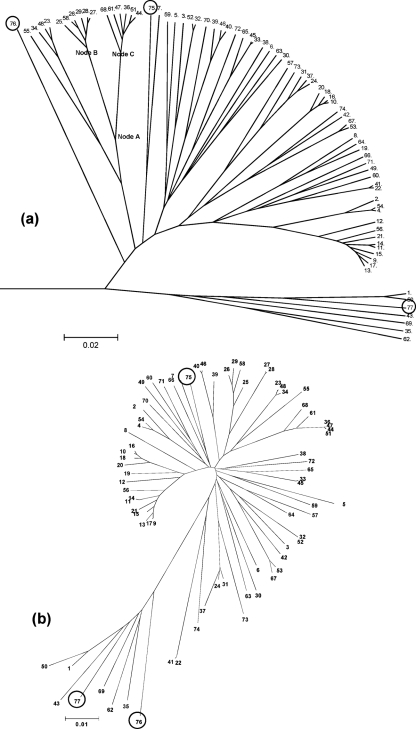
Fig. 1.
Fig. 1.
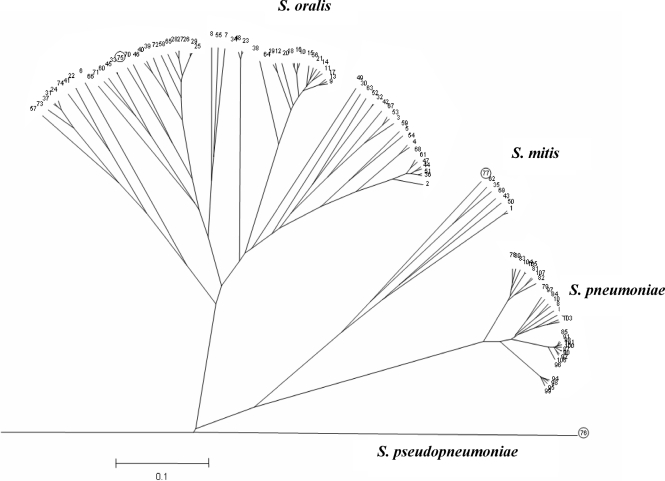
(a) Radial phylogenetic tree constructed with the ClonalFrame program, displaying the clonal relationship between the STs of the S. oralis/mitis population at seven loci. The dendrogram was constructed from the combination of six ClonalFrame runs (with a cut-off value of 0.5, as a majority rule consensus; scale is coalescent units). (b) NJ tree constructed in mega v4.0, using the MLST concatenated sequences, and showing the relationship between the STs. ST-75, ST-76 and ST-77 (circled in both trees) are the STs for the S. oralis, S. pseudopneumoniae and S. mitis type strains, respectively.
Fig. 2.
Fig. 2.
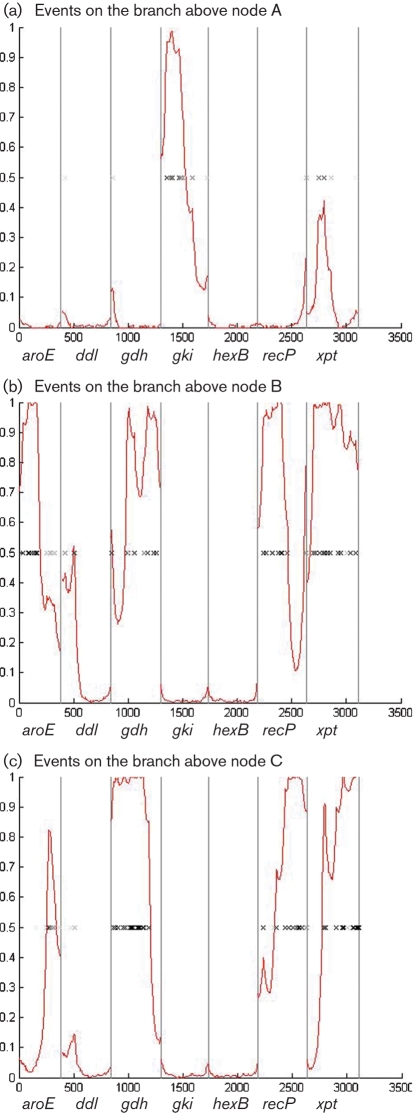
Graphical representations of the nucleotide differences (marked by crosses) in the concatenated sequences of aroE, ddl, gdh, gki, hexB, recP and xpt (as shown on the x-axis), above nodes A, B and C indicated in Fig. 1. The red lines indicate the probability that a nucleotide change has resulted from recombination, based on the clustering of changes.
Fig. 3.
Fig. 3.
Radial phylogenetic tree constructed with the ClonalFrame program for the five loci of the S. oralis and S. mitis STs and the 30 S. pneumoniae STs from http://spneumoniae.mlst.net/. ST-75, ST-76 and ST-77 (circled) are the STs for the S. oralis, S. pseudopneumoniae and S. mitis type strains, respectively. The dendrogram was constructed from the combination of six ClonalFrame runs (with a cut-off value of 0.5, as a majority-rule consensus). Scale is coalescent units.
Fig. 4.
Fig. 4.
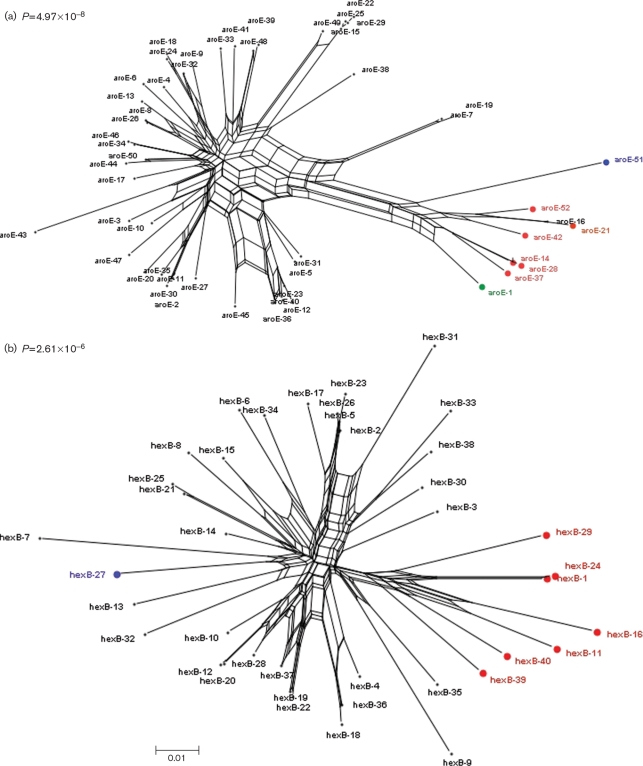
NeighborNet graphs of STs for the aroE (a) and hexB (b) loci, constructed in SplitsTree v4.0. The black-labelled STs are S. oralis loci, the blue label denotes S. pseudopneumoniae, the red labels denote the S. mitis loci and the green label corresponds to the one allele shared by both S. oralis and S. mitis.
Fig. 5.
Fig. 5.
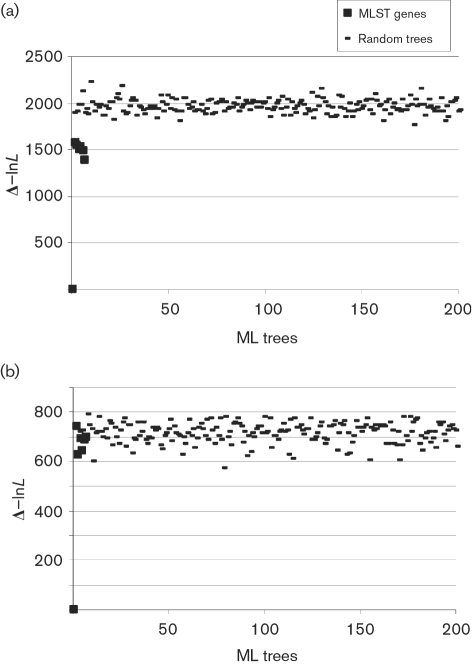
Congruence of the aroE ML tree with trees generated from other MLST loci and 200 random trees for S. oralis STs (a) and for selected STs (34, 26, 47, 75, 7, 59, 5, 3, 32, 70, 40, 72, 65, 33, 38, 6, 63, 30, 57, 73, 37, 18, 74, 42, 53, 8, 64, 19, 66, 71, 49, 60, 41, 54, 12, 11) as single representatives of the individual clusters identified in the ClonalFrame analysis (Fig. 1) (b). The same pattern was observed with the other loci (data not shown).

References

    1. Alam, S., Brailsford, S. R., Whiley, R. A. & Beighton, D. (1999). PCR-based methods for genotyping viridans group streptococci. J Clin Microbiol 37, 2772–2776. - PMC - PubMed
    1. Alam, S., Brailsford, S. R., Adams, S., Allison, C., Sheehy, E., Zoitopoulos, L., Kidd, E. A. & Beighton, D. (2000). Genotypic heterogeneity of Streptococcus oralis and distinct aciduric subpopulations in human dental plaque. Appl Environ Microbiol 66, 3330–3336. - PMC - PubMed
    1. Arbique, J. C., Poyart, C., Trieu-Cuot, P., Quesne, G., Carvalho Mda, G., Steigerwalt, A. G., Morey, R. E., Jackson, D., Davidson, R. J. & Facklam, R. R. (2004). Accuracy of phenotypic and genotypic testing for identification of Streptococcus pneumoniae and description of Streptococcus pseudopneumoniae sp. nov. J Clin Microbiol 42, 4686–4696. - PMC - PubMed
    1. Bek-Thomsen, M., Tettelin, H., Hance, I., Nelson, K. E. & Kilian, M. (2008). Population diversity and dynamics of Streptococcus mitis, Streptococcus oralis, and Streptococcus infantis in the upper respiratory tracts of adults, determined by a nonculture strategy. Infect Immun 76, 1889–1896. - PMC - PubMed
    1. Bishop, C. J., Aanensen, D. M., Jordan, G. E., Kilian, M., Hanage, W. P. & Spratt, B. G. (2009). Assigning strains to bacterial species via the internet. BMC Biol 7, 3. - PMC - PubMed

Publication types

LinkOut - more resources