


Cupping for treating pain: a systematic review
- PMID: 19423657
- PMCID: PMC3136528
- DOI: 10.1093/ecam/nep035
Cupping for treating pain: a systematic review
Abstract
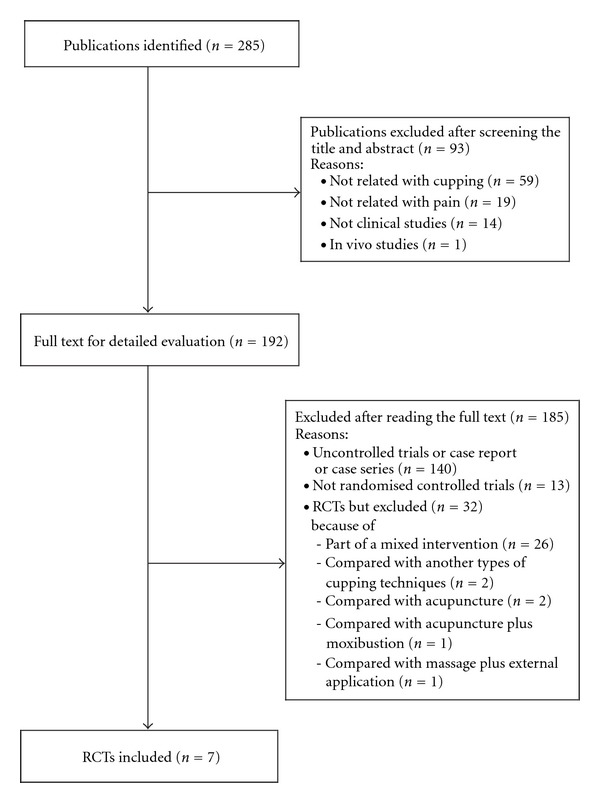
The objective of this study was to assess the evidence for or against the effectiveness of cupping as a treatment option for pain. Fourteen databases were searched. Randomized clinical trials (RCTs) testing cupping in patients with pain of any origin were considered. Trials using cupping with or without drawing blood were included, while trials comparing cupping with other treatments of unproven efficacy were excluded. Trials with cupping as concomitant treatment together with other treatments of unproven efficacy were excluded. Trials were also excluded if pain was not a central symptom of the condition. The selection of studies, data extraction and validation were performed independently by three reviewers. Seven RCTs met all the inclusion criteria. Two RCTs suggested significant pain reduction for cupping in low back pain compared with usual care (P < .01) and analgesia (P < .001). Another two RCTs also showed positive effects of cupping in cancer pain (P < .05) and trigeminal neuralgia (P < .01) compared with anticancer drugs and analgesics, respectively. Two RCTs reported favorable effects of cupping on pain in brachialgia compared with usual care (P = .03) or heat pad (P < .001). The other RCT failed to show superior effects of cupping on pain in herpes zoster compared with anti-viral medication (P = .065). Currently there are few RCTs testing the effectiveness of cupping in the management of pain. Most of the existing trials are of poor quality. Therefore, more rigorous studies are required before the effectiveness of cupping for the treatment of pain can be determined.
Figures
References
-
- Astin JA. Why patients use alternative medicine: results of a national study. Journal of the American Medical Association. 1998;279(19):1548–1553. - PubMed
-
- Chirali IZ. Cupping Therapy. Philadelphia, Pa, USA: Elservier; 2007.
-
- Yoo SS, Tausk F. Cupping: East meets West. International Journal of Dermatology. 2004;43(9):664–665. - PubMed
-
- Kwon YD, Cho HJ. Systematic review of cupping including bloodletting therapy for musculoskeletal diseases in Korea. Korean Journal of Oriental Physiology & Pathology. 2007;21:789–793.
LinkOut - more resources
Full Text Sources
Medical
Miscellaneous
