


Health extension workers improve tuberculosis case detection and treatment success in southern Ethiopia: a community randomized trial
- PMID: 19424460
- PMCID: PMC2678194
- DOI: 10.1371/journal.pone.0005443
Health extension workers improve tuberculosis case detection and treatment success in southern Ethiopia: a community randomized trial
Abstract
Background: One of the main strategies to control tuberculosis (TB) is to find and treat people with active disease. Unfortunately, the case detection rates remain low in many countries. Thus, we need interventions to find and treat sufficient number of patients to control TB. We investigated whether involving health extension workers (HEWs: trained community health workers) in TB control improved smear-positive case detection and treatment success rates in southern Ethiopia.
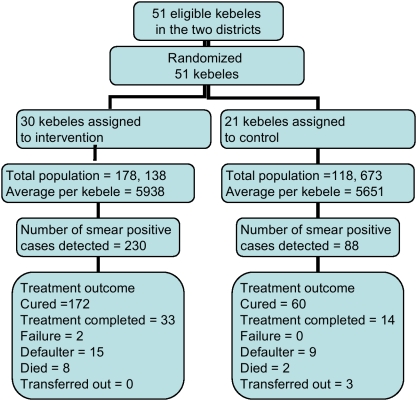
Methodology/principal finding: We carried out a community-randomized trial in southern Ethiopia from September 2006 to April 2008. Fifty-one kebeles (with a total population of 296, 811) were randomly allocated to intervention and control groups. We trained HEWs in the intervention kebeles on how to identify suspects, collect sputum, and provide directly observed treatment. The HEWs in the intervention kebeles advised people with productive cough of 2 weeks or more duration to attend the health posts. Two hundred and thirty smear-positive patients were identified from the intervention and 88 patients from the control kebeles. The mean case detection rate was higher in the intervention than in the control kebeles (122.2% vs 69.4%, p<0.001). In addition, more females patients were identified in the intervention kebeles (149.0 vs 91.6, p<0.001). The mean treatment success rate was higher in the intervention than in the control kebeles (89.3% vs 83.1%, p = 0.012) and more for females patients (89.8% vs 81.3%, p = 0.05).
Conclusions/significance: The involvement of HEWs in sputum collection and treatment improved smear-positive case detection and treatment success rate, possibly because of an improved service access. This could be applied in settings with low health service coverage and a shortage of health workers.
Trial registration: ClinicalTrials.gov NCT00803322.
Conflict of interest statement
Figures
References
-
- Harries A, Maher Dermot, Graham Stephan. TB/HIV: A Clinical Manual. Geneva, Switzerland: WHO; 2004. p. 210.
-
- Subramani R, Radhakrishna S, Frieden TR, Kolappan C, Gopi PG, et al. Rapid decline in prevalence of pulmonary tuberculosis after DOTS implementation in a rural area of South. India Int J Tuberc Lung Dis. 2008;12:916–920(915). - PubMed
-
- Dye C, Watt CJ, Bleed DM, Williams BG. What is the limit to case detection under the DOTS strategy for tuberculosis control? Tuberculosis. 2003;83:35–43. - PubMed
-
- Murray CJ, Salomon JA. Expanding the WHO tuberculosis control strategy: rethinking the role of active case finding. Int J Tuberc Lung Dis. 1998;2:S9–S15. - PubMed
Publication types
MeSH terms
Associated data
LinkOut - more resources
Full Text Sources
Medical
Miscellaneous
