


Can serotonin transporter genotype predict craving in alcoholism?
- PMID: 19426172
- PMCID: PMC2747793
- DOI: 10.1111/j.1530-0277.2009.00962.x
Can serotonin transporter genotype predict craving in alcoholism?
Abstract
Background: We hypothesize that functional control of the serotonergic system is regulated in part by differential expression of the serotonin (5-HT) transporter (5-HTT). Alcohol-dependent individuals with the LL/LS genotype (L-carriers), compared with those with the SS genotype, have a lower 5-HT neurotransmission, which we hypothesize would be associated with higher craving for alcohol among L-carriers. We hypothesize further that acute peripheral depletion of tryptophan (5-HT's precursor), while further reducing 5-HT function, might decrease auto-inhibition of 5-HT neuronal firing, thereby increasing 5-HT neurotransmission transiently and lowering alcohol craving.
Methods: We tested these hypotheses by examining whether in 34 Hispanic alcohol-dependent individuals subjective and physiological cue craving for alcohol differed by genotype, age of onset of problem drinking, and tryptophan availability.
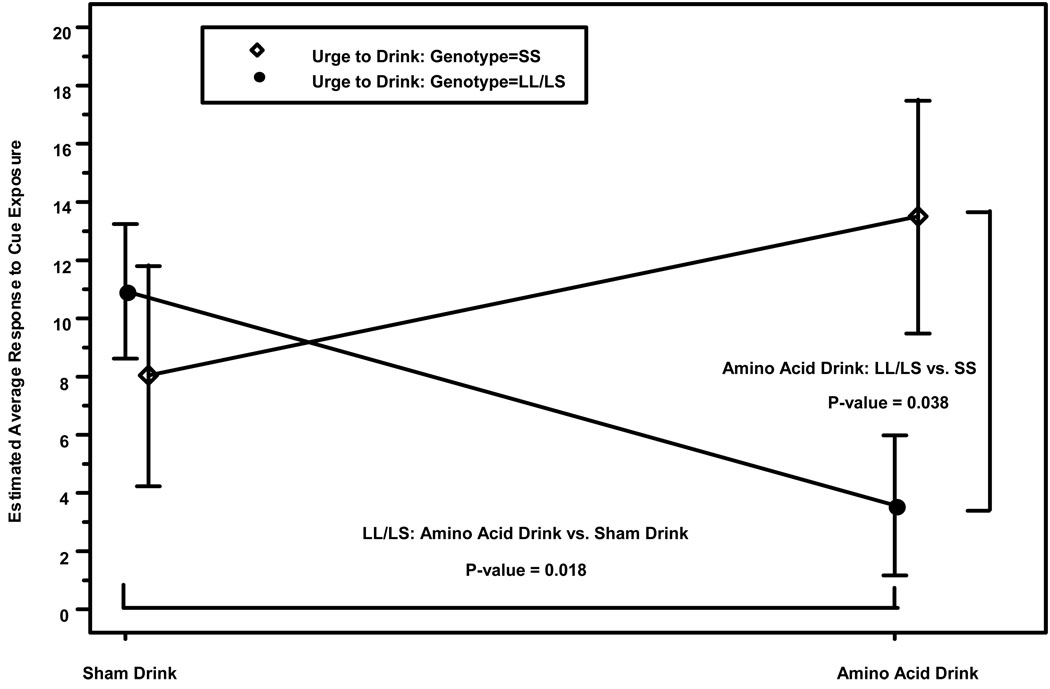
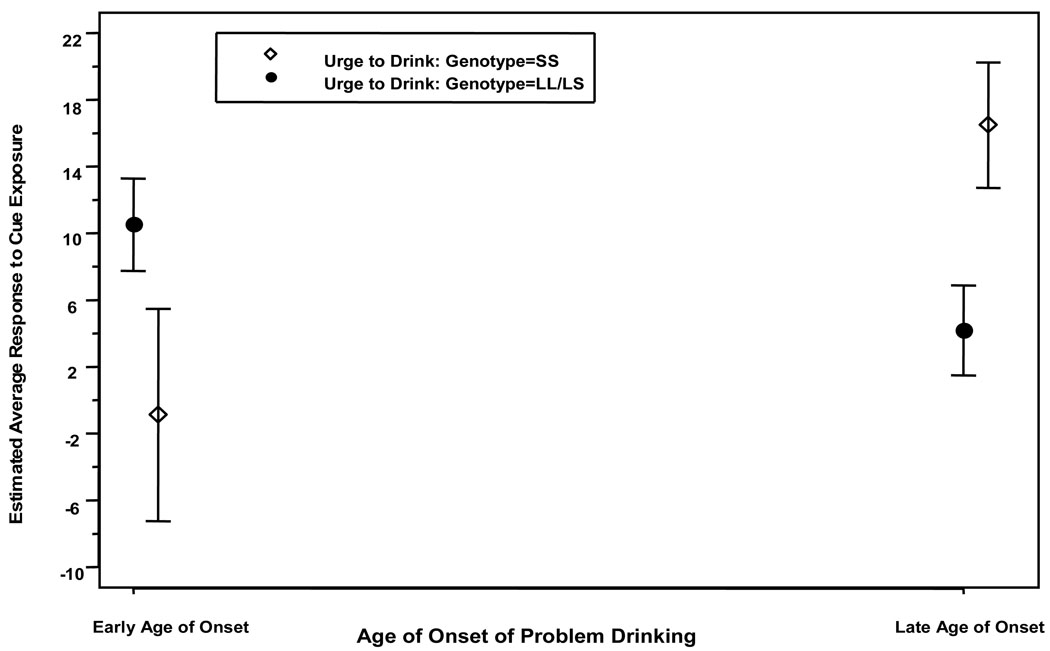
Results: On subjective "urge to drink" and "crave for a drink," we found a significant (p < 0.05) main effect of genotype and cue, as well as an interaction among genotype, age of onset of problem drinking, and tryptophan depletion. For the physiological measure of pulse, there was a main effect of genotype. L-carriers had higher craving than their SS counterparts, an effect that decreased under tryptophan depletion. While craving in L-carriers increased with an earlier age of onset of problem drinking, the opposite effect was seen in those with the SS genotype.
Conclusion: These results not only provide support for the hypothesis that alcoholics who are L-carriers have greater alcohol craving and possibly greater propensity for drinking but also propose that there is an important 5-HTT gene-by-environment interaction that alters cue craving response for alcohol.
Figures
References
-
- American Psychiatric Association. Diagnostic and Statistical Manual of Mental Disorders. 4th ed. Washington, DC: American Psychiatric Association; 1994.
-
- Babor TF, Dolinsky ZS, Meyer RE, Hesselbrock M, Hofmann M, Tennen H. Types of alcoholics: concurrent and predictive validity of some common classification schemes. Br J Addict. 1992;87:1415–1431. - PubMed
-
- Balldin J, Berggren U, Engel J, Eriksson M. Neuroendocrine evidence for reduced serotonergic neurotransmission during heavy drinking. Alcohol Clin Exp Res. 1994;18:822–825. - PubMed
-
- Benkelfat C, Ellenbogen MA, Dean P, Palmour RM, Young SN. Mood-lowering effect of tryptophan depletion. Enhanced susceptibility in young men at genetic risk for major affective disorders. Arch Gen Psychiatry. 1994;51:687–697. - PubMed
-
- Brown J, Babor TF, Litt MD, Kranzler HR. The type A/type B distinction: subtyping alcoholics according to indicators of vulnerability and severity. Ann N Y Acad Sci. 1994;708:23–33. - PubMed
Publication types
MeSH terms
Substances
Grants and funding
- K23 AA000329/AA/NIAAA NIH HHS/United States
- 7 U10 AA011776-10/AA/NIAAA NIH HHS/United States
- R01 AA013964/AA/NIAAA NIH HHS/United States
- 1 N01 AA001016-000/AA/NIAAA NIH HHS/United States
- 5 R01 AA013964-05/AA/NIAAA NIH HHS/United States
- R01 AA012964/AA/NIAAA NIH HHS/United States
- 5 R01 AA012964-06/AA/NIAAA NIH HHS/United States
- R01 AA010522/AA/NIAAA NIH HHS/United States
- 5 K23 AA000329-06/AA/NIAAA NIH HHS/United States
- 5 R01 AA014628-04/AA/NIAAA NIH HHS/United States
- R01 AA014628/AA/NIAAA NIH HHS/United States
- U10 AA011776/AA/NIAAA NIH HHS/United States
- 2 R01 AA010522-13/AA/NIAAA NIH HHS/United States
LinkOut - more resources
Full Text Sources
Other Literature Sources
