


Are immigrant enclaves healthy places to live? The Multi-ethnic Study of Atherosclerosis
- PMID: 19427731
- PMCID: PMC2750873
- DOI: 10.1016/j.socscimed.2009.04.010
Are immigrant enclaves healthy places to live? The Multi-ethnic Study of Atherosclerosis
Abstract
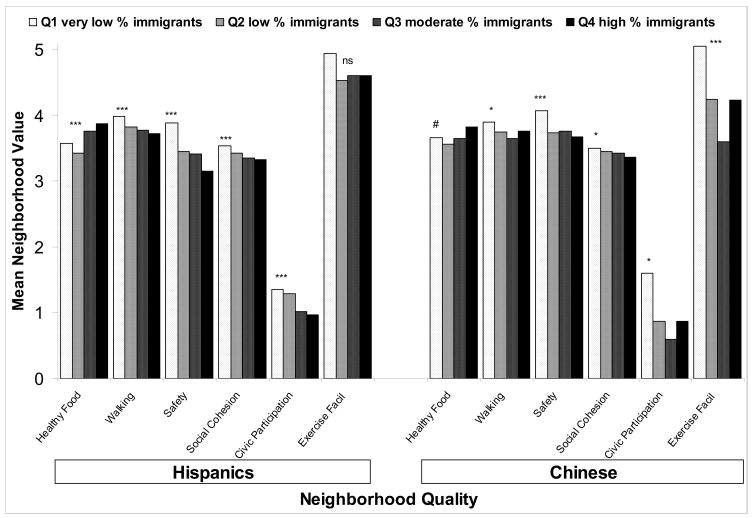
The growing size and changing composition of the foreign-born population in the USA highlights the importance of examining the health consequences of living in neighborhoods with higher proportions of immigrants. Using data from the Multi-ethnic Study of Atherosclerosis in four US cities, we examined whether neighborhood immigrant composition was associated with health behaviors (diet, physical activity) among Hispanic and Chinese Americans (n=1902). Secondarily we tested whether neighborhoods with high proportions of immigrants exhibited better or worse neighborhood quality, and whether these dimensions of neighborhood quality were associated with healthy behaviors. Neighborhood immigrant composition was defined based on the Census 2000 tract percent of foreign-born from Latin-America, and separately, percent foreign-born from China. After adjustment for age, gender, income, education, neighborhood poverty, and acculturation, living in a tract with a higher proportion of immigrants was associated with lower consumption of high-fat foods among Hispanics and Chinese, but with being less physically active among Hispanics. Residents in neighborhoods with higher proportions of immigrants reported better healthy food availability, but also worse walkability, fewer recreational exercise resources, worse safety, lower social cohesion, and lower neighborhood-based civic engagement. Associations of neighborhood immigrant composition with diet persisted after adjustment for reported neighborhood characteristics, and associations with physical activity were attenuated. Respondent-reported neighborhood healthy food availability, walkability, availability of exercise facilities and civic participation remained associated with behaviors after adjusting for immigrant composition and other covariates. Results show that living in an immigrant enclave is not monolithically beneficial and may have different associations with different health behaviors.
Figures
References
-
- Berrigan D, Dodd K, Troiano R, Reeve B, Ballard-Barbash R. Physical activity and acculturation among adult Hispanics in the United States. Res Q Exerc Sport. 2006;77(2):147–157. - PubMed
-
- Bild DE, Bluemke DA, Burke GL, Detrano R, Diez Roux AV, Folsom AR, Greenland P, Jacobs DR, Jr, Kronmal R, Liu K, Nelson JC, O’Leary D, Saad MF, Shea S, Szklo M, Tracy RP. Multi-Ethnic Study of Atherosclerosis: Objectives and Design. Am J Epidemiol. 2002;156(9):871–881. - PubMed
Publication types
MeSH terms
Grants and funding
- N01-HC-95162/HC/NHLBI NIH HHS/United States
- R01 HL071759/HL/NHLBI NIH HHS/United States
- N01 HC095169/HL/NHLBI NIH HHS/United States
- N01-HC-95163/HC/NHLBI NIH HHS/United States
- N01 HC095164/HC/NHLBI NIH HHS/United States
- N01-HC-95159/HC/NHLBI NIH HHS/United States
- N01 HC095159/HL/NHLBI NIH HHS/United States
- N01 HC095165/HC/NHLBI NIH HHS/United States
- N01-HC-95161/HC/NHLBI NIH HHS/United States
- N01 HC095163/HC/NHLBI NIH HHS/United States
- N01 HC095159/HC/NHLBI NIH HHS/United States
- P60 MD002249/MD/NIMHD NIH HHS/United States
- N01 HC095161/HC/NHLBI NIH HHS/United States
- N01-HC-95165/HC/NHLBI NIH HHS/United States
- N01 HC095160/HC/NHLBI NIH HHS/United States
- N01-HC-95169/HC/NHLBI NIH HHS/United States
- N01-HC-95164/HC/NHLBI NIH HHS/United States
- N01 HC095169/HC/NHLBI NIH HHS/United States
- N01-HC-95160/HC/NHLBI NIH HHS/United States
- N01 HC095162/HC/NHLBI NIH HHS/United States
- N01 HC095165/HL/NHLBI NIH HHS/United States
LinkOut - more resources
Full Text Sources
Medical
Molecular Biology Databases
