Comparative Study
. 2009 May 11:10:216.
doi: 10.1186/1471-2164-10-216.

Comparative genomics of Toll-like receptor signalling in five species

Affiliations
Comparative Study

Comparative genomics of Toll-like receptor signalling in five species

Oliver C Jann et al. BMC Genomics. .

Abstract

Background: Over the last decade, several studies have identified quantitative trait loci (QTL) affecting variation of immune related traits in mammals. Recent studies in humans and mice suggest that part of this variation may be caused by polymorphisms in genes involved in Toll-like receptor (TLR) signalling. In this project, we used a comparative approach to investigate the importance of TLR-related genes in comparison with other immunologically relevant genes for resistance traits in five species by associating their genomic location with previously published immune-related QTL regions.

Results: We report the genomic localisation of TLR1-10 and ten associated signalling molecules in sheep and pig using in-silico and/or radiation hybrid (RH) mapping techniques and compare their positions with their annotated homologues in the human, cattle and mouse whole genome sequences. We also report medium-density RH maps for porcine chromosomes 8 and 13. A comparative analysis of the positions of previously published relevant QTLs allowed the identification of homologous regions that are associated with similar health traits in several species and which contain TLR related and other immunologically relevant genes. Additional evidence was gathered by examining relevant gene expression and association studies.

Conclusion: This comparative genomic approach identified eight genes as potentially causative genes for variations of health related traits. These include susceptibility to clinical mastitis in dairy cattle, general disease resistance in sheep, cattle, humans and mice, and tolerance to protozoan infection in cattle and mice. Four TLR-related genes (TLR1, 6, MyD88, IRF3) appear to be the most likely candidate genes underlying QTL regions which control the resistance to the same or similar pathogens in several species. Further studies are required to investigate the potential role of polymorphisms within these genes.


Figures
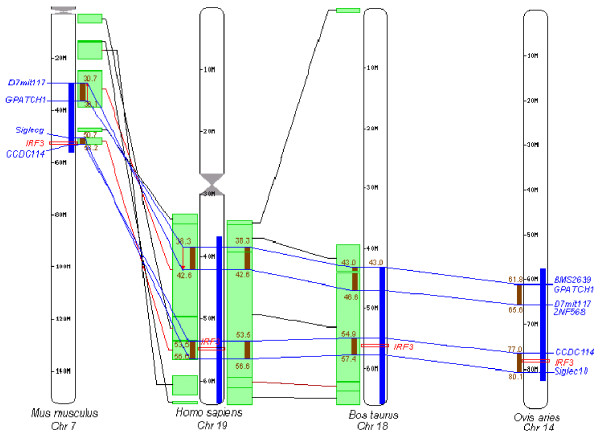
Figure 1
Figure 1
Position of IRF3 and overlap of QTLs in mouse, human, cattle and sheep. QTL positions are indicated by bold blue lines. Green boxes indicate the localisation of syntenic blocks conserved between species. Inversions of the gene order are indicated by red arrows. Markers located on the boundaries of the QTLs in mouse (susceptibility to Mycobaterium tuberculosis), human (Coxsackie virus resistance), cattle (susceptibility to clinical mastitis) and sheep (Nematodirus egg count) or the blocks of conserved synteny are indicated in blue. Under the assumption that the indicated QTLs are caused by the same loci, the significant region can be narrowed to two segments with a combined length of less than 7 Mb (brown line in syntenic blocks). Immunologically relevant genes located in these regions are listed in additional file 4: Immunologically relevant genes in regions of conserved synteny surrounding the TLR1 family cluster, MyD88 and IRF3.
Figure 2
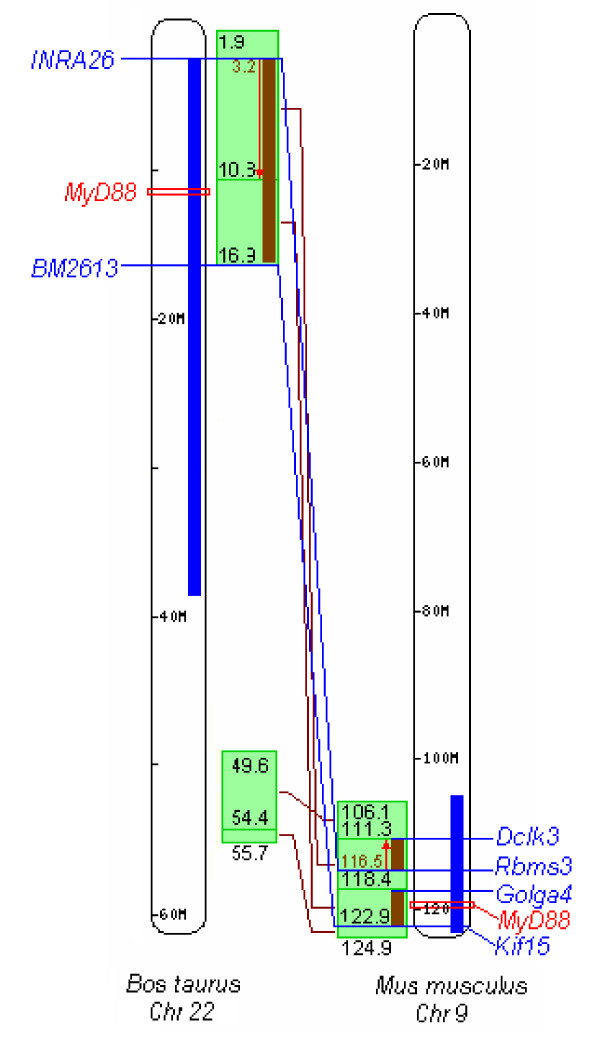
Figure 2
Position of MyD88 and overlap of QTLs in cattle and mouse. QTL positions are indicated by bold blue lines. Green boxes indicate the localisation of syntenic blocks conserved among species. Inversions of the gene order are indicated by red arrows. Loci located on the boundaries of the overlap between the QTL in cattle (Tryanosoma resistance) and in mice (Plasmodium chabaudi malaria) are indicated in blue. Under the assumption that the indicated QTLs are caused by the same loci, the significant region can be narrowed to segments with a combined length of approximately 10 Mb (brown line in syntenic blocks). Immunologically relevant genes located in these regions are listed in additional file 4: Immunologically relevant genes in regions of conserved synteny surrounding the TLR1 family cluster, MyD88 and IRF3.
Figure 3
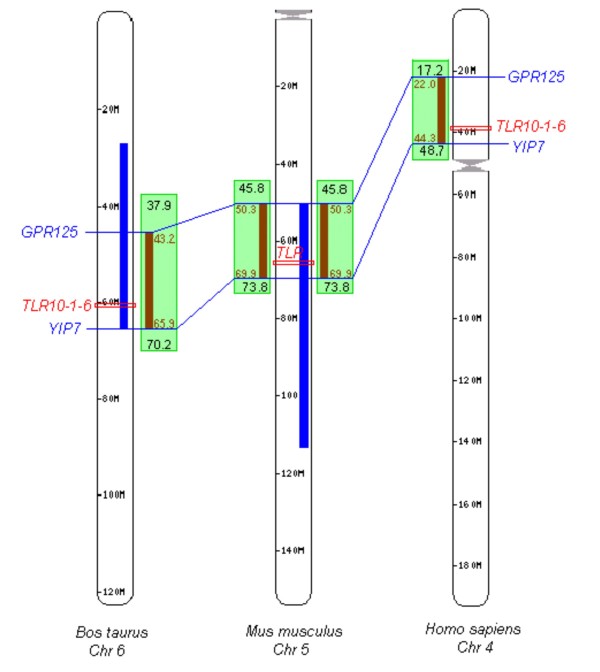
Figure 3
Position of the TLR1 family cluster and overlap of QTLs in cattle, mouse and human. QTL positions are indicated by bold blue lines. Green boxes indicate the localisation of the syntenic block conserved between species. Under the assumption that the indicated QTLs are caused by the same loci, the significant region can be narrowed to a segments with a length of approximately 20 Mb (brown line in syntenic blocks). Two loci (GPR125 and YIP7, in blue) limit the overlap of the QTL for susceptibility to clinical mastitis in cattle with the QTL for Listeria monocytogenes susceptibility in mice. Polymorphisms in human TLR6 (red, within the QTL overlap) have been associated with susceptibility to tuberculosis. Immunologically relevant genes located in this region are listed in additional file 4: Immunologically relevant genes in regions of conserved synteny surrounding the TLR1 family cluster, MyD88 and IRF3.

References

    1. Takeda K, Kaisho T, Akira S. Toll-like receptors. Annual Review of Immunology. 2003;21:335–376. doi: 10.1146/annurev.immunol.21.120601.141126. - DOI - PubMed
    1. Baker B, Zambryski P, Staskawicz B, Dinesh-Kumar SP. Signalling in plant-microbe interactions. Science. 1997;276:726–733. doi: 10.1126/science.276.5313.726. - DOI - PubMed
    1. Werling D, Jungi TW. TOLL-like receptors linking innate and adaptive immune response. Vet Immunol Immunopathol. 2003;91:1–12. doi: 10.1016/S0165-2427(02)00228-3. Review. - DOI - PubMed
    1. Zhang G, Ghosh S. Negative regulation of toll-like receptor-mediated signaling by Tollip. J Biol Chem. 2002;277:7059–7065. doi: 10.1074/jbc.M109537200. - DOI - PubMed
    1. Bannerman DD, Goldblum SE. Mechanisms of bacterial lipopolysaccharide-induced endothelial apoptosis. Am J Physiol Lung Cell Mol Physiol. 2003;284:L899–914. Review. - PubMed

Publication types

Substances

LinkOut - more resources