Editorial
. 2009 May 11:4:7.
doi: 10.1186/1750-9378-4-7.

The evolving definition of carcinogenic human papillomavirus

Affiliations
Editorial

The evolving definition of carcinogenic human papillomavirus

Philip E Castle. Infect Agent Cancer. .

Abstract

Thirteen human papillomavirus (HPV) genotypes have been judged to be carcinogenic or probably carcinogenic, and the cause of virtually all cervical cancer worldwide. Other HPV genotypes could possibly be involved. Although the inclusion of possibly carcinogenic HPV genotypes may hurt test specificity, it may indirectly increase the reassurance following a negative HPV test (i.e. the negative predictive value of an HPV test for cervical precancer and cancer). The future of cervical cancer screening in low-resource setting, however, may include once-in-a-lifetime, low-cost and rapid HPV testing. However, the tradeoff of more false positives for greater reassurance may not be acceptable if the local infrastructure cannot manage the screen positives. Now is the time for the community of scientists, doctors, and public health advocates to use the data presented at the 100th International Agency for Research on Cancer monograph meeting to rationally decide the target HPV genotypes for the next generation of HPV tests for use in high-resource and low-resource settings. The implications of including possibly HPV genotypes on HPV test performance, also for guidance on the use of these tests for cervical cancer prevention programs, are discussed.


Figures
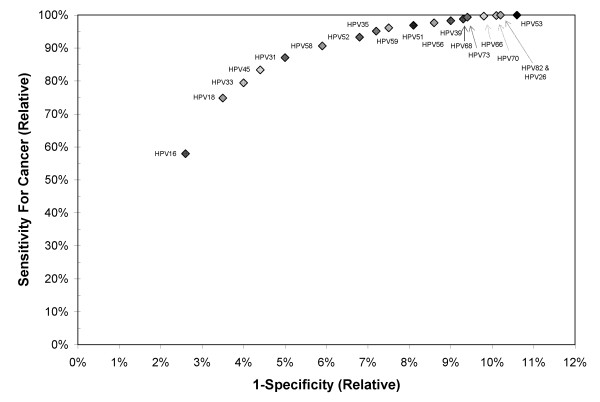
Figure 1
Figure 1
The impact of adding individual carcinogenic, probable carcinogenic, and possible carcinogenic human papillomavirus (HPV) genotypes to a clinical HPV assay. The impact of adding individual carcinogenic, probable carcinogenic, and possible carcinogenic human papillomavirus (HPV) genotypes to a clinical HPV assay was estimated using a receiver-operator curve (ROC)-like approach of stepwise adding individual HPV genotypes according to their prevalence, from most prevalent (HPV16) to least (HPV53), in cervical cancer [8,17]. Relative sensitivity (true positive fraction) was estimated based on those prevalences using the following assumptions: 1) HPV genotypes act independently such that cancers with multiple HPV genotypes detected were proportionally attributable to the HPV genotypes according to their overall prevalence; and 2) all cervical cancer is caused by HPV, and false negative results were independent of HPV genotype. Therefore, it was assumed that all cancers would have tested HPV positive with a perfectly sensitive test, and the relative contribution of each HPV genotype to cervical was a constant (although the absolute number increased). The relative false positive fraction, 1-Specificity, was estimated from the prevalence of individual HPV genotypes in the cytologic normal population, ignoring the overlap between HPV genotypes due to multi-HPV genotype infections (~25% of HPV positives).

References

    1. IARC Monographs on the Evaluation of Carcinogenic Risks to Humans. Lyon, France, IARC; 2007. Human Papillomaviruses. [90] Ref Type: Serial (Book, Monograph) - PMC - PubMed
    1. Cogliano V, Baan R, Straif K, Grosse Y, Secretan B, El Ghissassi F. Carcinogenicity of human papillomaviruses. Lancet Oncol. 2005;6:204. doi: 10.1016/S1470-2045(05)70086-3. - DOI - PubMed
    1. Bouvard V, Baan R, Straif K, Grosse Y, Secretan B, El GF, et al. A review of human carcinogens – Part B: biological agents. Lancet Oncol. 2009;10:321–322. doi: 10.1016/S1470-2045(09)70096-8. - DOI - PubMed
    1. Schiffman M, Herrero R, Desalle R, Hildesheim A, Wacholder S, Cecilia RA, et al. The carcinogenicity of human papillomavirus types reflects viral evolution. Virology. 2005;20:76–84. doi: 10.1016/j.virol.2005.04.002. - DOI - PubMed
    1. Schiffman M, Khan MJ, Solomon D, Herrero R, Wacholder S, Hildesheim A, et al. A study of the impact of adding HPV types to cervical cancer screening and triage tests. J Natl Cancer Inst. 2005;97:147–150. - PubMed

Publication types

LinkOut - more resources
