. 2009 May 11:10:38.
doi: 10.1186/1471-2121-10-38.

Beta-catenin and transforming growth factor beta have distinct roles regulating fibroblast cell motility and the induction of collagen lattice contraction

Affiliations

Beta-catenin and transforming growth factor beta have distinct roles regulating fibroblast cell motility and the induction of collagen lattice contraction

Raymond Poon et al. BMC Cell Biol. .

Abstract

Background: beta-catenin and transforming growth factor beta signaling are activated in fibroblasts during wound healing. Both signaling pathways positively regulate fibroblast proliferation during this reparative process, and the effect of transforming growth factor beta is partially mediated by beta-catenin. Other cellular processes, such as cell motility and the induction of extracellular matrix contraction, also play important roles during wound repair. We examined the function of beta-catenin and its interaction with transforming growth factor beta in cell motility and the induction of collagen lattice contraction.

Results: Floating three dimensional collagen lattices seeded with cells expressing conditional null and stabilized beta-catenin alleles, showed a modest negative relationship between beta-catenin level and the degree of lattice contraction. Transforming growth factor beta had a more dramatic effect, positively regulating lattice contraction. In contrast to the situation in the regulation of cell proliferation, this effect of transforming growth factor beta was not mediated by beta-catenin. Treating wild-type cells or primary human fibroblasts with dickkopf-1, which inhibits beta-catenin, or lithium, which stimulates beta-catenin produced similar results. Scratch wound assays and Boyden chamber motility studies using these same cells found that beta-catenin positively regulated cell motility, while transforming growth factor beta had little effect.

Conclusion: This data demonstrates the complexity of the interaction of various signaling pathways in the regulation of cell behavior during wound repair. Cell motility and the induction of collagen lattice contraction are not always coupled, and are likely regulated by different intracellular mechanisms. There is unlikely to be a single signaling pathway that acts as master regulator of fibroblast behavior in wound repair. beta-catenin plays dominant role regulating cell motility, while transforming growth factor beta plays a dominant role regulating the induction of collagen lattice contraction.


Figures
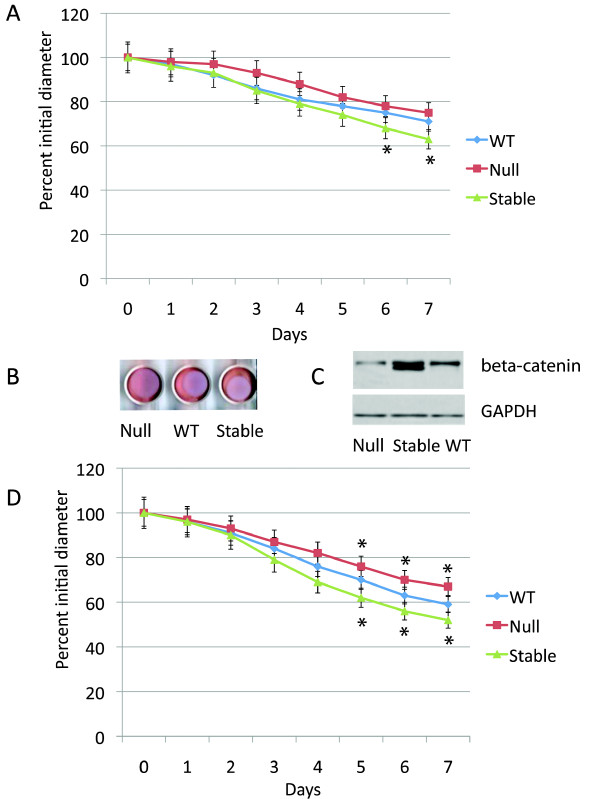
Figure 1
Figure 1
Collagen lattice contraction is negatively regulated by β-catenin. A. Means and 95% confidence intervals for collagen lattice mean diameter as observed over seven days are given for fibroblasts from mice expressing the wild type, null, or stabilized β-catenin alleles, all treated with the adenovirus expressing cre recombinase in the absence of serum. There is a statistically significant difference between the stabilized and wild type cells for the time points with an asterisk below the data points. B. Representative photograph of the collagen lattices at day five. C. Western analysis for β-catenin showing successful recombination in the fibroblasts in the lattices. D. Means and 95% confidence intervals for collagen lattice mean diameter as observed over seven days are given for fibroblasts from mice expressing the wild type, null, or stabilized β-catenin alleles, all treated with the adenovirus expressing cre recombinase in the presence of serum. There is a statistically significant difference between either the stabilized or null cells and wild type cells at the time points with an asterisk either above or below the data points.
Figure 2
Figure 2
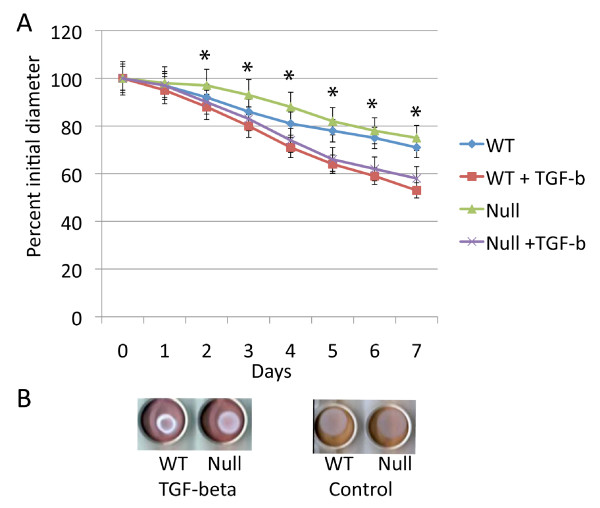
Transforming growth factor β induces collagen lattice contraction independent of β-catenin. A Means and 95% confidence intervals for collagen lattice mean diameter as observed over seven days for fibroblasts from mice expressing null β-catenin alleles or wild type littermates treated with the adenovirus expressing cre recombinase also treated with transforming growth factor β, or the carrier. There is a statistically significant difference between transforming growth factor β and carrier treatment for time points identified with an asterisk above the point, but no statistically significant difference between fibroblasts in which the β-catenin null allele was activated compared to treatment with transforming growth factor. Data is shown in the absence of serum. B. Representative photographs of the collagen lattices at day seven.
Figure 3
Figure 3
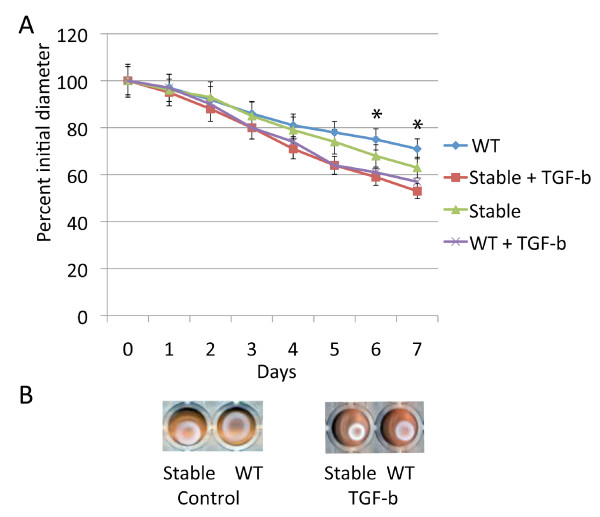
β-catenin stabilization has a minor effect on collagen lattice contraction compared to transforming growth factor β. A. Means and 95% confidence intervals for collagen lattice areas as observed over seven days for fibroblasts from mice expressing stabilized β-catenin alleles or wild type littermates treated with the adenovirus expressing cre recombinase, also treated with either transforming growth factor β, or carrier. There is a statistically significant difference between transforming growth factor β and carrier treatment for all time points after day three, and a statistically significant difference between fibroblasts in which the stabilized β-catenin allele was activated compared to fibroblasts from wild type mice for the time points with an asterisk above the data points. Data obtained using serum free media is shown. B. Representative photographs of the collagen lattices at day seven.
Figure 4
Figure 4
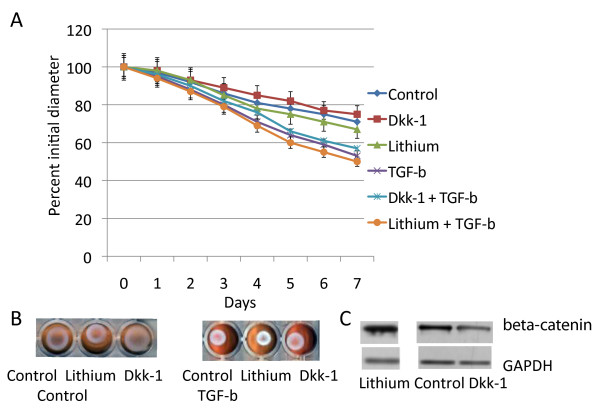
Dkk-1 and lithium have a minimal effect on collagen lattice contraction. A. Means and 95% confidence intervals for collagen lattice average diameters as observed over seven days are given for fibroblasts from mice expressing the wild type fibroblasts treated with either an adenovirus expressing Dkk-1 or a control adenovirus. Cultures were also treated with either transforming growth factor β or a carrier. There is a statistically significant difference for transforming growth factor β treatment compared to carrier after day three. For Dkk-1 and lithium treatment there is a minimal change in lattice contraction rate. B. Representative photographs of the collagen lattices at day seven. C. Western analysis for β-catenin showing how Dkk-1 and lithium regulates the protein level of β-catenin.
Figure 5
Figure 5
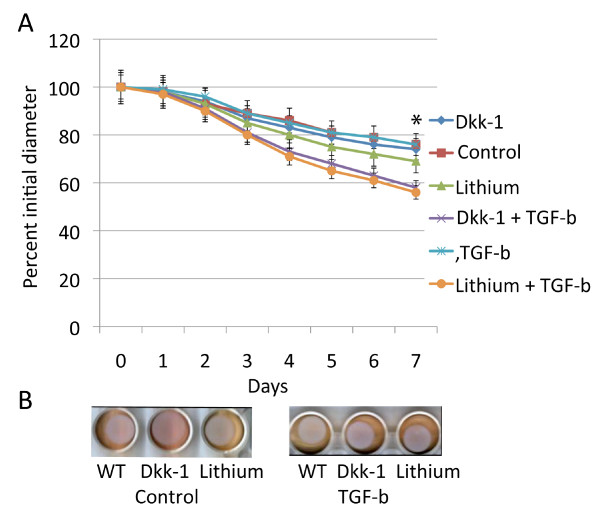
Human fibroblasts induce collagen lattice contraction in a similar manner as murine firoblasts. A. Means and 95% confidence intervals for collagen lattice areas as observed over seven days are given for primary cultures from human fibroblasts treated with lithium, Dkk-1, TGF-β, or a carrier. There is a statistically significant difference for TGF-β treatment compared to carrier after day three. For lithium treatment there is a statistically significant difference for the time points with an asterisk above the data points. B. Representative photographs of the collagen lattices at day five.
Figure 6
Figure 6
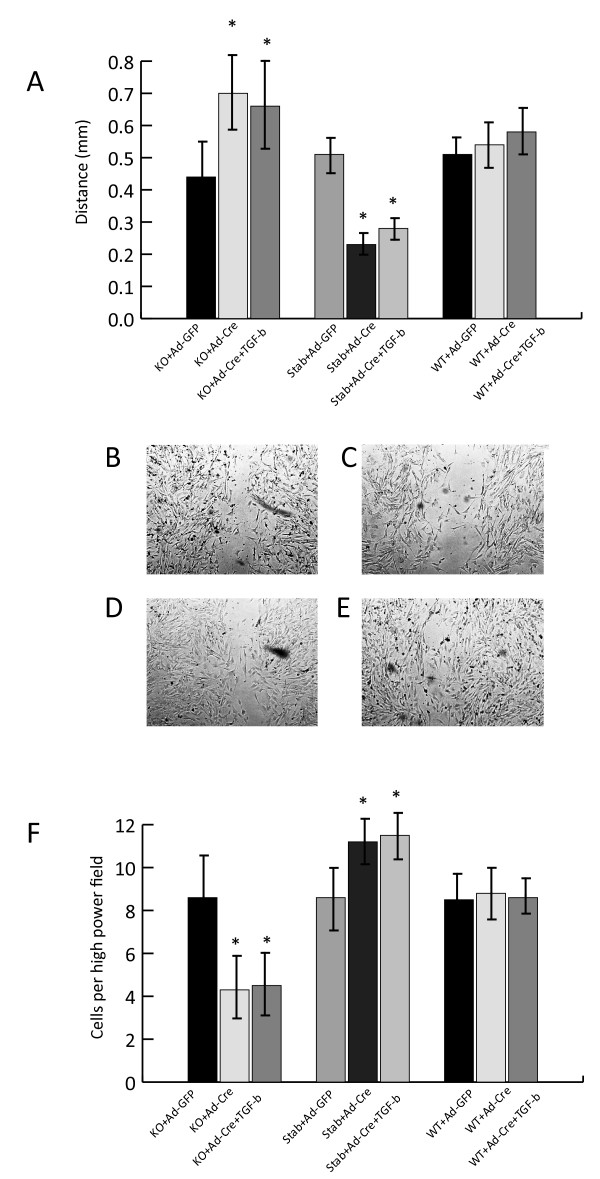
β-catenin positively regulates cell motility in the scratch assay, while transforming growth factor β has little effect. A. The means and 95% confidence intervals of the average distance between cells on either side of the scratch (mm). Statistically significant differences (p < 0.05) compared to the controls are indicated with an asterisk above the bar. B through E. Representative photomicrographs of the gap in the cell cultures. B is from wild type cells, C from cells expressing null β-catenin alleles, D from cells treated with transforming growth factor β, and E is from cells expressing stabilized β-catenin alleles. F. The means and 95% confidence intervals of the number of cells passing through the membrane in the Boyden chamber. Statistically significant differences (p < 0.05) compared to the controls are indicated with an asterisk above the bar.
Figure 7
Figure 7
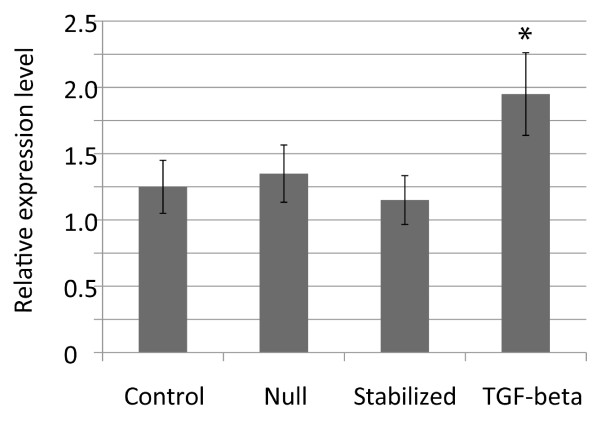
Transforming growth factor β, but not β-catenin regulates the expression of alpha smooth muscle actin. Mean and 95% confidence intervals for the relative expression of alpha smooth muscle actin. Treatment with transforming growth factor β resulted in a significantly different level of expression, while activation of conditional alleles of β-catenin had little effect. An asterix above the data point indicates a significant difference from the control value.

References

    1. Tomasek JJ, Gabbiani G, Hinz B, Chaponnier C, Brown RA. Myofibroblasts and mechano-regulation of connective tissue remodelling. Nat Rev Mol Cell Biol. 2002;3:349–363. doi: 10.1038/nrm809. - DOI - PubMed
    1. Shin D, Minn KW. The effect of myofibroblast on contracture of hypertrophic scar. Plast Reconstr Surg. 2004;113:633–640. doi: 10.1097/01.PRS.0000101530.33096.5B. - DOI - PubMed
    1. Dale PD, Sherratt JA, Maini PK. Role of fibroblast migration in collagen fiber formation during fetal and adult dermal wound healing. Bull Math Biol. 1997;59:1077–1100. doi: 10.1007/BF02460102. - DOI - PubMed
    1. Liang CC, Park AY, Guan JL. In vitro scratch assay: a convenient and inexpensive method for analysis of cell migration in vitro. Nat Protoc. 2007;2:329–333. doi: 10.1038/nprot.2007.30. - DOI - PubMed
    1. Oberringer M, Meins C, Bubel M, Pohlemann T. In vitro wounding: effects of hypoxia and transforming growth factor beta(1) on proliferation, migration and myofibroblastic differentiation in an endothelial cell-fibroblast co-culture model. J Mol Histol. 2008;39:37–47. doi: 10.1007/s10735-007-9124-3. - DOI - PubMed

Publication types

LinkOut - more resources