Preclinical evidence of Alzheimer changes: convergent cerebrospinal fluid biomarker and fluorodeoxyglucose positron emission tomography findings
- PMID: 19433663
- PMCID: PMC2718788
- DOI: 10.1001/archneurol.2009.59
Preclinical evidence of Alzheimer changes: convergent cerebrospinal fluid biomarker and fluorodeoxyglucose positron emission tomography findings
Abstract
Background: Alterations in cerebrospinal fluid (CSF) tau and beta-amyloid peptide 1-42 (Abeta(42)) levels and rates of cerebral glucose metabolism (CMRglu) on fluorodeoxyglucose positron emission tomography (FDG-PET) occur years before clinical symptoms of Alzheimer disease (AD) become manifest, but their relationship remains unclear.
Objective: To determine whether CSF AD biomarker levels and CMRglu in healthy individuals correlate in brain structures affected early in AD.
Design: Cohort study.
Setting: Alzheimer disease research center.
Participants: Twenty individuals without dementia aged 46 to 83 years.
Interventions: Lumbar CSF sampling and FDG-PET imaging of CMRglu. The CSF Abeta(42), tau, and tau phosphorylated at threonine 181 (ptau(181)) levels were measured using immunobead-based multiplex assays.
Main outcome measures: Correlations between CMRglu and CSF biomarker levels were analyzed via voxel-based and volume-of-interest approaches.
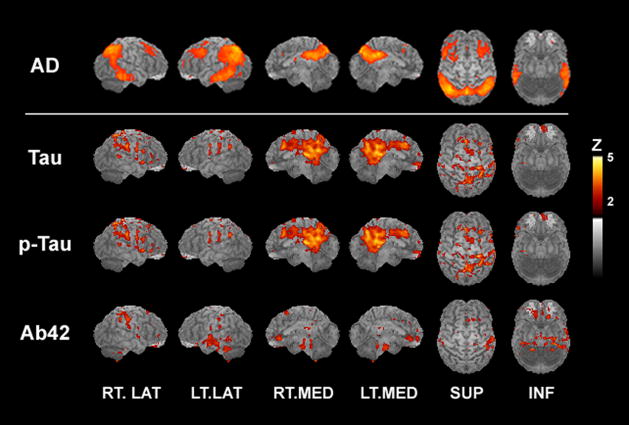
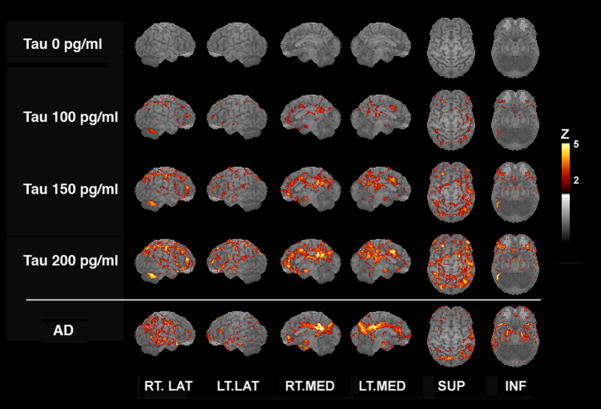
Results: Voxel-based analyses demonstrated significant negative correlations between CSF tau and ptau(181) levels and CMRglu in the posterior cingulate, precuneus, and parahippocampal regions. In contrast, a limited positive correlation was found between CSF Abeta(42) levels and CMRglu in the inferior temporal cortex. Volume-of-interest analyses confirmed negative associations between CSF tau and ptau(181) levels and CMRglu in the parietal and medial parietal lobes and a positive association between CSF Abeta(42) levels and CMRglu in the parahippocampal gyrus.
Conclusions: In healthy individuals, higher CSF tau and ptau(181) concentrations were associated with more severe hypometabolism in several brain regions affected very early in AD, whereas lower CSF Abeta(42) concentrations were associated with hypometabolism only in the medial temporal lobe. This suggests that early tau and Abeta abnormalities may be associated with subtle synaptic changes in brain regions vulnerable to AD. A longitudinal assessment of CSF and FDG-PET biomarkers is needed to determine whether these changes predict cognitive impairment and incipient AD.
Figures
References
-
- Braak H, Braak E. Neuropathological stageing of Alzheimer–related changes. Acta Neuropathol. 1991;82(4):239–259. Medline:1759558. - PubMed
-
- Gomez–Isla T, Hollister R, West H et al. Neuronal loss correlates with but exceeds neurofibrillary tangles in Alzheimer’s disease. Ann Neurol. 1997;41(1):17–24. Medline:9005861. - PubMed
-
- Hansson O, Zetterberg H, Buchhave P, Londos E, Blennow K, Minthon L. Association between CSF biomarkers and incipient Alzheimer’s disease in patients with mild cognitive impairment: a follow–up study. Lancet Neurol. 2006;5(3):228–234. Medline:16488378. - PubMed
-
- Peskind ER, Li G, Shofer J et al. Age and apolipoprotein E*4 allele effects on cerebrospinal fluid β– amyloid 42 in adults with normal cognition. Arch Neurol. 2006;63(7):936–939. Medline:16831961. - PubMed
Publication types
MeSH terms
Substances
Grants and funding
LinkOut - more resources
Full Text Sources
Medical