. 2009 May 26;106(21):8611-6.
doi: 10.1073/pnas.0903045106. Epub 2009 May 11.

Analysis of genomic diversity in Mexican Mestizo populations to develop genomic medicine in Mexico

Affiliations

Analysis of genomic diversity in Mexican Mestizo populations to develop genomic medicine in Mexico

Irma Silva-Zolezzi et al. Proc Natl Acad Sci U S A. .

Abstract

Mexico is developing the basis for genomic medicine to improve healthcare of its population. The extensive study of genetic diversity and linkage disequilibrium structure of different populations has made it possible to develop tagging and imputation strategies to comprehensively analyze common genetic variation in association studies of complex diseases. We assessed the benefit of a Mexican haplotype map to improve identification of genes related to common diseases in the Mexican population. We evaluated genetic diversity, linkage disequilibrium patterns, and extent of haplotype sharing using genomewide data from Mexican Mestizos from regions with different histories of admixture and particular population dynamics. Ancestry was evaluated by including 1 Mexican Amerindian group and data from the HapMap. Our results provide evidence of genetic differences between Mexican subpopulations that should be considered in the design and analysis of association studies of complex diseases. In addition, these results support the notion that a haplotype map of the Mexican Mestizo population can reduce the number of tag SNPs required to characterize common genetic variation in this population. This is one of the first genomewide genotyping efforts of a recently admixed population in Latin America.


Conflict of interest statement

The authors declare no conflict of interest.

Figures
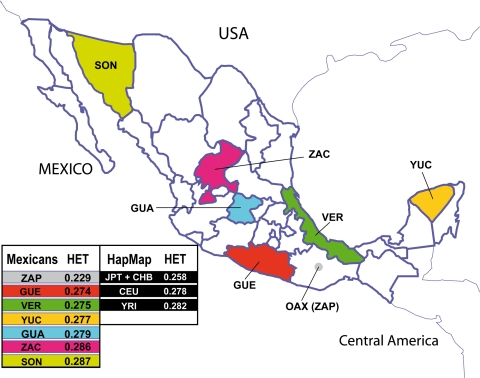
Fig. 1.
Fig. 1.
Genetic diversity measured by heterozygosity (HET) in Mexican and HapMap populations. Northern, central, central-Gulf, central-Pacific, and southern regions in Mexico were included. Average HET values are shown for Amerindian Zapotecos (ZAP), 6 Mexican Mestizo subpopulations (GUA, GUE, SON, VER, YUC, and ZAC), and HapMap populations (YRI, CEU, and JPT + CHB).
Fig. 2.
Fig. 2.
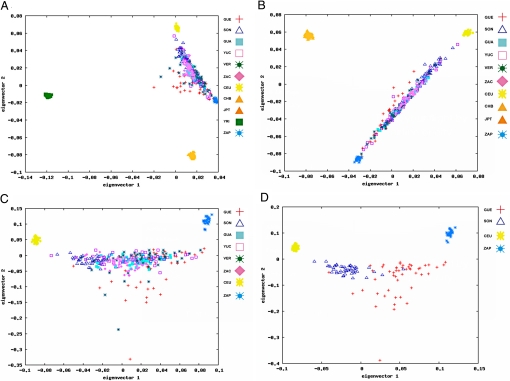
Principal components analysis. The 2 most informative eigenvectors were plotted in all cases. Four different data sets are presented: (A) all Mexican subpopulations, Mestizo (GUA, GUE, SON, VER, YUC, ZAC) and Amerindian (ZAP) populations, and HapMap populations (YRI, CEU and JPT + CHB); (B) all Mestizos, ZAP, CEU, and JPT + CHB; (C) all Mestizos, ZAP, and CEU; and (D) Mestizo subpopulations showing the largest difference in eigenvector 1 (SON and GUE), ZAP, and CEU.
Fig. 3.
Fig. 3.
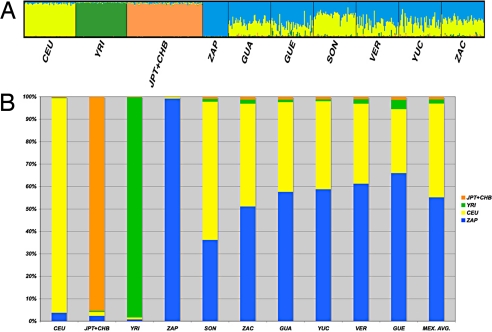
Population structure analysis using 1814 AIMs. (A) Individual ancestry proportions. (B) Average ancestral contributions in Mexican Mestizos. Significant differences in ancestry proportions were mainly observed for EUR and AMI contributions (Table S2).
Fig. 4.
Fig. 4.
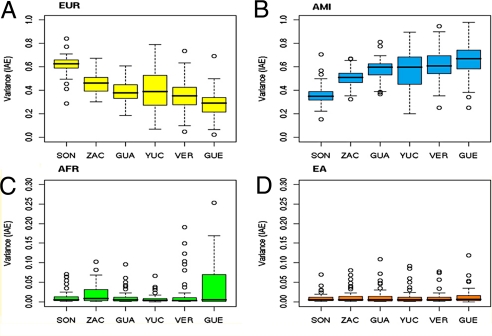
Boxplot distribution of ancestry estimates. Quantile distributions of ancestry proportions for 6 Mexican Mestizo subpopulations are shown: GUA, GUE, SON, VER, YUC, and ZAC. Panels correspond to parental populations: (A) EUR, (B) AMI, (C) AFR, and (D) EA. The plot represents the minimum and maximum values (whiskers), the first and third quartiles (box), and the median value (midline). Outliers are also displayed. The y-axis represents the variance of the individual ancestral estimate (STRUCTURE).
Fig. 5.
Fig. 5.
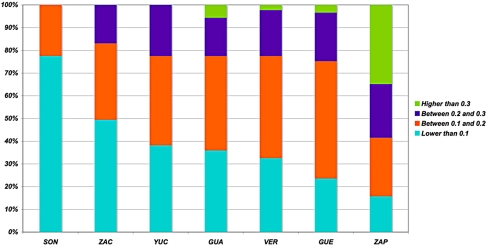
Frequency distribution of SNPs private to Mexicans compared to HapMap populations. Private SNPs have a MAF > 0.05 in at least 1 Mexican subpopulation, but are absent in all HapMap populations. Each bar represents the frequency distribution of all private SNPs (n = 89) for each Mexican subpopulation.

References

    1. Gonzalez Burchard E, et al. Latino populations: A unique opportunity for the study of race, genetics, and social environment in epidemiological research. Am J Public Health. 2005;95:2161–2168. - PMC - PubMed
    1. Wang S, et al. Geographic patterns of genome admixture in Latin American Mestizos. PLoS Genet. 2008;4:e1000037. - PMC - PubMed
    1. Jimenez-Sanchez G. Developing a platform for genomic medicine in Mexico. Science. 2003;300:295–296. - PubMed
    1. Hardy BJ, et al. The next steps for genomic medicine: Challenges and opportunities for the developing world. Nat Rev Genet. 2008;9(Suppl 1):S23–S27. - PubMed
    1. Seguin B, Hardy BJ, Singer PA, Daar AS. Genomics, public health and developing countries: The case of the Mexican National Institute of Genomic Medicine (INMEGEN) Nat Rev Genet. 2008;9(Suppl 1):S5–S9. - PubMed

Publication types

LinkOut - more resources