


A preliminary guideline for the assignment of methicillin-resistant Staphylococcus aureus to a Canadian pulsed-field gel electrophoresis epidemic type using spa typing
- PMID: 19436507
- PMCID: PMC2604773
- DOI: 10.1155/2008/754249
A preliminary guideline for the assignment of methicillin-resistant Staphylococcus aureus to a Canadian pulsed-field gel electrophoresis epidemic type using spa typing
Abstract
Background: Increasing rates of methicillin-resistant Staphylococcus aureus (MRSA) infections on a global scale is a major health concern. In Canada, there are 10 known epidemic types of MRSA as determined by pulsed-field gel electrophoresis (PFGE). Despite the excellent discriminatory power of PFGE, there are several disadvantages of using this technique, such as high degree of labour intensity and the inability to easily develop an MRSA typing database due to the subjective interpretation of results.
Objectives: The purpose of the present study was to determine whether spa typing, an established DNA sequence-based typing method, could be used as an alternative to PFGE for the typing of Canadian MRSA (CMRSA) epidemic isolates.
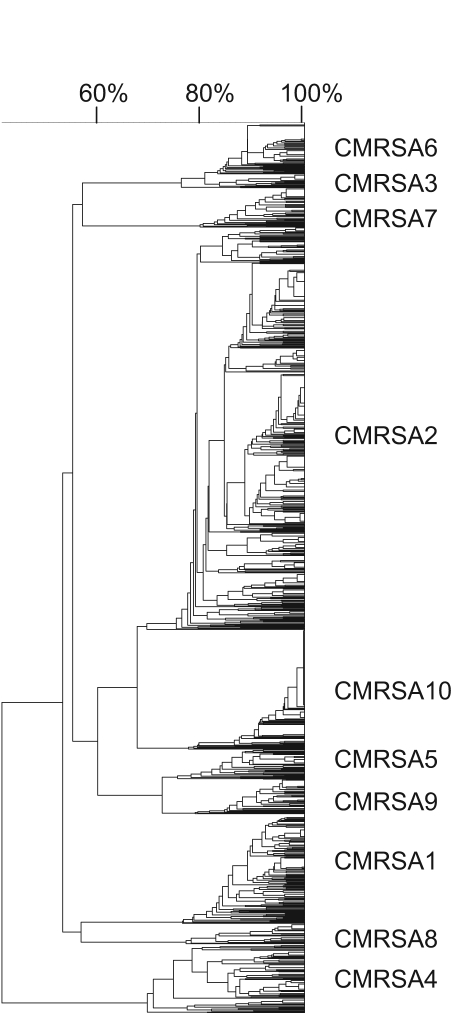
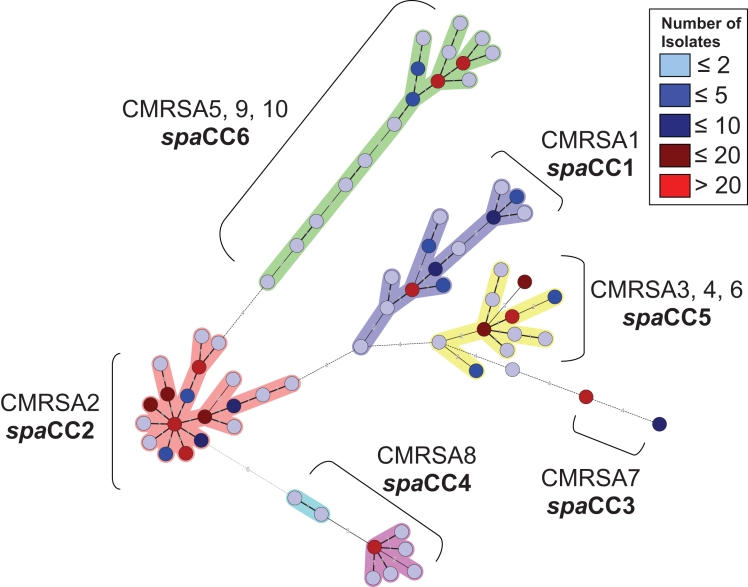
Results: spa types were determined for 1488 CMRSA isolates, and the method was analyzed for its ability to identify and cluster CMRSA1-10 strains. Minimal spanning tree analysis of 1452 spa types revealed individual clonal clusters for PFGE epidemic types CMRSA1, 2, 7 and 8, but spa typing could not distinguish CMRSA5 from CMRSA9 and CMRSA10, and CMRSA3 from CMRSA4 and CMRSA6. However, specific spa types were generally associated with only one PFGE epidemic type. Based on these results, a spa typing guideline for CMRSA isolates was developed and tested using the first 300 MRSA isolates received in 2007 through the Canadian Nosocomial Infection Surveillance Program.
Conclusions: The high concordance of spa types with PFGE epidemic types using this guideline demonstrated the feasibility of spa typing as a more rapid and less technically demanding alternative typing method for MRSA in Canada.
HISTORIQUE: Le taux croissant d’infections à Staphylococcus aureus méthicillinorésistant (ou MRSA, pour Methicillin-Resistant Staphylococcus Aureus) à l’échelle mondiale est un important problème de santé publique. Au Canada, on dénombre dix types épidémiques connus de MRSA déterminés par électrophorèse en champ pulsé (ÉCP). Malgré l’excellent pouvoir discriminant de l’ÉCP, cette technique comporte plusieurs inconvénients, notamment son coefficient de main-d’œuvre et la difficulté de mettre facilement au point une base de données pour le typage du MRSA en raison de l’interprétation suggestive des résultats.
OBJECTIF: Le but de la présente étude était de déterminer si le typage du gène spa, méthode éprouvée établie selon les séquences d’ADN, pourrait être utilisé à titre de solution de rechange à l’ÉCP pour le typage des isolats épidémiques de MRSA au Canada (CMRSA).
RÉSULTATS: Les types spa ont été déterminés pour 1 488 isolats de CMRSA et la méthode a été analysée sur le plan de sa capacité à identifier et à regrouper les souches 1 à 10 de CMRSA. L’analyse de l’arbre maximal-minimal de 1 452 types spa a révélé des complexes clonaux individuels pour les types épidémiques de CMRSA 1, 2, 7 et 8, déterminés par ÉCP, mais le typage spa n’a pas permis de distinguer le CMRSA5, du CMRSA9 et du CMRSA10, ni le CMRSA3 du CMRSA4 et du CMRSA6. Par contre, les types spa spécifiques ont en général été associés à un seul type épidémique déterminé par ÉCP. Selon ces résultats, des directives pour le typage du gène spa appliqués aux isolats de CMRSA ont été mises au point et testées sur les 300 premiers isolats de MRSA reçus en 2007 par l’entremise du Programme canadien de surveillance des infections nosocomiales
CONCLUSION: La forte concordance des types spa et des types épidémiques déterminés par ÉCP à l’aide de cette directive a démontré l’applicabilité du typage spa à titre de méthode de rechange plus rapide et moins exigeante sur le plan technique pour le typage du MRSA au Canada.
Keywords: CNISP; Canada; Methicillin-resistant Staphylococcus aureus; Pulsed-field gel electrophoresis; spa typing.
Figures
References
-
- Simor AE, Ofner-Agostini M, Bryce E, McGeer A, Paton S, Mulvey MR Canadian Hospital Epidemiology Committee and Canadian Nosocomial Infection Surveillance Program, Health Canada. Laboratory characterization of methicillin-resistant Staphylococcus aureus in Canadian hospitals: Results of 5 years of National Surveillance, 1995–1999. J Infect Dis. 2002;186:652–60. - PubMed
-
- Richardson JF, Reith S. Characterisation of a strain of methicillin-resistant Staphylococcus aureus (EMRSA-15) by conventional and molecular methods. J Hosp Infect. 1993;25:45–52. - PubMed
LinkOut - more resources
Full Text Sources
