


Life expectancy and years of life lost in chronic obstructive pulmonary disease: findings from the NHANES III Follow-up Study
- PMID: 19436692
- PMCID: PMC2672796
- DOI: 10.2147/copd.s5237
Life expectancy and years of life lost in chronic obstructive pulmonary disease: findings from the NHANES III Follow-up Study
Abstract
Rationale: Previous studies have demonstrated that chronic obstructive pulmonary disease (COPD) causes increased mortality in the general population. But life expectancy and the years of life lost have not been reported.
Objectives: To quantify mortality, examine how it varies with age, sex, and other risk factors, and determine how life expectancy is affected.
Methods: We constructed mortality models using the Third National Health and Nutrition Examination Survey, adjusting for age, sex, race, and major medical conditions. We used these to compute life expectancy and the years of life lost.
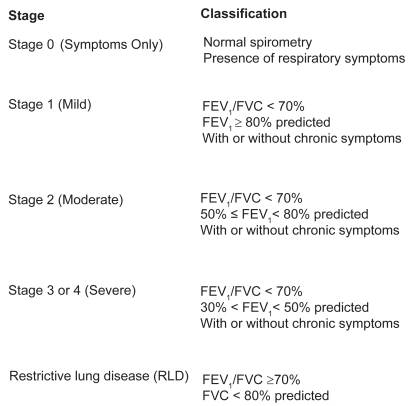
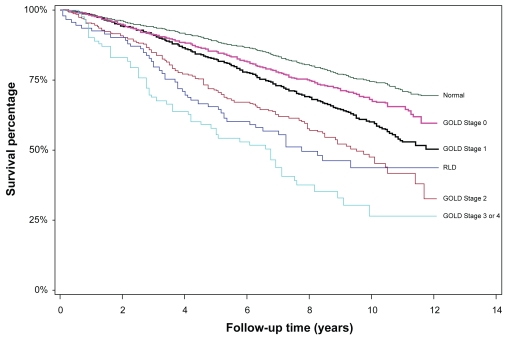
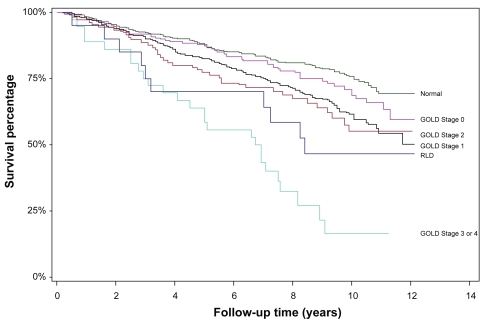
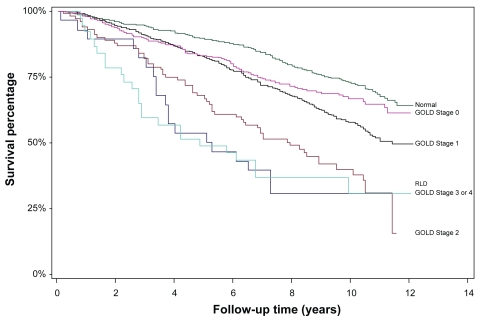
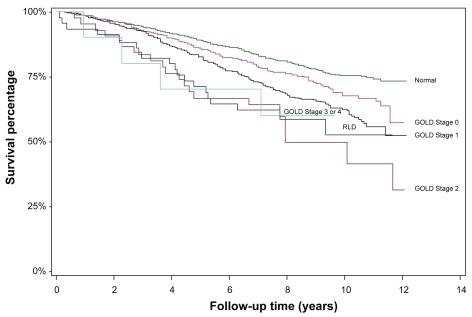
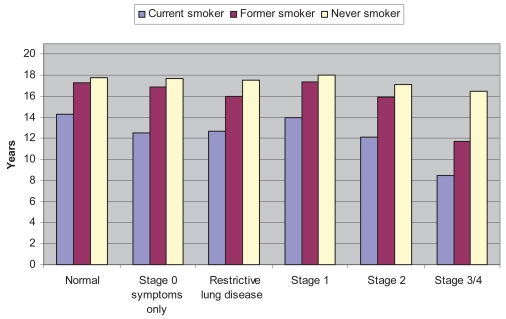
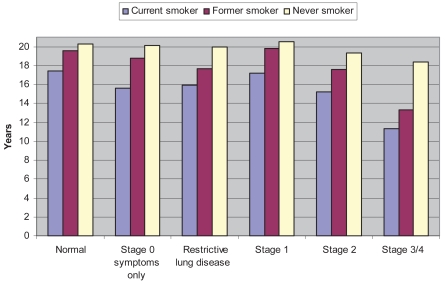
Measurements and main results: Pulmonary function testing classified patients as having Global Initiative on Obstructive Lung Disease (GOLD) stage 0, 1, 2, 3 or 4 COPD or restriction. COPD is associated with only a modest reduction in life expectancy for never smokers, but with a very large reduction for current and former smokers. At age 65, the reductions in male life expectancy for stage 1, stage 2, and stages 3 or 4 disease in current smokers are 0.3 years, 2.2 years, and 5.8 years. These are in addition to the 3.5 years lost due to smoking. In former smokers the reductions are 1.4 years and 5.6 years for stage 2 and stages 3 or 4 disease, and in never smokers they are 0.7 and 1.3 years.
Conclusions: Persons with COPD have an increased risk of mortality compared to those who do not, with consequent reduction in life expectancy. The effect is most marked in current smokers, and this is further reason for smokers to quit.
Figures
References
-
- de Torres JP, Campo A, Casanova C, Aguirre-Jaime, Zulueta J. Gender and chronic obstructive pulmonary disease in high-risk smokers. Respiration. 2006;73:306–310. - PubMed
-
- Lindberg A, Jonsson AC, Ronmark E, Lundgren R, Larsson LG, Lundback B. Ten-year cumulative incidence of COPD and risk factors for incident disease in a symptomatic cohort. Chest. 2005;127:1544–1552. - PubMed
MeSH terms
LinkOut - more resources
Full Text Sources
Medical
