


Non-invasive assessment of liver fibrosis in chronic liver diseases: implementation in clinical practice and decisional algorithms
- PMID: 19437558
- PMCID: PMC2682233
- DOI: 10.3748/wjg.15.2190
Non-invasive assessment of liver fibrosis in chronic liver diseases: implementation in clinical practice and decisional algorithms
Abstract
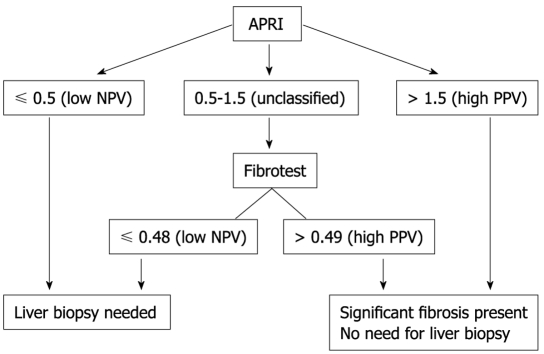
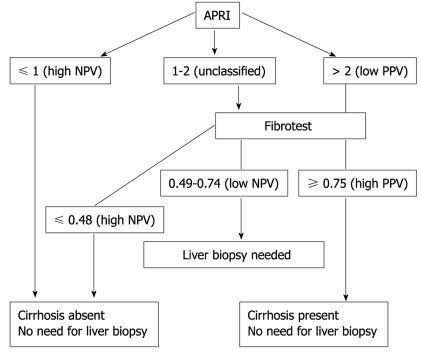
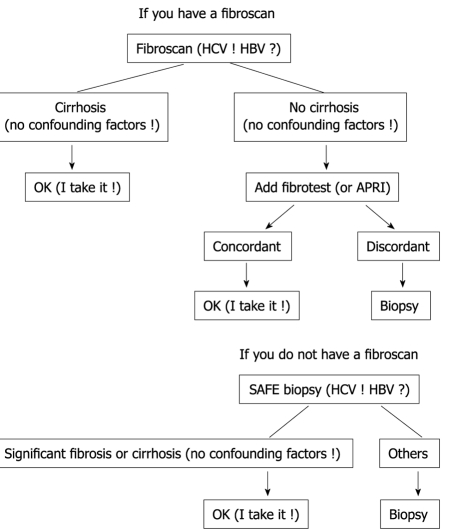
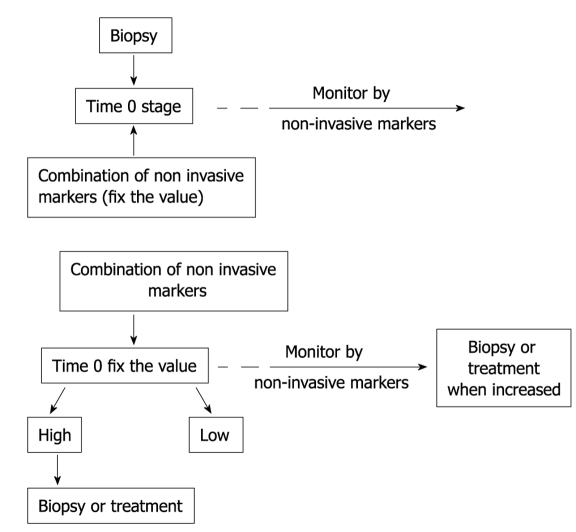
Chronic hepatitis B and C together with alcoholic and non-alcoholic fatty liver diseases represent the major causes of progressive liver disease that can eventually evolve into cirrhosis and its end-stage complications, including decompensation, bleeding and liver cancer. Formation and accumulation of fibrosis in the liver is the common pathway that leads to an evolutive liver disease. Precise definition of liver fibrosis stage is essential for management of the patient in clinical practice since the presence of bridging fibrosis represents a strong indication for antiviral therapy for chronic viral hepatitis, while cirrhosis requires a specific follow-up including screening for esophageal varices and hepatocellular carcinoma. Liver biopsy has always represented the standard of reference for assessment of hepatic fibrosis but it has some limitations being invasive, costly and prone to sampling errors. Recently, blood markers and instrumental methods have been proposed for the non-invasive assessment of liver fibrosis. However, there are still some doubts as to their implementation in clinical practice and a real consensus on how and when to use them is not still available. This is due to an unsatisfactory accuracy for some of them, and to an incomplete validation for others. Some studies suggest that performance of non-invasive methods for liver fibrosis assessment may increase when they are combined. Combination algorithms of non-invasive methods for assessing liver fibrosis may represent a rational and reliable approach to implement non-invasive assessment of liver fibrosis in clinical practice and to reduce rather than abolish liver biopsies.
Figures
References
-
- Sorrell MF, Belongia EA, Costa J, Gareen IF, Grem JL, Inadomi JM, Kern ER, McHugh JA, Petersen GM, Rein MF, et al. National Institutes of Health Consensus Development Conference Statement: management of hepatitis B. Ann Intern Med. 2009;150:104–110. - PubMed
-
- Lai CL, Ratziu V, Yuen MF, Poynard T. Viral hepatitis B. Lancet. 2003;362:2089–2094. - PubMed
-
- Global surveillance and control of hepatitis C. Report of a who consultation organized in collaboration with the viral hepatitis prevention board, antwerp, belgium. J Viral Hepat. 1999;6:35–47. - PubMed
-
- Alberti A, Chemello L, Benvegnu L. Natural history of hepatitis C. J Hepatol. 1999;31 Suppl 1:17–24. - PubMed
-
- de Franchis R, Hadengue A, Lau G, Lavanchy D, Lok A, McIntyre N, Mele A, Paumgartner G, Pietrangelo A, Rodes J, et al. EASL International Consensus Conference on Hepatitis B. 13-14 September, 2002 Geneva, Switzerland. Consensus statement (long version) J Hepatol. 2003;39 Suppl 1:S3–S25. - PubMed
MeSH terms
Substances
LinkOut - more resources
Full Text Sources
Medical
