Comparative Study
. 2009 Aug;39(8):1246-54.
doi: 10.1111/j.1365-2222.2009.03260.x. Epub 2009 May 3.

Comparison of adjuvant and adjuvant-free murine experimental asthma models

Affiliations
Free PMC article
Comparative Study

Comparison of adjuvant and adjuvant-free murine experimental asthma models

M L Conrad et al. Clin Exp Allergy. 2009 Aug.
Free PMC article

Abstract

Introduction: The most widely used protocol for the induction of experimental allergic airway inflammation in mice involves sensitization by intraperitoneal (i.p.) injections of the antigen ovalbumin (OVA) used in conjunction with the adjuvant aluminium hydroxide (alum). Although adjuvants are frequently used, there are questions regarding the necessity of alum for murine asthma studies due to the non-physiological nature of this chemical.

Objective: The objective of this study was to compare experimental asthma phenotypes between adjuvant and adjuvant-free protocols of murine allergic airway inflammation in an attempt to develop a standardized alternative to adjuvant use.

Method: An adjuvant-free OVA model of experimental asthma was investigated in BALB/c mice using i.p. or subcutaneous (s.c.) sensitization routes. For the s.c. sensitization, beta-galactosidase (beta-gal) was also tested as an antigen. In addition, OVA adjuvant and adjuvant-free sensitization protocols were compared in BALB/c and C57BL/6 mice. Open-field testing was performed to assess the effect of alum on mouse behaviour.

Results: Comparison of adjuvant vs. adjuvant-free and i.p. vs. s.c. protocols revealed that both adjuvant use and route of antigen application significantly influenced OVA-specific antibody production. Comparison of adjuvant and adjuvant-free protocols in this study clearly demonstrated the non-requirement of alum for the induction of acute allergic airway inflammation, as both protocols induce a similar disease phenotype. BALB/c mice were significantly more susceptible than C57BL/6 mice to sensitization. Using the improved s.c. adjuvant-free protocol, it was demonstrated that alternative antigens such as beta-gal can also be utilized. Behavioural studies indicated severe distress in mice treated with alum.

Conclusion: The OVA s.c. adjuvant-free protocol used in this study generates a phenotype comparable to the benchmark adjuvant protocol widely used in the literature. The adjuvant-free alternative avoids the added complication of non-physiological adjuvants that may interfere with asthma treatment or prevention strategies.


Figures
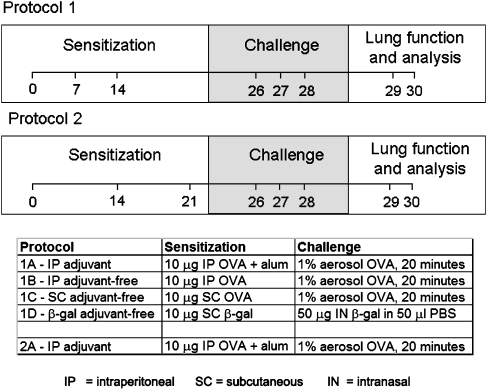
Fig. 1
Fig. 1
Sensitization and challenge protocols used for murine experimental asthma induction.
Fig. 2
Fig. 2
Total and differential cell counts in the BAL of BALB/c and C57BL/6 mice subjected to an OVA s.c. adjuvant-free (Protocol 1C) or OVA i.p. adjuvant protocol (Protocol 2A). (a) Leukocytes, (b) Eosinophils, (c) macrophages, (d) lymphocytes, and (e) neutrophils. Both protocols generated a comparable cell influx into the BAL fluids. BAL leukocytes and eosinophils were significantly increased between sham controls and the respective OVA-treated groups. Lymphocyte number significantly increased in BALB/c mice only. nd=not detectable, ns=not significant, *P<0.05, **P<0.01, ***P<0.001. Shown are mean ± SEM.
Fig. 3
Fig. 3
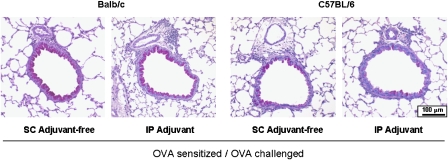
Representative PAS-stained lung histology sections of OVA-sensitized and -challenged BALB/c and C57BL/6 mice subjected to an s.c. adjuvant-free (Protocol 1C) or i.p. adjuvant protocol (Protocol 2A). The airways of BALB/c mice contained significantly more PAS-stained mucus-producing goblet cells than C57BL/6 mice regardless of the protocol used.
Fig. 4
Fig. 4
Airway reactivity to methacholine of BALB/c and C57BL/6 mice subjected to either s.c. adjuvant-free (Protocol 1C) or i.p. adjuvant (Protocol 2A) protocols using the antigen OVA. Both protocols led to comparable extents of airway reactivity in each respective mouse strain. In BALB/c mice, significant differences were observed between sham and OVA-sensitized groups, indicating the induction of airway hyperreactivity. This data also demonstrate the difficulty of achieving airway reactivity in the C57BL/6 strain. Airway responsiveness to methacholine was analysed by head-out body plethysmography 24 h after the last challenge. ns=not significant, *P<0.05. Shown are mean ± SEM.
Fig. 5
Fig. 5
Cytokine concentrations measured in the BAL fluid of BALB/c and C57BL/6 mice using s.c. adjuvant-free (Protocol 1C) and i.p. adjuvant (Protocol 2A) models with the antigen OVA. Analysis illustrates that the s.c. adjuvant-free protocol generated greater levels of IL-5 than the i.p. adjuvant protocol. No differences were observed in IL-13 or IL-10. Further comparison of strains in both protocols demonstrates that BALB/c mice consistently produce higher levels of IL-5 and IL-10 than C57BL/6 mice. ns=not significant, *P<0.05, **P<0.01, ***P<0.001. Shown are mean ± SEM.
Fig. 6
Fig. 6
The airway inflammation phenotype generated by the s.c. adjuvant-free protocol utilizing the alternative antigen β-gal and i.n. challenge in BALB/c mice (Protocol 1D). β-Gal-sensitized and -challenged animals showed (a) an increased cell influx into the BAL fluid, (b) increased airway reactivity, (c) goblet cell hyperplasia in the lung and (d) significantly higher levels of BAL fluid IL-5, IL-13 and IL-10 than sham treated controls. ns=not significant, *P<0.05, ***P<0.001. Shown are mean ± SEM.
Fig. 7
Fig. 7
Behavioural tests measuring the average velocity and rearing in untreated, sham-injected and adjuvant-injected mice. Mice were either left untreated, injected with sham PBS (i.p. or s.c.) or adjuvant (i.p.+alum). After treatment, animals were allowed a 15-, 120- or 240-min rest period, and then subjected to open-field testing for 15 min. Black circles indicate the untreated group (no injection), green squares indicate mice sham injected either s.c. (solid line) or i.p. (dashed line), and red triangles indicate mice injected with i.p. with the adjuvant alum. *P<0.05, ***P<0.001 vs. untreated. Shown are mean ± SEM.

References

    1. Kumar RK, Herbert C, Foster PS. The “classical” ovalbumin challenge model of asthma in mice. Curr Drug Targets. 2008;9:485–94. - PubMed
    1. Nakae S, Lunderius C, Ho LH, Schafer B, Tsai M, Galli SJ. TNF can contribute to multiple features of ovalbumin-induced allergic inflammation of the airways in mice. J Allergy Clin Immunol. 2007;119:680–6. - PubMed

    1. Eisenbarth SC, Colegio OR, O'Connor W, Sutterwala FS, Flavell RA. Crucial role for the Nalp3 inflammasome in the immunostimulatory properties of aluminium adjuvants. Nature. 2008;453:1122–6. - PMC - PubMed
    1. Franchi L, Nunez G. The Nlrp3 inflammasome is critical for aluminium hydroxide-mediated IL-1beta secretion but dispensable for adjuvant activity. Eur J Immunol. 2008;38:2085–9. - PMC - PubMed
    1. Li H, Willingham SB, Ting JP, Re F. Cutting edge: inflammasome activation by alum and alum's adjuvant effect are mediated by NLRP3. J Immunol. 2008;181:17–21. - PMC - PubMed

Publication types

MeSH terms