. 2009 Apr 24;1(4):42.
doi: 10.1186/gm42.

Genomic disorders ten years on

Affiliations

Genomic disorders ten years on

James R Lupski. Genome Med. .

Abstract

It is now becoming generally accepted that a significant amount of human genetic variation is due to structural changes of the genome rather than to base-pair changes in the DNA. As for base-pair changes, knowledge of gene and genome function has been informed by structural alterations that convey clinical phenotypes. Genomic disorders are a class of human conditions that result from structural changes of the human genome that convey traits or susceptibility to traits. The path to the delineation of genomic disorders is intertwined with the evolving technologies that have enabled the resolution of human genome analyses to continue increasing. Similarly, the ability to perform high-resolution human genome analysis has fueled the current and future clinical implementation of such discoveries in the evolving field of genome medicine.


Figures
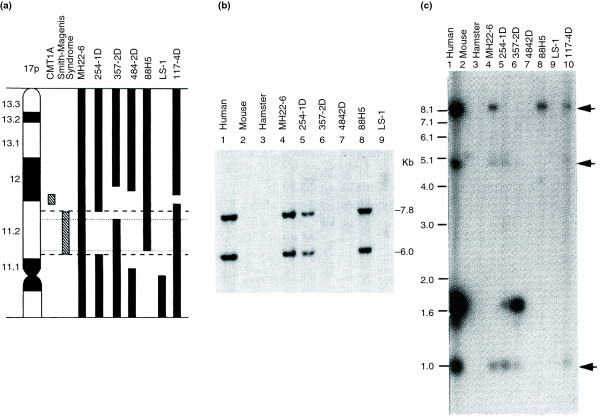
Figure 1
Figure 1
Low-copy repeats (LCRs) flanking the Charcot-Marie-Tooth disease type 1A duplication (CMT1A-REP) and the Smith-Magenis deletion (SMS-REP). (a) A somatic cell hybrid panel with a chromosome 17p ideogram (left) and vertical bars representing the regions retained in the individual human hybrid cell lines listed at the top. (b) Southern hybridization with a CMT1A-REP probe. There are two cross-hybridizing signals in human genomic DNA (lane 1), none in the mouse and hamster genomic DNA (lanes 2 and 3), and the same two in a monochromosomal hybrid (MH22-6, lane 4) retaining human chromosome 17. Both copies map to the CMT1A duplication region at 17p12. This is interpreted as showing that there are two copies of CMT1A-REP, both mapping to the CMT1A duplication locus, and both of which evolved late in the mammalian radiation as they are not present in mouse or hamster [9]. (c) Three copies of SMS-REP (arrows) on chromosome 17 [21]. We used the term REP because at the time my laboratory was working with prokaryotic repeated sequences (REP) and had developed a technique we referred to as rep-PCR [157,158].
Figure 2
Figure 2
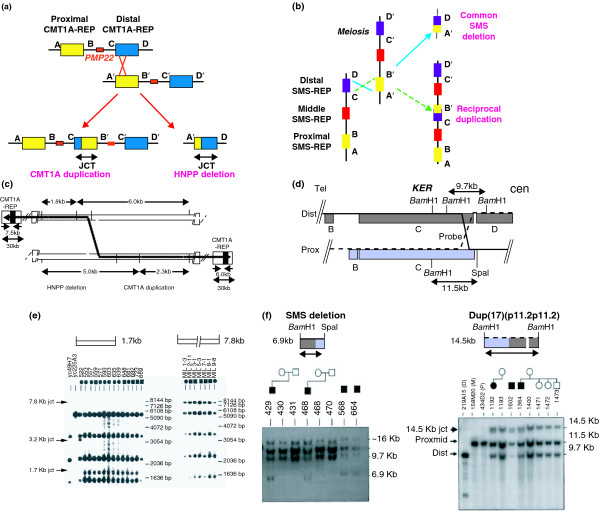
Reciprocal recombinations at the Charcot-Marie-Tooth disease type 1A (CMT1A) duplication locus in 17p12 and the Smith-Magenis syndrome (SMS) locus in 17p11.2. (a) The non-allelic homologous recombination (NAHR) in which the low-copy repeat (CMT1A-REP) substrates lead to reciprocal CMT1A duplication and HNPP deletion [15]. (b, d, f) Analogous data for the SMS deletion and its predicted reciprocal duplication [23]. (c) The model for the crossover and the predicted junction fragments; (e) the Southern analysis supporting this model. Note that these are the same molecular mechanism (NAHR), but it is shown horizontally (as usually depicted by molecular biologists) in (a) and vertically (as usually depicted by cytogeneticists) in (b). Abbreviations: cen, centromeric; dist, distal; mid, middle; prox, proximal; tel, telomeric.
Figure 3
Figure 3
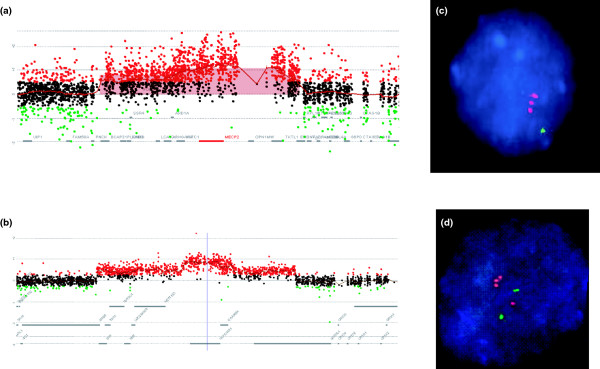
Complex genomic rearrangements. Shown are examples of complex duplication-triplication-duplication rearrangements at MECP2 [93] and LIS1 [134]. (a, b) Array CGH using Agilent custom-designed arrays with interrogating oligonucleotides every few hundred base-pairs from the regions of the genome containing (a) MECP2 and (b) LIS1. Red dots indicate gain of copy number in relation to sex-matched reference DNA; black dots, copy number neutral; green dots, loss of copy number. (c, d) fluorescent in situ hybridization confirmation of the triplication of (c) MECP2 and (d) LIS1 (red, probe interrogating the indicated gene; green, control probe from same chromosome). Note that MECP2 (c) is on the one X chromosome in this male patient, whereas LIS1 (d) is on an autosome and shows both the duplicated (two red signals paired with one green control) with the normal chromosome 17 homologue, with only one copy of LIS1 paired with the green control signal.

References

    1. Online Mendelian Inheritance in Man. http://hhttp://www.ncbi.nlm.nih.gov/sites/entrez?db=omim
    1. Chakravarti A, Patel PI. DNA duplication associated with Charcot-Marie-Tooth disease type 1A. Cell. 1991;66:219–232. doi: 10.1016/0092-8674(91)90613-4. - DOI - PubMed
    1. Raeymaekers P, Timmerman V, Nelis E, De Jonghe P, Hoogendijk JE, Baas F, Barker DF, Martin JJ, De Visser M, Bolhuis PA. Duplication in chromosome 17p11.2 in Charcot-Marie-Tooth neuropathy type 1a (CMT 1a). The HMSN Collaborative Research Group. Neuromuscul Disord. 1991;1:93–97. doi: 10.1016/0960-8966(91)90055-W. - DOI - PubMed
    1. Chance PF, Alderson MK, Leppig KA, Lensch MW, Matsunami N, Smith B, Swanson PD, Odelberg SJ, Disteche CM, Bird TD. DNA deletion associated with hereditary neuropathy with liability to pressure palsies. Cell. 1993;72:143–151. doi: 10.1016/0092-8674(93)90058-X. - DOI - PubMed
    1. Lupski JR, Wise CA, Kuwano A, Pentao L, Parke JT, Glaze DG, Led-better DH, Greenberg F, Patel PI. Gene dosage is a mechanism for Charcot-Marie-Tooth disease type 1A. Nat Genet. 1992;1:29–33. doi: 10.1038/ng0492-29. - DOI - PubMed