


Viruses in the Anopheles A, Anopheles B, and Tete serogroups in the Orthobunyavirus genus (family Bunyaviridae) do not encode an NSs protein
- PMID: 19439468
- PMCID: PMC2708632
- DOI: 10.1128/JVI.02080-08
Viruses in the Anopheles A, Anopheles B, and Tete serogroups in the Orthobunyavirus genus (family Bunyaviridae) do not encode an NSs protein
Abstract
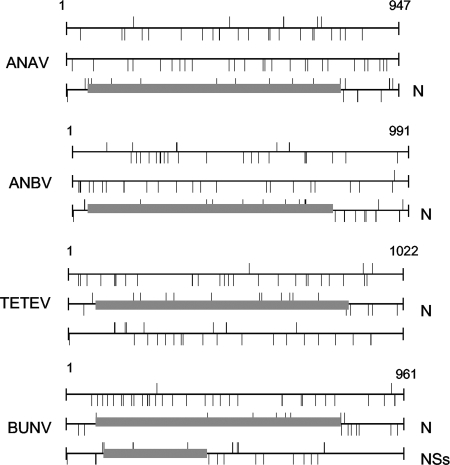
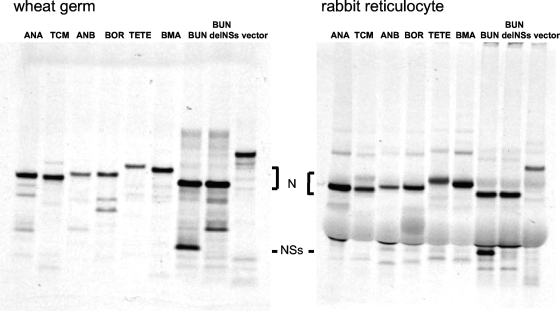
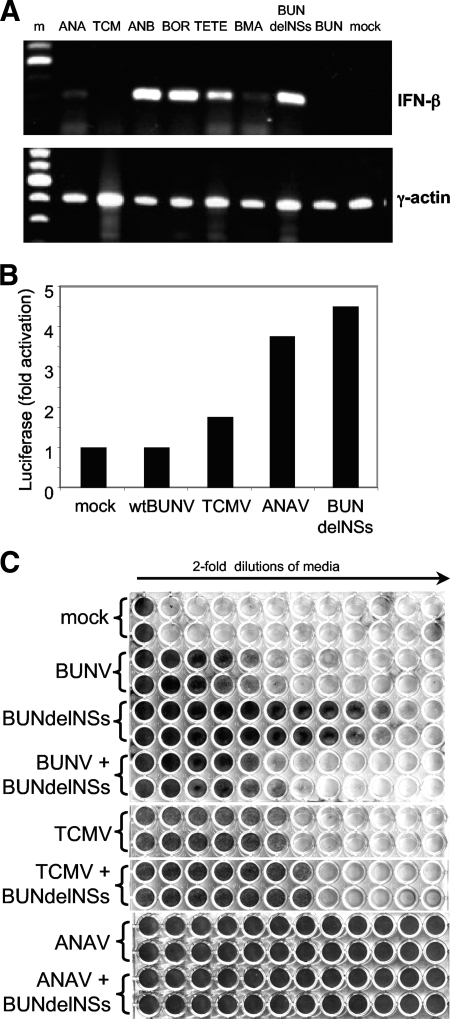
Viruses in the genus Orthobunyavirus, family Bunyaviridae, have a genome comprising three segments (called L, M, and S) of negative-sense RNA. Serological studies have classified the >170 named virus isolates into 18 serogroups, with a few additional as yet ungrouped viruses. Until now, molecular studies and full-length S-segment nucleotide sequences were available for representatives of eight serogroups; in all cases, the S segment encodes two proteins, N (nucleocapsid) and NSs (nonstructural), in overlapping open reading frames (ORFs) that are translated from the same mRNA. The NSs proteins of Bunyamwera virus (BUNV) and California serogroup viruses have been shown to play a role in inhibiting host cell mRNA and protein synthesis, thereby preventing induction of interferon (IFN). We have determined full-length sequences of the S segments of representative viruses in the Anopheles A, Anopheles B, and Tete serogroups, and we report here that these viruses do not show evidence of having an NSs ORF. In addition, these viruses have rather longer N proteins than those in the other serogroups. Most of the naturally occurring viruses that lack the NSs protein behaved like a recombinant BUNV with the NSs gene deleted in that they failed to prevent induction of IFN-beta mRNA. However, Tacaiuma virus (TCMV) in the Anopheles A serogroup inhibited IFN induction in a manner similar to that of wild-type BUNV, suggesting that TCMV has evolved an alternative mechanism, not involving a typical NSs protein, to antagonize the host innate immune response.
Figures
References
-
- Barrett, A. D. T., and R. E. Shope. 2005. Bunyaviridae, p. 1025-1058. In B. W. J. Mahy and V. ter Meulen (ed.), Topley and Wilson's microbiology and microbial infections, 10th ed., vol. 2. Hodder Arnold, London, United Kingdom.
-
- Beaty, B. J., and C. H. Calisher. 1991. Bunyaviridae—natural history. Curr. Top. Microbiol. Immunol. 16927-78. - PubMed
-
- Blakqori, G., S. Delhaye, M. Habjan, C. D. Blair, I. Sanchez-Vargas, K. E. Olson, G. Attarzadeh-Yazdi, R. Fragkoudis, A. Kohl, U. Kalinke, S. Weiss, T. Michiels, P. Staeheli, and F. Weber. 2007. La Crosse bunyavirus nonstructural protein NSs serves to suppress the type I interferon system of mammalian hosts. J. Virol. 814991-4999. - PMC - PubMed
-
- Bowen, M. D., A. O. Jackson, T. D. Bruns, D. L. Hacker, and J. L. Hardy. 1995. Determination and comparative analysis of the small RNA genomic sequences of California encephalitis, Jamestown Canyon, Jerry Slough, Melao, Keystone and Trivittatus viruses (Bunyaviridae, genus Bunyavirus, California serogroup). J. Gen. Virol. 76559-572. - PubMed
Publication types
MeSH terms
Substances
Associated data
- Actions
- Actions
- Actions
- Actions
- Actions
- Actions
Grants and funding
LinkOut - more resources
Full Text Sources
Molecular Biology Databases
