


Vaccination against human influenza A/H3N2 virus prevents the induction of heterosubtypic immunity against lethal infection with avian influenza A/H5N1 virus
- PMID: 19440239
- PMCID: PMC2678248
- DOI: 10.1371/journal.pone.0005538
Vaccination against human influenza A/H3N2 virus prevents the induction of heterosubtypic immunity against lethal infection with avian influenza A/H5N1 virus
Abstract
Annual vaccination against seasonal influenza viruses is recommended for certain individuals that have a high risk for complications resulting from infection with these viruses. Recently it was recommended in a number of countries including the USA to vaccinate all healthy children between 6 and 59 months of age as well. However, vaccination of immunologically naïve subjects against seasonal influenza may prevent the induction of heterosubtypic immunity against potentially pandemic strains of an alternative subtype, otherwise induced by infection with the seasonal strains. Here we show in a mouse model that the induction of protective heterosubtypic immunity by infection with a human A/H3N2 influenza virus is prevented by effective vaccination against the A/H3N2 strain. Consequently, vaccinated mice were no longer protected against a lethal infection with an avian A/H5N1 influenza virus. As a result H3N2-vaccinated mice continued to loose body weight after A/H5N1 infection, had 100-fold higher lung virus titers on day 7 post infection and more severe histopathological changes than mice that were not protected by vaccination against A/H3N2 influenza. The lack of protection correlated with reduced virus-specific CD8+ T cell responses after A/H5N1 virus challenge infection. These findings may have implications for the general recommendation to vaccinate all healthy children against seasonal influenza in the light of the current pandemic threat caused by highly pathogenic avian A/H5N1 influenza viruses.
Conflict of interest statement
Figures
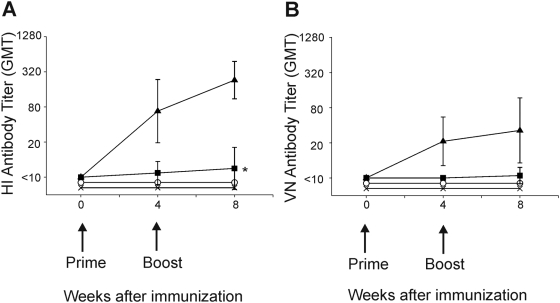
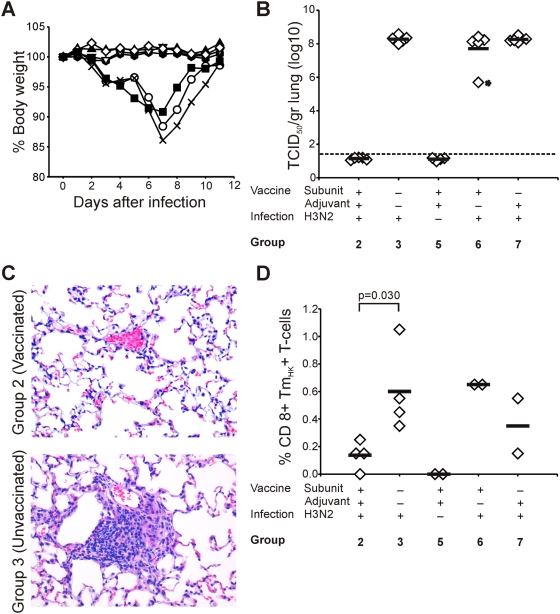
 ), 4 (▿) and 5 (⋄)). (A) Body weight after infection was determined daily and expressed as the percentage of the original body weight before infection. (B) Lung virus titers measured on day 4 p.i. in mice from the indicated experimental groups. Horizontal bars represent the average titers of five mice. The dotted line represents the cut-off value for obtaining a positive result. *This mouse from group 6 had before infection an HI antibody titer of 40. (C) Vaccination prevented the induction of iBALT after infection. Twenty-eight days post infection with IAV HK/68 iBALT was detected in mice from group 3, but not in mice from group 2. Lung tissue sections were stained with HE. (D) Virus-specific CD8+ T cell responses detected 28 days post infection. Splenocytes of mice from the indicated experimental groups were tested for the presence of CD8+ T cells that bound the H2-Db NPHK Tetramer. Horizontal bars represent the average of 2–4 mice. The difference in %CD8+ Tm+ T cells between groups 2 and 3 was statistically significant (P = 0.030).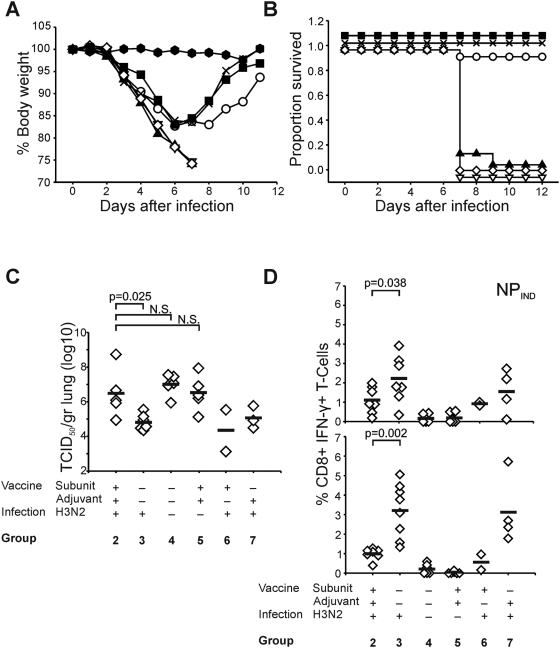
 ). (A) Body weight after infection was determined daily and expressed as the percentage of the original body weight before infection. (B) Survival rates after infection with IAV IND/05. The proportion of mice from the indicated groups that survived infection is shown in a Kaplan-Meier plot. Moribund animals were euthanized when they reached pre-fixed criteria regarding weight loss (>20%) and disease severity score, which was used to determine mortality rates. (C) Lung virus titers measured on 7 days p.i. in mice from the indicated groups. Horizontal bars represent the average of 2–6 mice. The difference in virus titers between mice of group 2 and group 3 was statistically significant (p = 0.025). N.S.: not significant. (D) Virus-specific CD8+ T cell responses on day 7 p.i.. The frequency of CD3+ CD8+ splenocytes specific for peptide NP366–374 and PA224–233 derived from IAV IND/05 was determined by intracellular IFN-γ staining. The horizontal bars represent the average frequency of IFN-γ+ cells in the CD8+ T cell population of 2–7 mice in the indicated groups. Differences between group 2 and group 3 were statistically significant for both peptides.
References
-
- World Health Organization (WHO) Confirmed human cases of avian influenza A H5N1. 2008. Available at http://www.who.int/csr/disease/avian_influenza/country/cases_table_2008_....
-
- Writing Committee of the Second World Health Organization Consultation on Clinical Aspects of Human Infection with Avian Influenza A Virus. Update on avian influenza A (H5N1) virus infection in humans. N Engl J Med. 2008:261–273. - PubMed
-
- Claas EC, Osterhaus AD, van Beek R, De Jong JC, Rimmelzwaan GF, et al. Human influenza A H5N1 virus related to a highly pathogenic avian influenza virus. Lancet. 1998;351:472–477. - PubMed
Publication types
MeSH terms
Substances
LinkOut - more resources
Full Text Sources
Medical
Research Materials
