Targeting glutamatergic signaling for the development of novel therapeutics for mood disorders
- PMID: 19442176
- PMCID: PMC2795357
- DOI: 10.2174/138161209788168010
Targeting glutamatergic signaling for the development of novel therapeutics for mood disorders
Abstract
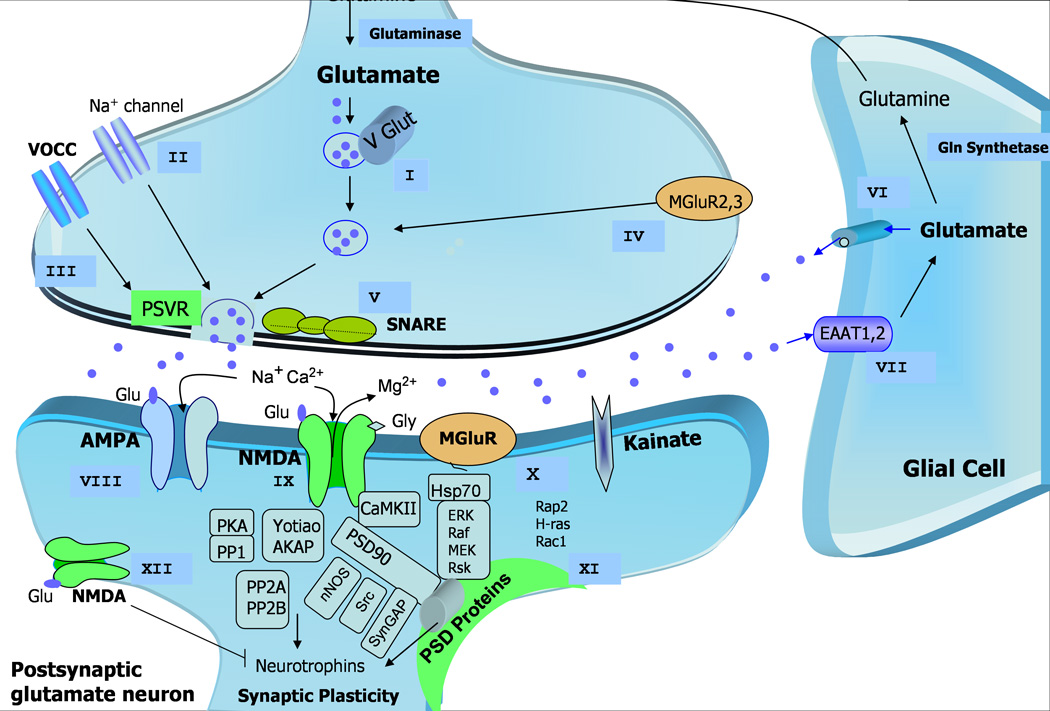
There have been no recent advances in drug development for mood disorders in terms of identifying drug targets that are mechanistically distinct from existing ones. As a result, existing antidepressants are based on decades-old notions of which targets are relevant to the mechanisms of antidepressant action. Low rates of remission, a delay of onset of therapeutic effects, continual residual depressive symptoms, relapses, and poor quality of life are unfortunately common in patients with mood disorders. Offering alternative options is requisite in order to reduce the individual and societal burden of these diseases. The glutamatergic system is a promising area of research in mood disorders, and likely to offer new possibilities in therapeutics. There is increasing evidence that mood disorders are associated with impairments in neuroplasticity and cellular resilience, and alterations of the glutamatergic system are known to play a major role in cellular plasticity and resilience. Existing antidepressants and mood stabilizers have prominent effects on the glutamate system, and modulating glutamatergic ionotropic or metabotropic receptors results in antidepressant-like properties in animal models. Several glutamatergic modulators targeting various glutamate components are currently being studied in the treatment of mood disorders, including release inhibitors of glutamate, N-methyl-D-aspartate (NMDA) antagonists, alpha-amino-3-hydroxy-5-methyl-4-isoxazolepropionic acid (AMPA) throughput enhancers, and glutamate transporter enhancers. This paper reviews the currently available knowledge regarding the role of the glutamatergic system in the etiopathogenesis of mood disorders and putative glutamate modulators.
Figures
References
-
- Kessler RC, Berglund P, Demler O, Jin R, Merikangas KR, Walters EE. Lifetime prevalence and age-of-onset distributions of DSM-IV disorders in the National Comorbidity Survey Replication. Arch Gen Psychiatry. 2005;62:593–602. - PubMed
-
- Dunn V, Goodyer IM. Longitudinal investigation into childhood-and adolescence-onset depression: psychiatric outcome in early adulthood. Br J Psychiatry. 2006;188:216–222. - PubMed
-
- Tohen M, Strakowski SM, Zarate C, Jr, Hennen J, Stoll AL, Suppes T, et al. The McLean-Harvard first-episode project: 6-month symptomatic and functional outcome in affective and nonaffective psychosis. Biol Psychiatry. 2000;48:467–476. - PubMed
-
- Murray CJ, Lopez AD. Evidence-based health policy--lessons from the Global Burden of Disease Study. Science. 1996;274:740–743. - PubMed
-
- Tohen M, Zhang F, Taylor CC, Burns P, Zarate C, Sanger T, et al. A meta-analysis of the use of typical antipsychotic agents in bipolar disorder. J Affect Disord. 2001;65:85–93. - PubMed
Publication types
MeSH terms
Substances
Grants and funding
LinkOut - more resources
Full Text Sources
Medical