. 2009 Jun;37(Pt 3):561-8.
doi: 10.1042/BST0370561.

Regulation of activation-induced cytidine deaminase DNA deamination activity in B-cells by Ser38 phosphorylation

Affiliations

Regulation of activation-induced cytidine deaminase DNA deamination activity in B-cells by Ser38 phosphorylation

Uttiya Basu et al. Biochem Soc Trans. 2009 Jun.

Abstract

Human and mouse Ig genes are diversified in mature B-cells by distinct processes known as Ig heavy-chain CSR (class switch recombination) and Ig variable-region exon SHM (somatic hypermutation). These DNA-modification processes are initiated by AID (activation-induced cytidine deaminase), a DNA cytidine deaminase predominantly expressed in activated B-cells. AID is post-transcriptionally regulated via multiple mechanisms, including microRNA regulation, nucleocytoplasmic shuttling, ubiquitination and phosphorylation. Among these regulatory processes, AID phosphorylation at Ser(38) has been a focus of particularly intense study and debate. In the present paper, we discuss recent biochemical and mouse genetic studies that begin to elucidate the functional significance of AID Ser(38) phosphorylation in the context of the evolution of this mode of AID regulation and the potential roles that it may play in activated B-cells during a normal immune response.


Figures
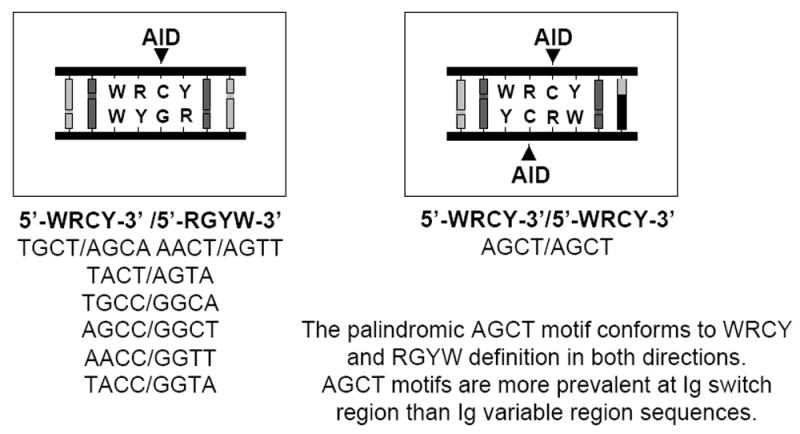
Figure 1
Figure 1. Schematic representation of activation-induced cytidine deaminase (AID) target preferences
In vitro, AID preferentially deaminates C residues in DNA to uracil in the context of a WRCY sequence motif (W = A or T, R = A or G, Y = C or T; the target of AID within the motif is underlined) [20-21]. Seven of the eight possible tetranucleotide permutations of this motif conform to 5’-WRCY-3’/5’-RGYW-3’ sequence structure in double-stranded (ds)DNA (left); in this context, a single AID-mediated deamination event is possible within each double-stranded motif (as indicated). The palindromic sequence AGCT is unique in that it conforms to 5’-WRCY-3’/5’-WRCY-3’ sequence structure in dsDNA (right); in this context, AID-mediated deamination events are potentially possible on both strands of the DNA duplex within the same double-stranded motif (as indicated). Switch regions contain a higher density of AGCT motifs than variable regions; AGCT motifs are often tandemly repeated within core switch sequences. AID-mediated deamination of C residues at switch and variable regions in vivo co-opts activities of the base excision repair (BER) and mismatch repair pathways [28]. The BER pathway is apparently the dominant pathway during CSR in vivo; it is thought that uracil-N glycosylase (UNG) removes AID-generated U lesions leading to subsequent endonuclease cleavage of the phosphodiester bond 5’ of the resultant abasic site [29]. AID-mediated deamination of cytosine residues on both DNA strands within the same or neighboring 5’-AGCT-3’/5’-AGCT-3’ motifs and processing of the resultant U lesions via activity of the BER pathway theoretically could lead to the efficient formation of the double strand breaks that are required for CSR.
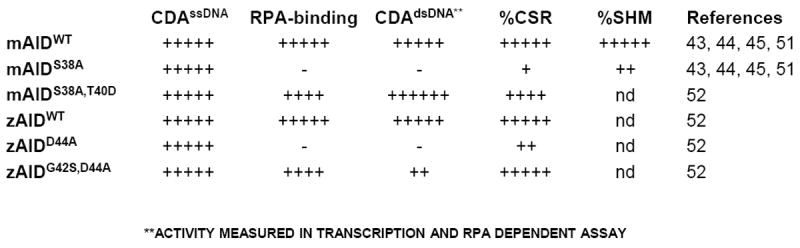
Figure 2
Figure 2. Schematic representation of different in vitro and in vivo activities of activation-induced cytidine deaminase (AID) mutant proteins
The in vitro biochemical activities of each of the proteins presented are its cytidine deaminase activity on single-stranded (ss)DNA (CDAssDNA) or on transcribed RGYW-rich double-stranded (ds)DNA (CDAdsDNA). The ability of each protein to bind to replication protein A (RPA) in vitro is also represented (RPA-binding). The class switch recombination (CSR) or somatic hypermutation (SHM) in vivo activities of each protein represents data obtained from retroviral complementation assays or from knock-in mouse models. “nd” represents “not done”.
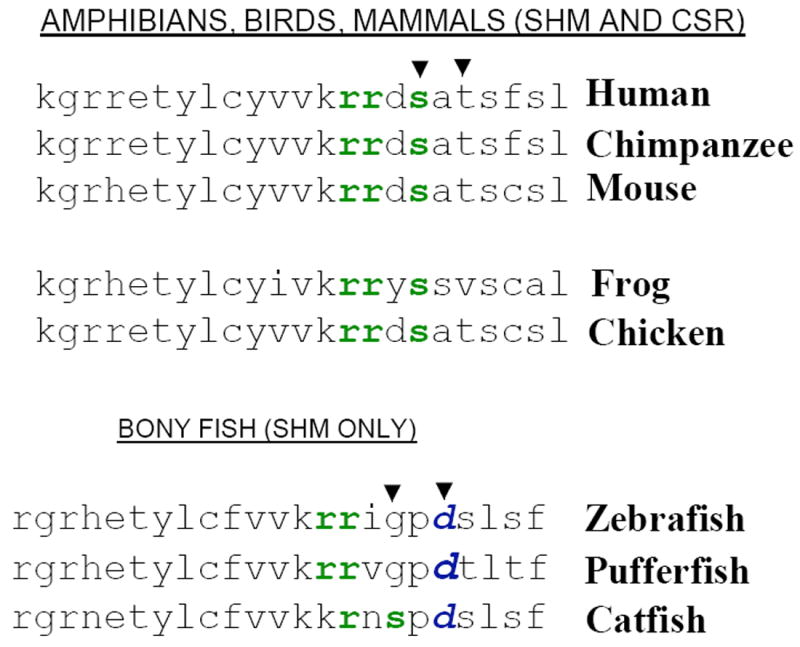
Figure 3
Figure 3. Conservation of activation-induced cytidine deaminase (AID) phosphorylation site Serine-38 in different species
The protein kinase A (PKA) phosphorylation site of AID at Serine-38 is present in all organisms that undergo CSR (mammals, amphibians and birds) but is absent in organisms that undergo SHM only (bonyfish). The PKA consensus site is represented by “rrxs/t”, where “r” represents an arginine residue, “x” any amino acid and “s/t” represents “serine or threonine”. All bonyfish AID amino acid sequences contain an aspartic acid residue “d”, which is absent in the AID amino acid sequences of organisms that undergo CSR.

References

    1. Chaudhuri J, Alt FW. Class-switch recombination: interplay of transcription, DNA deamination and DNA repair. Nat Rev Immunol. 2004;4:541–552. - PubMed
    1. Honjo T, Kinoshita K, Muramatsu M. Molecular Mechanism of Class Switch Recombination: Linkage with Somatic Hypermutation. Annu Rev Immunol. 2002;20:165–196. - PubMed
    1. Muramatsu M, Kinoshita K, Fagarasan S, Yamada S, Shinkai Y, Honjo T. Class switch recombination and hypermutation require activation-induced cytidine deaminase (AID), a potential RNA editing enzyme. Cell. 2000;102:553–563. - PubMed
    1. Muramatsu M, Sankaranand VS, Anant S, Sugai M, Kinoshita K, Davidson NO, Honjo T. Specific expression of activation-induced cytidine deaminase (AID), a novel member of the RNA-editing deaminase family in germinal center B cells. J Biol Chem. 1999;274:18470–18476. - PubMed
    1. Revy P, Muto T, Levy Y, Geissmann F, Plebani A, Sanal O, Catalan N, Forveille M, Dufourcq-Labelouse R, Gennery A, Tezcan I, Ersoy F, Kayserili H, Ugazio AG, Brousse N, Muramatsu M, Notarangelo LD, Kinoshita K, Honjo T, Fischer A, Durandy A. Activation-induced cytidine deaminase (AID) deficiency causes the autosomal recessive form of the Hyper-IgM syndrome (HIGM2) Cell. 2000;102:565–575. - PubMed

Publication types

MeSH terms

Substances