


Will the NHS continue to function in an influenza pandemic? A survey of healthcare workers in the West Midlands, UK
- PMID: 19442272
- PMCID: PMC2690584
- DOI: 10.1186/1471-2458-9-142
Will the NHS continue to function in an influenza pandemic? A survey of healthcare workers in the West Midlands, UK
Abstract
Background: If UK healthcare services are to respond effectively to pandemic influenza, levels of absenteeism amongst healthcare workers (HCWs) must be minimised. Current estimates of the likelihood that HCWs will continue to attend work during a pandemic are subject to scientific and predictive uncertainty, yet an informed evidence base is needed if contingency plans addressing the issues of HCW absenteeism are to be prepared.
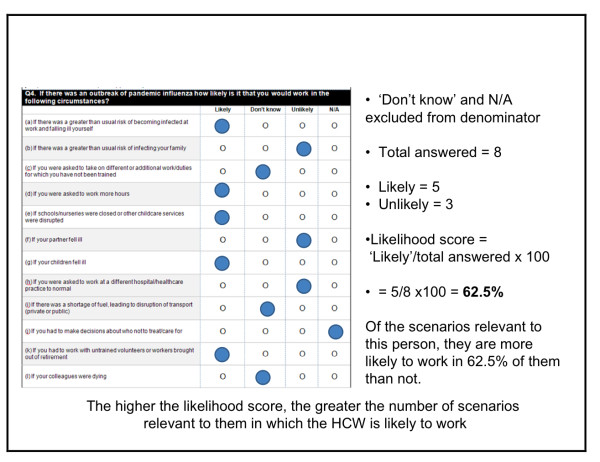
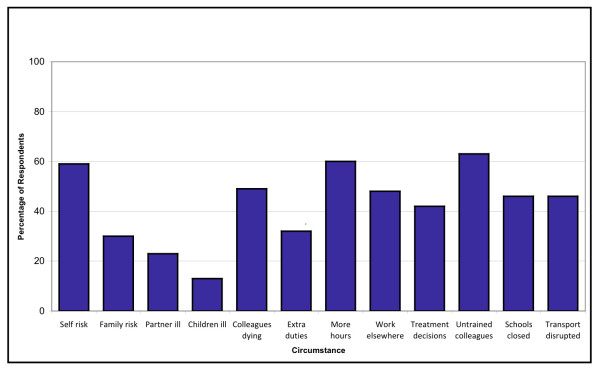
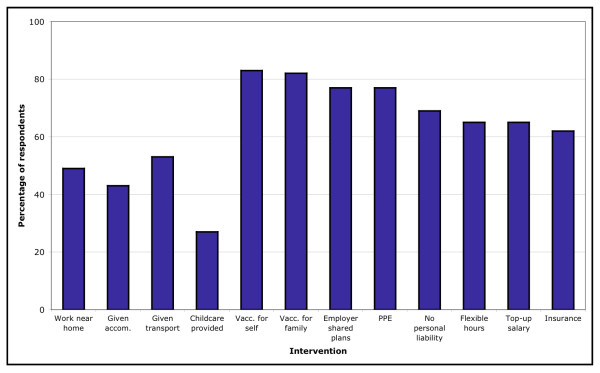
Methods: This paper reports the findings of a self-completed survey of randomly selected HCWs across three purposively sampled healthcare trusts in the West Midlands. The survey aimed to identify the factors positively or negatively associated with willingness to work during an influenza pandemic, and to evaluate the acceptability of potential interventions or changes to working practice to promote the continued presence at work of those otherwise unwilling or unable to attend. 'Likelihood' and 'persuadability' scores were calculated for each respondent according to indications of whether or not they were likely to work under different circumstances. Binary logistic regression was used to compute bivariate and multivariate odds ratios to evaluate the association of demographic variables and other respondent characteristics with the self-described likelihood of reporting to work.
Results: The survey response rate was 34.4% (n = 1032). Results suggest absenteeism may be as high as 85% at any point during a pandemic, with potential absence particularly concentrated amongst nursing and ancillary workers (OR 0.3; 95% CI 0.1 to 0.7 and 0.5; 95% CI 0.2 to 0.9 respectively).
Conclusion: Levels of absenteeism amongst HCWs may be considerably higher than official estimates, with potential absence concentrated amongst certain groups of employees. Although interventions designed to minimise absenteeism should target HCWs with a low stated likelihood of working, members of these groups may also be the least receptive to such interventions. Changes to working conditions which reduce barriers to the ability to work may not address barriers linked to willingness to work, and may fail to overcome HCWs' reluctance to work in the face of what may still be deemed unacceptable risk to self and/or family.
Figures
References
-
- Wong TY, Koh GCH, Cheong SK, Sundram M, Koh K, Chia SE, Koh D. A cross-sectional study of primary-care physicians in Singapore on their concerns and preparedness for an avian influenza outbreak. Ann Acad Med Singapore. 2008;37:458–464. - PubMed
Publication types
MeSH terms
Grants and funding
LinkOut - more resources
Full Text Sources
Medical
