


Effects of a popular exercise and weight loss program on weight loss, body composition, energy expenditure and health in obese women
- PMID: 19442301
- PMCID: PMC2693519
- DOI: 10.1186/1743-7075-6-23
Effects of a popular exercise and weight loss program on weight loss, body composition, energy expenditure and health in obese women
Abstract
Objective: To determine the safety and efficacy of altering the ratio of carbohydrate and protein in low-energy diets in conjunction with a popular exercise program in obese women.
Design: Matched, prospective clinical intervention study to assess efficacy of varying ratios of carbohydrate and protein intake in conjunction with a regular exercise program.
Participants: One-hundred sixty one sedentary, obese, pre-menopausal women (38.5 ± 8.5 yrs, 164.2 ± 6.7 cm, 94.2 ± 18.8 kg, 34.9 ± 6.4 kg.m⁻², 43.8 ± 4.2%) participated in this study. Participants were weight stable and not participating in additional weight loss programs.
Methods: Participants were assigned to either a no exercise + no diet control (CON), a no diet + exercise group (ND), or one of four diet + exercise groups (presented as kcals; % carbohydrate: protein: fat): 1) a high energy, high carbohydrate, low protein diet (HED) [2,600; 55:15:30%], 2) a very low carbohydrate, high protein diet (VLCHP) [1,200 kcals; 63:7:30%], 3) a low carbohydrate, moderate protein diet (LCMP) [1,200 kcals; 50:20:30%] and 4) a high carbohydrate, low protein diet (HCLP) [1,200 kcals; 55:15:30%]. Participants in exercise groups (all but CON) performed a pneumatic resistance-based, circuit training program under supervision three times per week.
Measurements: Anthropometric, body composition, resting energy expenditure (REE), fasting blood samples and muscular fitness assessments were examined at baseline and weeks 2, 10 and 14.
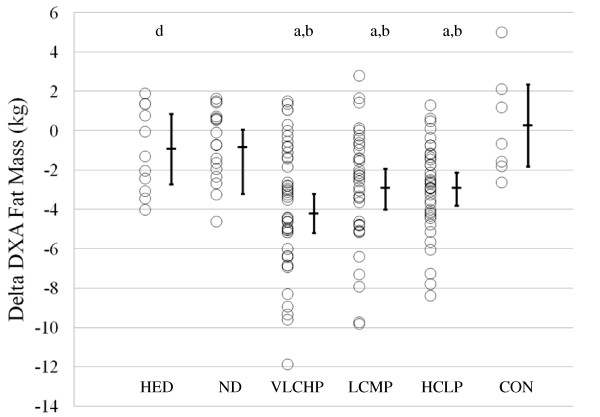
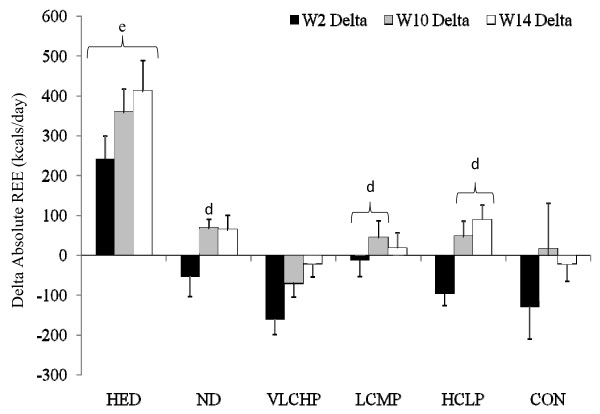
Results: All groups except CON experienced significant reductions (P < 0.05 - 0.001) in waist circumference over 14 weeks. VLCHP, LCHP and LPHC participants experienced similar but significant (P < 0.05 - 0.001) reductions in body mass when compared to other groups. Delta responses indicated that fat loss after 14 weeks was significantly greatest in VLCHP (95% CI: -5.2, -3.2 kg), LCMP (-4.0, -1.9 kg) and HCLP (-3.8, -2.1 kg) when compared to other groups. Subsequent reductions in % body fat were significantly greater in VLCHP, LCMP and HCLP participants. Initial dieting decreased (P < 0.05) relative REE similarly in all groups. All exercise groups significantly (P < 0.05) improved in muscular fitness, but these improvements were not different among groups. Favorable but non-significant mean changes occurred in lipid panels, glucose and HOMA-IR. Leptin levels decreased (P < 0.05) in all groups, except for CON, after two weeks of dieting and remained lower throughout the 14 week program. Exercise participation resulted in significant improvements in quality of life and body image.
Conclusion: Exercise alone (ND) appears to have minimal impact on measured outcomes with positive outcomes apparent when exercise is combined with a hypoenergetic diet. Greater improvements in waist circumference and body composition occurred when carbohydrate is replaced in the diet with protein. Weight loss in all diet groups (VLCHP, LCMP and HCLP) was primarily fat and stimulated improvements in markers of cardiovascular disease risk, body composition, energy expenditure and psychosocial parameters.
Figures


References
-
- Wilborn C, Beckham J, Campbell B, Harvey T, Galbreath M, La Bounty P, Nassar E, Wismann J, Kreider R. Obesity: Prevalence, Theories, Medical Consequences, Management, and Research Directions. Journal of the International Society of Sports Nutrition. 2005;2:4–31. doi: 10.1186/1550-2783-2-2-4. - DOI - PMC - PubMed
-
- Fox AA, Thompson JL, Butterfield GE, Gylfadottir U, Moynihan S, Spiller G. Effects of diet and exercise on common cardiovascular disease risk factors in moderately obese older women. Am J Clin Nutr. 1996;63:225–233. - PubMed
-
- Svendsen OL, Hassager C, Christiansen C. Effect of an energy-restrictive diet, with or without exercise, on lean tissue mass, resting metabolic rate, cardiovascular risk factors, and bone in overweight postmenopausal women. Am J Med. 1993;95:131–140. doi: 10.1016/0002-9343(93)90253-L. - DOI - PubMed
LinkOut - more resources
Full Text Sources
Medical
