


Race, place and AIDS: the role of socioeconomic context on racial disparities in treatment and survival in San Francisco
- PMID: 19443092
- PMCID: PMC2764314
- DOI: 10.1016/j.socscimed.2009.04.019
Race, place and AIDS: the role of socioeconomic context on racial disparities in treatment and survival in San Francisco
Abstract
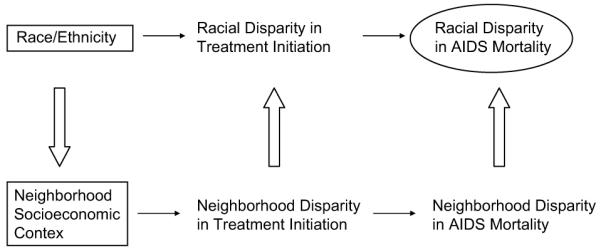
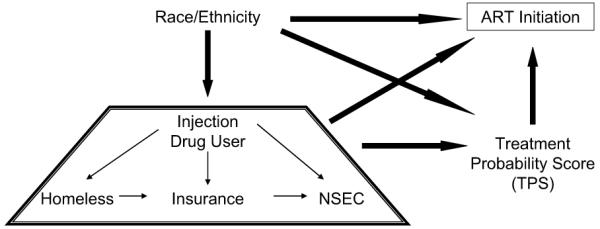
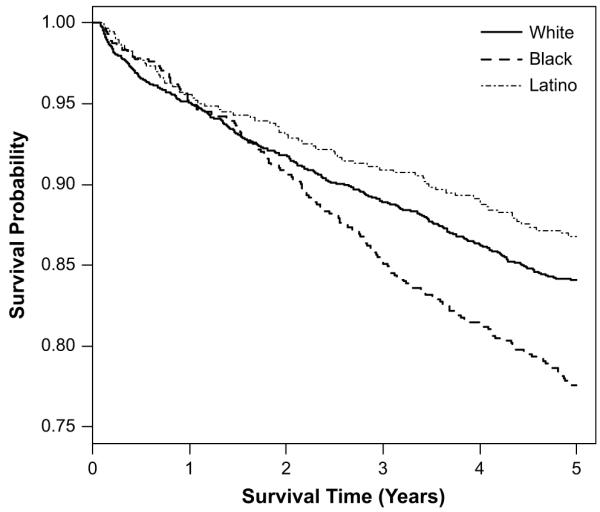
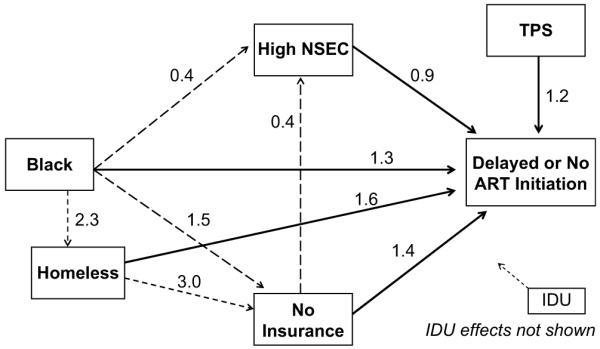
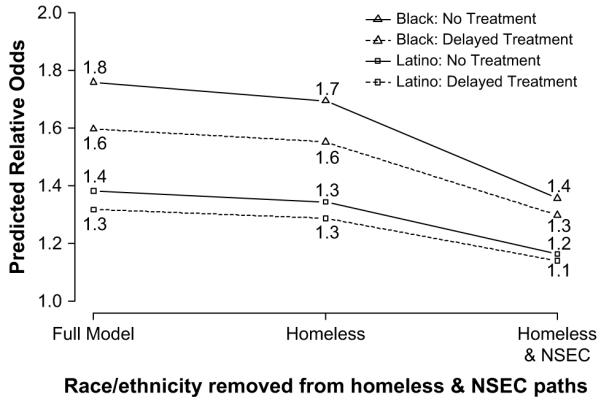
Prior evidence suggests that the health and longevity benefits of antiretroviral therapy (ART) for persons living with AIDS (PLWAs) have not been equally distributed across racial/ethnic groups in the United States. Notably, black PLWAs tend to fare worse than their counterparts. We examine the role of neighborhood socioeconomic context on racial/ethnic differences in AIDS treatment and survival in San Francisco. The study population encompassed 4211 San Francisco residents diagnosed with AIDS between 1996 and 2001. Vital status was reported through 2006. Census data were used to define neighborhood-level indicators of income, housing, demographics, employment and education. Cox proportional hazards models were employed in multivariate analyses of survival times. Compared to whites, blacks had a significant 1.4 greater mortality hazard ratio (HR), which decreased after accounting for ART initiation. PLWAs in the lowest socioeconomic neighborhoods had a significant HR of 1.4 relative to those in higher socioeconomic neighborhoods, independent of race/ethnicity. The neighborhood association decreased after accounting for ART initiation. Path analysis was used to explore causal pathways to ART initiation. Racial/ethnic differences in neighborhood residence accounted for 19-22% of the 1.6-1.8 black-white relative odds ratio (ROR) and 14-15% of the 1.3-1.4 Latino-white ROR for delayed or no treatment. Our findings illuminate the independent and synergistic contributions of race and place on treatment disparities and highlight the need for future studies and interventions to address treatment initiation as well as neighborhood effects on treatment differences.
Figures
References
-
- Altice FL, Mostashari F, Friedland GH. Trust and the acceptance of and adherence to antiretroviral therapy. Journal of Acquired Immune Deficiency Syndrome. 2001;28(1):47–58. - PubMed
-
- Boardman JD. Stress and physical health: the role of neighborhoods as mediating and moderating mechanisms. Social Science & Medicine. 2004;58(12):2473–2483. - PubMed
-
- Centers for Disease Control and Prevention . HIV/AIDS surveillance report. Department of Health and Human Services; 2001.
-
- Cummins S, Curtis S, Diez-Roux AV, Macintyre S. Understanding and representing ‘place’ in health research: A relational approach. Social Science & Medicine. 2007;65(9):1825–1838. - PubMed
MeSH terms
Substances
Grants and funding
LinkOut - more resources
Full Text Sources
Medical
