. 2009 Jun 2;106(22):8998-9003.
doi: 10.1073/pnas.0813063106. Epub 2009 May 14.

Diverse roles of HP1 proteins in heterochromatin assembly and functions in fission yeast

Affiliations

Diverse roles of HP1 proteins in heterochromatin assembly and functions in fission yeast

Tamás Fischer et al. Proc Natl Acad Sci U S A. .

Abstract

Conserved chromosomal HP1 proteins capable of binding to histone H3 methylated at lysine 9 are believed to provide a dynamic platform for the recruitment and/or spreading of various regulatory proteins involved in diverse chromosomal processes. The fission yeast Schizosaccharomyces pombe HP1 family members Chp2 and Swi6 are important for heterochromatin assembly and transcriptional silencing, but their precise roles are not fully understood. Here, we show that Swi6 and Chp2 associate with histone deacetylase (HDAC) protein complexes containing class I HDAC Clr6 and class II HDAC Clr3 (a component of Snf2/HDAC repressor complex), which are critical for transcriptional silencing of centromeric repeats targeted by the heterochromatin machinery. Mapping of RNA polymerase (Pol) II distribution in single and double mutant backgrounds revealed that Swi6 and Chp2 proteins and their associated HDAC complexes have overlapping functions in limiting Pol II occupancy across pericentromeric heterochromatin domains. The purified Swi6 fraction also contains factors involved in various chromosomal processes such as chromatin remodeling and DNA replication. Also, Swi6 copurifies with Mis4 protein, a cohesin loading factor essential for sister chromatid cohesion, and with centromere-specific histone H3 variant CENP-A, which is incorporated into chromatin in a heterochromatin-dependent manner. These analyses suggest that among other functions, HP1 proteins associate with chromatin-modifying factors that in turn cooperate to assemble repressive chromatin; thus, precluding accessibility of underlying DNA sequences to transcriptional machinery.


Conflict of interest statement

The authors declare no conflict of interest.

Figures
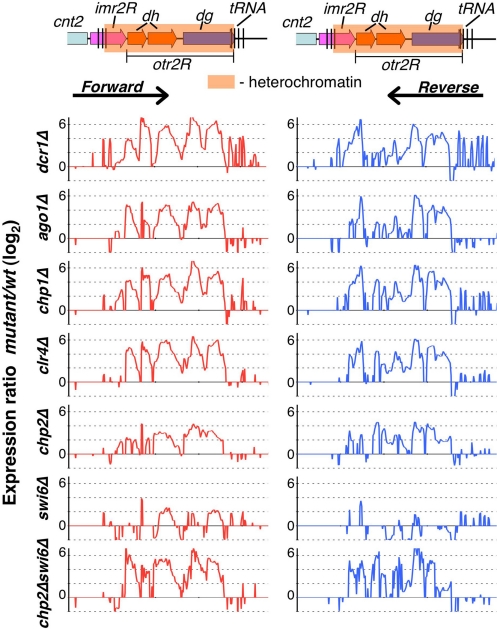
Fig. 1.
Fig. 1.
Chp2 and Swi6 contribute cooperatively to heterochromatic silencing. Schematic representation of S. pombe right pericentromeric repeat region at cen2 (Upper) is shown, including part of the central core region (cnt2), the innermost repeat (imr2R), and the outermost repeat (otr2R), which consist of dh and dg repeat regions. The shaded box represents the heterochromatin region covered by H3K9me and heterochromatin proteins. Expression profiles in indicated strain backgrounds (Lower); cDNAs isolated from wt and mutant strains were labeled and hybridized to high density microarrays containing alternating forward and reverse strand 60-mer probes at every 50 nt. Expression ratios (mutant/wt) for forward strand (Left) and reverse strand (Right) probes were plotted on a log2 scale. Note that, because of the repetitive nature of centromeric probes, the observed expression changes represent average values of centromeric repeat regions.
Fig. 2.
Fig. 2.
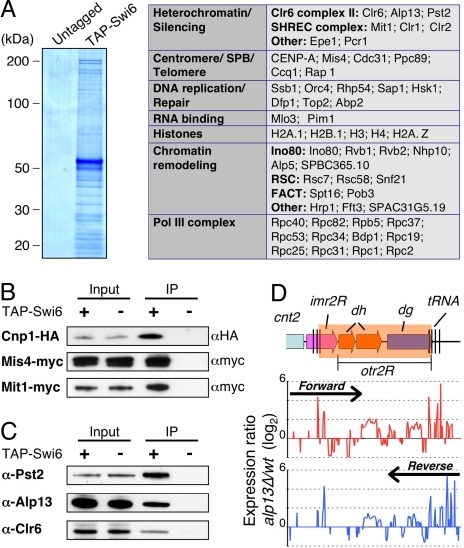
Swi6 associates with the Clr6 HDAC, and factors involved in chromosome segregation. (A) Coomassie blue staining of TAP Swi6 from cells expressing amino-terminally TAP-tagged Swi6 and untagged Swi6 are shown. The purified proteins were subjected to tandem MS (LC-MS/MS) analyses. The identified nuclear proteins were sorted into functional groups, as indicated in the table. (B and C) Fractions immunoprecipitated from indicated strains were subjected to Western blot analyses by using α-HA antibody (12CA5) to detect Cnp1-HA, α-myc antibody (9E10) to detect Mis4-myc or Mit1-myc (B) or α-Alp13, and α-PstII and α-Clr6 antibodies (C) to detect Clr6 complex II. (D) Expression profiling at the right pericentromeric repeat region of cen2 was performed for the wild-type and alp13Δ cells. Expression ratios (mutant/wt) for forward strand (Upper, red) and reverse strand (Lower, blue) probes were plotted on a log2 scale.
Fig. 3.
Fig. 3.
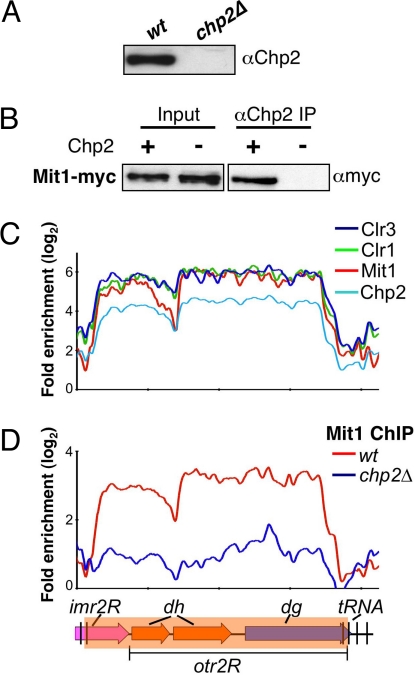
Chp2 interacts with SHREC. (A) The antibody specifically recognizes Chp2 protein. Extracts prepared from wt and chp2Δ strains were analyzed by Western blot analysis using α-Chp2 antibody. (B) Mit1, a component of the SHREC interacts with Chp2. Extracts prepared from wt and chp2Δ cells expressing Myc-tagged Mit1 were immunoprecipitated using the α-Chp2 antibody. Immunoprecipitated (IP) fractions were analyzed by Western blot analysis using α-myc antibody. (C) Chp2 colocalizes with SHREC subunits. Distribution profiles of indicated factors were determined by ChIP-chip. (D) Chp2 dependent localization of Mit1 at centromeric repeats. Mit1-myc distributions in wt or in chp2Δ backgrounds are shown. The probes are aligned to correspond with the schematic representation below.
Fig. 4.
Fig. 4.
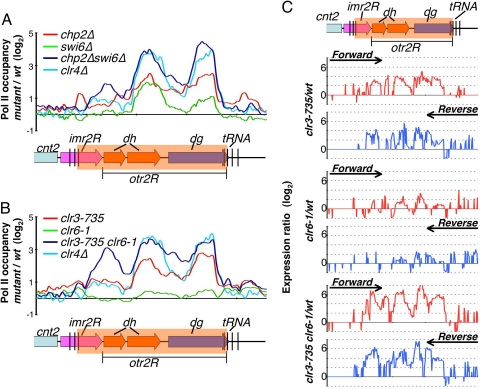
Chp2 and Swi6 proteins and their associated HDACs collaborate to limit Pol II occupancy at pericentromeric heterochromatic repeats. (A) Chp2 and Swi6 cooperatively contribute in transcriptional silencing of the pericentromeric heterochromatin regions. Pol II distributions were determined by ChIP-chip analysis in the indicated mutants and wt strains. Changes in Pol II occupancy in the mutants compared with wt (mutant/wt) were plotted on a log2 scale. (B) Clr3 and Clr6 cooperatively contribute to transcriptional silencing of the pericentromeric heterochromatin regions. Differential Pol II occupancy in indicated mutant strains compared with wt strains (mutant/wt) were plotted on a log2 scale. (C) Expression profiles for the indicated strains, at the right pericentromeric repeat region of cen2, are shown. Expression ratios (mutant/wt) for forward strand (Upper, red) and reverse strand (Lower, blue) probes were plotted on a log2 scale.

References

    1. Grewal SI, Jia S. Heterochromatin revisited. Nat Rev Genet. 2007;8:35–46. - PubMed
    1. Richards EJ, Elgin SC. Epigenetic codes for heterochromatin formation and silencing: Rounding up the usual suspects. Cell. 2002;108:489–500. - PubMed
    1. Selker EU. Repeat-induced gene silencing in fungi. Adv Genet. 2002;46:439–450. - PubMed
    1. Birchler JA, Bhadra MP, Bhadra U. Making noise about silence: Repression of repeated genes in animals. Curr Opin Genet Dev. 2000;10:211–216. - PubMed
    1. Jenuwein T, Allis CD. Translating the histone code. Science. 2001;293:1074–1080. - PubMed

Publication types

MeSH terms

LinkOut - more resources