Comparative Study
. 2009 Oct;50(10):4709-18.
doi: 10.1167/iovs.09-3586. Epub 2009 May 14.

Comparison of clinical and spectral domain optical coherence tomography optic disc margin anatomy

Affiliations
Comparative Study

Comparison of clinical and spectral domain optical coherence tomography optic disc margin anatomy

Nicholas G Strouthidis et al. Invest Ophthalmol Vis Sci. 2009 Oct.

Abstract

Purpose: To investigate spectral domain optical coherence tomography (SD-OCT)-detected optic disc margin anatomy in the monkey eye by colocalizing disc photographs to SD-OCT scans acquired from the same eyes.

Methods: The neural canal opening (NCO) was delineated within 40 digital radial sections generated from SD-OCT volumes acquired from 33 normal monkey eyes (15 degrees, 290 x 768 horizontal grid pattern). Each volume was colocalized to its disc photograph by matching the retinal vessels within each photograph to vessel outlines visible within en face SD-OCT images. Border tissue was delineated where it extended internally to the NCO. A clinician (masked to delineated points) marked the disc margin onto each photograph while viewing the relevant stereophotograph pair. Alignment of the clinician-ascribed disc margin to the NCO and border tissue delineation was assessed. The process was repeated in a single myopic human eye.

Results: In 23 eyes, the NCO aligned to the disc margin. In 10 eyes, externally oblique border tissue was detectable in the temporal disc. In these regions of the disc, the termination of border tissue was the disc margin. An exaggerated form of this phenotype was observed in the myopic human eye. In this case, temporal border tissue terminated at the anterior scleral canal opening, which was detected as the disc margin.

Conclusions: The termination of Bruch's membrane, border tissue, and the anterior scleral canal opening may constitute the disc margin within the same eye, depending on the border tissue architecture; this anatomy is consistently visualized by SD-OCT.


Figures
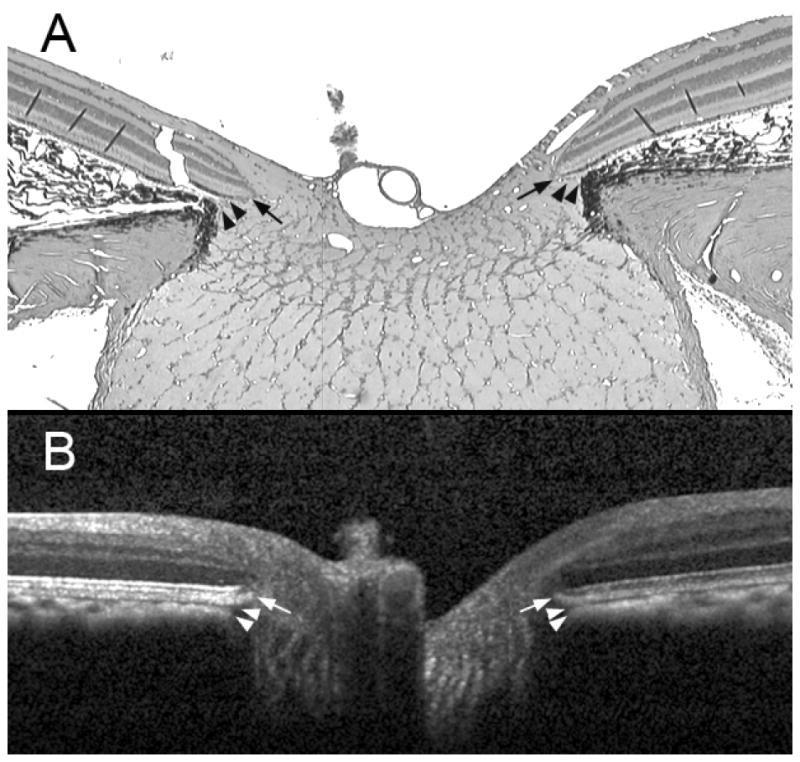
Figure 1
Figure 1. Neural canal architecture, demonstrating the neural canal opening (NCO) and Border Tissue within a histologic section (upper) and a co-localized spectral domain OCT B-scan
A representative serial histologic section (hematoxylin and eosin stain, × 2.5 magnification) through the optic nerve head of a normal monkey eye (not part of this report), perfusion fixed at an IOP of 10 mmHg (panel A) compared to an equivalent B-scan acquired in vivo from the same optic nerve head at an IOP of 10 mmHg (panel B). The arrows show the position of the NCO, which in the histologic section (black arrows) is at the termination of Bruch’s Membrane either side of the neural canal and in the B-scan (white arrows) is at the termination of the retinal pigment epithelium/Bruch’s Membrane signal either side of the neural canal. The arrowheads show the position of Border Tissue, which in the histologic section (black arrowheads) is an extension of the scleral connective tissue, enclosing the choroid to meet Bruch’s Membrane; in the B-scan (white arrowheads) the Border Tissue is identified as the junction of the choroidal signal with the neural canal. The neural canal extends from the NCO until the point where the optic nerve exits the globe, passing through a choroidal component (bound by the Border Tissue) followed by a scleral component.
Figure 2
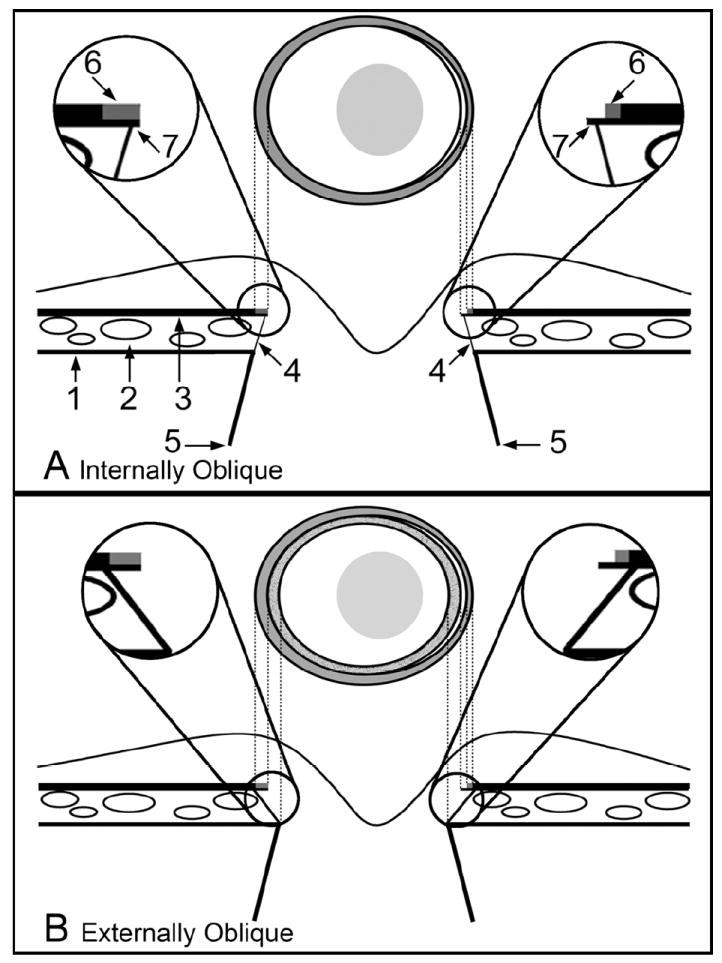
Figure 2. Two principal Border Tissue configurations, their relationship to a pigmented or unpigmented extension of Bruch’s Membrane and the resultant clinical disc margin anatomy
A. Internally Oblique The diagram shows the clinical optic disc appearance (above) and a cross section of the optic nerve head (below). Labeling is as follows:
  1. 1 = Sclera

  2. 2 = Choriocapillaris

  3. 3 = Retinal pigment epithelium with Bruch’s Membrane

  4. 4 = Border Tissue

  5. 5 = Neural canal boundary

  6. 6 = Pigment on the surface of Bruch’s Membrane

  7. 7 = Bruch’s Membrane

Magnified Inset Left – pigmented Bruch’s Membrane corresponds to the halo of pigment on the left side of the disc margin Magnified Inset Right – a region of unpigmented Bruch’s Membrane is shown; this corresponds to a white crescent internal to the pigment halo at the disc margin (which corresponds to a portion of pigmented Bruch’s Membrane) B. Externally Oblique Labeling is as per the schematic in panel A Magnified Inset Left – Bruch’s Membrane is pigmented to its end and extends beyond the termination of the Border Tissue. This Bruch’s Membrane extension corresponds to an external crescent of pigment at the disc margin that is internal to the termination of the retinal pigment epithelium. The portion of the Border Tissue that is internal to the end of Bruch’s Membrane (BMO) may be clinically recognizable as an inner reflective (if there is no pigment on the Border Tissue surface) or a pigmented crescent (if there is pigment on the Border Tissue surface) that is posterior to the plane of the retinal pigment epithelium. An inner pigmented halo (lighter grey and stippled) is shown on both sides of the disc diagram Magnified Inset Right– unpigmented Bruch’s Membrane extends internally to the Border Tissue termination, corresponding to a reflective crescent internal to the pigment crescent. Again, pigmented Border Tissue (lighter grey and stippled) extends internal to the reflective crescent. In both the left and right insets the Border Tissue/scleral junction is depicted without a true scleral lip which when present and visible, appears internal and deep to the other structures. Figure previously published in: Strouthidis NG, Yang H, Downs JC, Burgoyne CF. Comparison of Clinical and Three-Dimensional Histomorphometric Optic Disc Margin Anatomy. Invest Ophthalmol Vis Sci 2009;50:2165-2174. © Association for Research in Vision and Ophthalmology
Figure 3
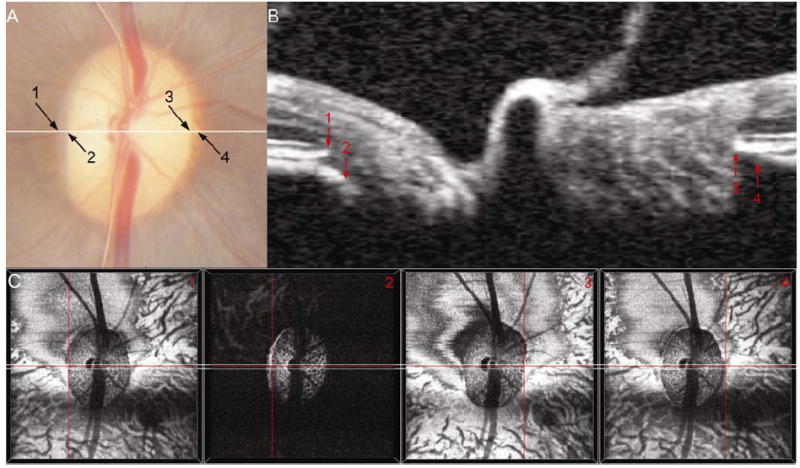
Figure 3. The disc photograph (Panel A) and spectral domain OCT (Panels B and C) appearance of internally oblique and externally oblique Border Tissue in the normal monkey eye
Externally Oblique: In Panel A, arrow 1 marks a thin pale crescent, which is located at the same stereoscopic depth as the retinal pigment. Internal to this is a pigment crescent deep to the retinal pigment; the end of this pigment is the temporal disc margin (arrow 2). In a co-localized horizontal B-scan (panel B, location of B-scan shown by a white line in panel A), an externally oblique Border Tissue configuration is seen temporally. Arrow 1 marks the location of the neural canal opening (NCO) temporally and arrow 2 marks the position of the Border Tissue, which can be seen to extend internal to the NCO. In the disc photograph (panel A), the pale crescent labeled 1 is a stripe of unpigmented Bruch’s Membrane – external to this is pigmented Bruch’s Membrane continuous with the retinal pigment epithelium. The pigment crescent internal to 1 is caused by pigment on the surface of an externally oblique Border Tissue. Panels C1 and 2 show the location of these structures (at the center of the red cross-hairs) within the en face OCT images. Note that the externally oblique Border Tissue (Panel C2) is visible as a high intensity signal, internal to and at a greater depth than, the NCO (Panel C1). Internally Oblique: In Panel A, arrow 3 highlights the disc margin location, which is at the termination of a crescent of mottled pigment, visible at the same depth as the retinal pigment. Within the B-scan (Panel B), internally oblique Border Tissue can be clearly seen at the nasal side of the neural canal. Arrow 3 shows the termination of the retinal pigment epithelium/Bruch’s Membrane (NCO). The internally oblique Border Tissue can be seen to meet the retinal pigment epithelium/Bruch’s Membrane signal external to the NCO (arrow 4) and to extend away from the neural canal. The pigment crescent at the nasal disc margin represents a region of pigmented Bruch’s Membrane. The region of Bruch’s Membrane ‘overhang’, beyond the point where Border Tissue meets Bruch’s Membrane is visible as a dark crescent in the en face OCT image (panel C4), external to the NCO (panel C3).
Figure 4
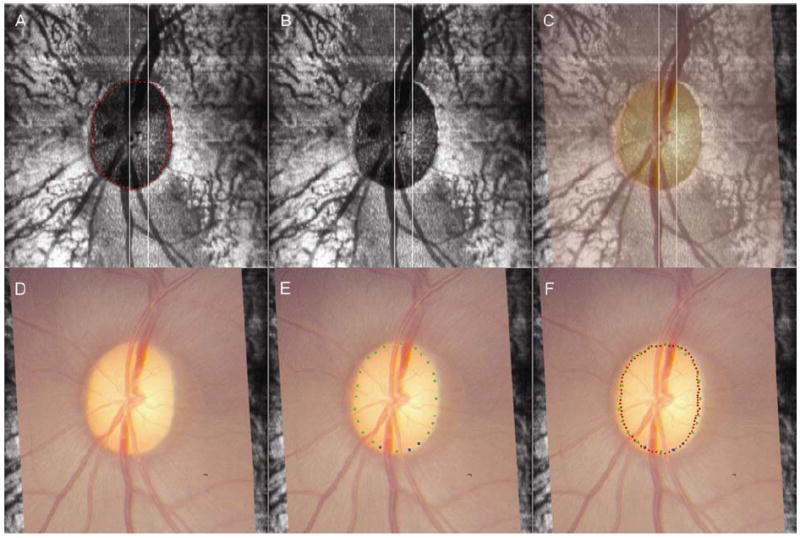
Figure 4. The co-localization and disc margin delineation process
Panel A shows the location of the neural canal opening points (NCO, visible as red glyphs) within an en face OCT image. During co-localization, the en face OCT image is used with the NCO glyphs not visible (Panel B). Panel C shows the clinical photograph, at 50% opacity, laid onto the en face OCT image. By adjusting x- and y- axis shifts, z-axis rotation and by scaling at a 1:1 ratio, the central retinal vessels are matched between the photograph and the en face OCT image. The disc photograph, co-localized to the en face OCT image is then presented to the clinical observer for disc margin delineation (Panel D). Whilst delineating the disc margin, the observer simultaneously views the representative stereophotograph pair. Panel E shows completed disc margin delineation, with blue glyphs representing ‘certainty’ regarding disc margin location and green glyphs representing ‘forced choice’. Once disc margin delineation is completed, the co-localized OCT delineated points are revealed, so that their alignment to the disc margin can be compared (Panel F). In this case, the spectral domain OCT-defined NCO is well aligned to the disc margin, as there is less than a glyph’s separation between adjacent glyphs for 360° of the disc margin.
Figure 5
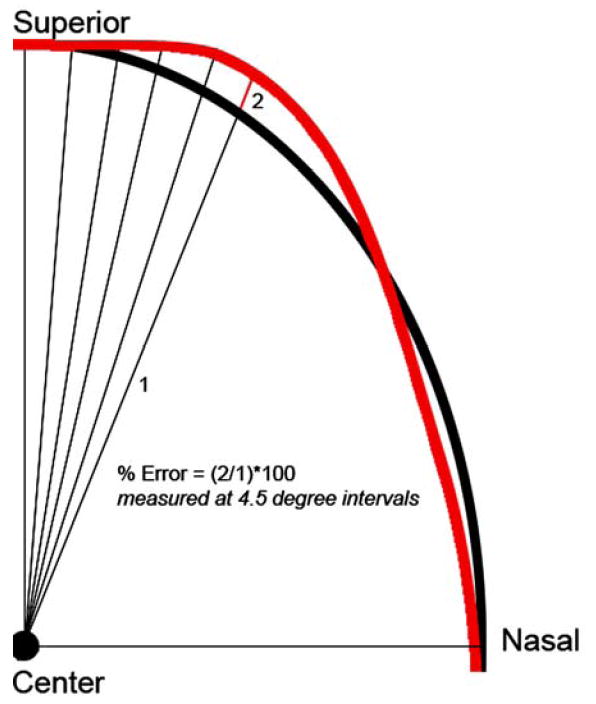
Figure 5. Schematic to illustrate the estimation of alignment error in the superonasal quadrant of a co-localized image (all images in right eye orientation – all four quadrants used in the analysis, not shown in diagram)
The clinician-ascribed disc margin is shown in black and the SD-OCT delineated curve is shown in red. Radial spokes are generated from the center of the disc margin at 4.5° intervals from the temporal meridian Alignment error is the distance between the clinician’s disc margin and the SD-OCT curve (the red line – 2), expressed as a percentage of the disc radius (the black line marked – 1). The alignment errors are calculated for each radial spoke enabling an estimation of global and regional alignment error for each eye.
Figure 6
Figure 6. Examples of good alignment between disc margin delineations and spectral domain OCT delineations
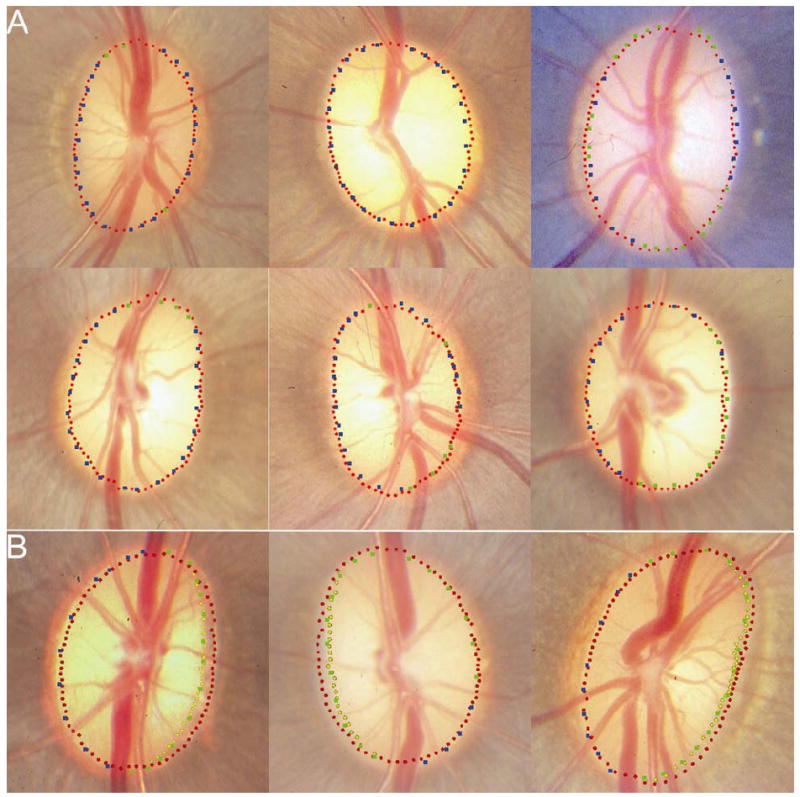
Panel A shows 6 discs where the neural canal opening (NCO – red glyphs) aligns to within one glyph’s diameter for 360° of the disc margin (blue glyphs – ‘certain’ disc margin location; green glyphs – ‘forced choice’ disc margin location). Panel B shows 3 examples where the termination of externally oblique Border Tissue (yellow glyphs) aligns to the temporal disc margin and the NCO aligns to the remainder of the disc margin.
Figure 7
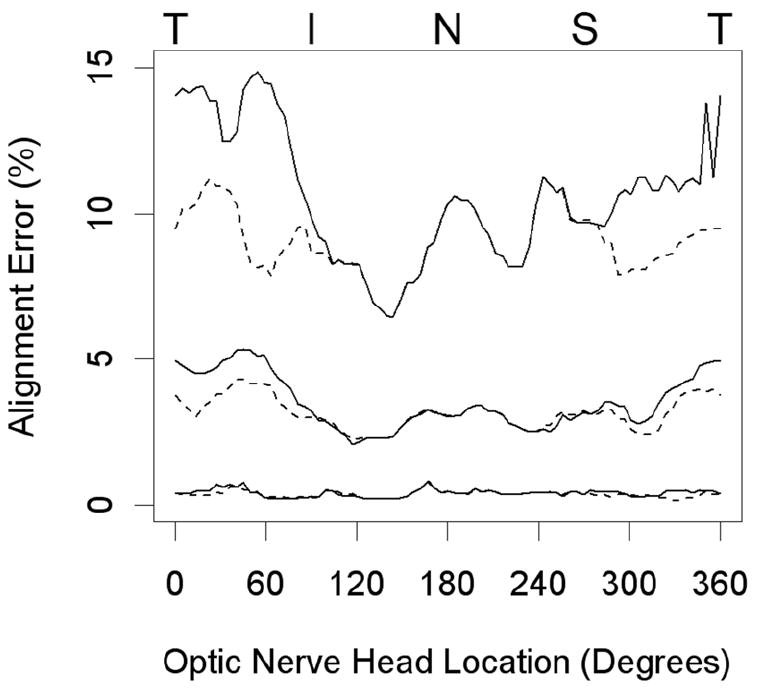
Figure 7. Regional alignment error for all eyes included in the study
The lines shown are for the median (middle lines), 95 % (upper lines) and 5 % quantiles of alignment error. This is measured at each 4.5° location as a moving average of that location and the 2 locations either side of it. Solid lines indicate the degree of misalignment from the disc margin of the curves generated by the neural canal opening, whereas the dotted lines indicate the degree of misalignment from the disc margin of the curves generated by a combination of the neural canal opening and the Border Tissue. (T = temporal, I = inferior, N = nasal, S = superior)
Figure 8
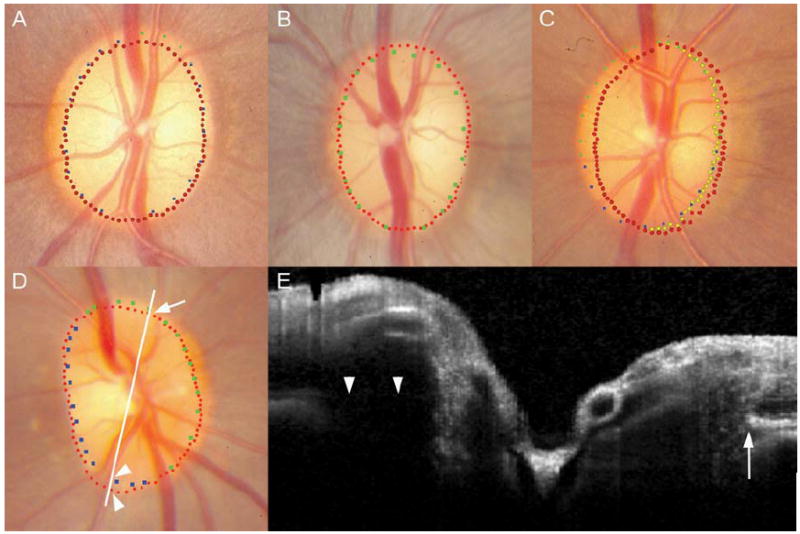
Figure 8. Examples of misalignment between the disc margin and spectral domain OCT delineations
In panel A, the neural canal opening (NCO) is internal to the disc margin, beyond one glyph’s diameter, at the superior pole. In Panel B, the NCO is misaligned at the superior pole. In both cases, the remainder of the disc margin is well aligned to the NCO. A possible reason for misalignment in these two cases is the fact that the disc margin may be indistinct in regions of the disc poles where the nerve fiber layer is particularly thick. Panel C shows a left disc where the NCO is misaligned from the nasal disc margin. It is possible in this case that a wide crescent of unpigmented Bruch’s Membrane was not visible at the nasal disc margin on the stereophotographs but was picked up by spectral domain OCT imaging. In panel D, the NCO at the inferior pole is external to the disc margin, which had been marked ‘with certainty’ (blue glyphs) in this region. When examining the B-scan (Panel E) acquired at the location highlighted by the white line in the disc photograph, the superior NCO, which is aligned to the disc margin, is clearly visible (white arrows). The inferior NCO and the retinal pigment epithelium/Bruch’s Membrane complex are obscured by a shadow cast by a blood vessel (white arrowheads), causing difficulties in accurate delineation of the NCO.
Figure 9
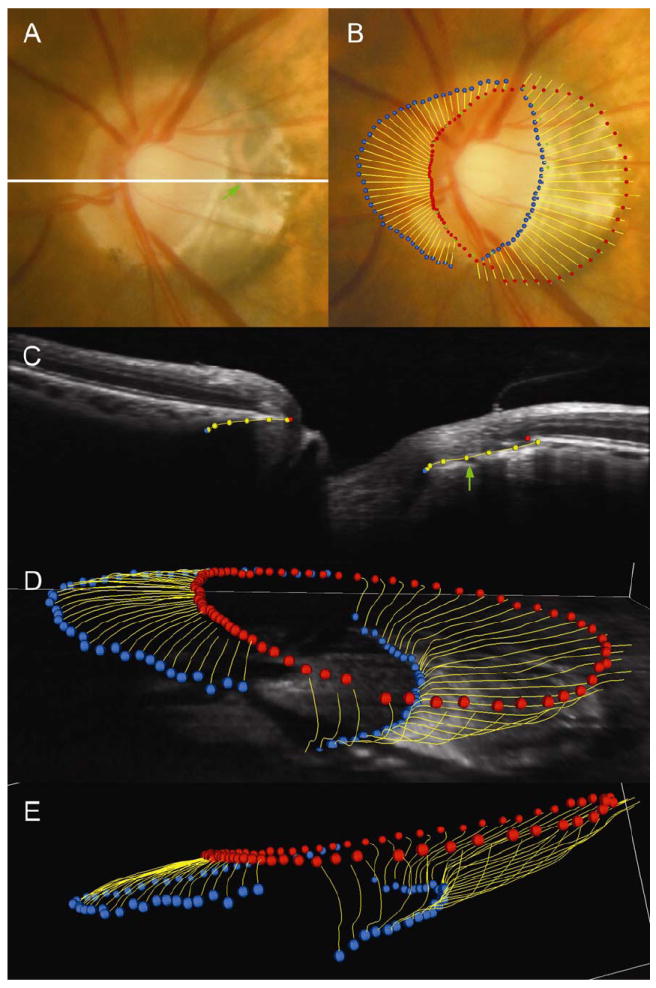
Figure 9. SD-OCT disc margin anatomy in a myopic human left eye
Panel A shows the disc photograph; a white line highlights the location of the B-scan shown in panel C. Panel B shows the alignment of the disc margin (blue and green square glyphs) to the spectral domain OCT delineations. In panels B, C (the representative B-scan), D and E (three-dimensional point clouds) circular red glyphs are the neural canal opening (NCO), circular blue glyphs are the anterior scleral canal opening and yellow lines represent the full extent of the Border tissue. In panel B, the anterior scleral canal opening, at the termination of externally oblique Border Tissue, can be seen to align to the temporal disc margin. This is seen clinically as a ‘true’ scleral lip at the disc margin. The NCO is aligned to the nasal disc margin. A green arrow shown in panel C highlights the location of a choroidal vessel within the Border Tissue signal which is also shown in its co-localized position within the disc photograph (Panel A). Panels D and E are three-dimensional point clouds generated from the delineation of the spectral domain OCT images.

References

    1. Jonas JB, Airaksinen PJ, Robert Y. Definitionsentwurf der intra- und parapapillären Parameter für die Biomorphometrie des Nervus opticus. Klin Monatsbl Augenheilkd. 1988;192:621.
    1. Anderson DR, Hoyt WF. Ultrastructure of intraorbital portion of human and monkey optic nerve. Arch Ophthalmol. 1969;82:506–530. - PubMed
    1. Fantes FE, Anderson DR. Clinical histologic correlation of human peripapillary anatomy. Ophthalmology. 1989;96:20–25. - PubMed
    1. Nevarez J, Rockwood EJ, Anderson DR. The configuration of peripapillary tissue in unilateral glaucoma. Arch Ophthalmol. 1988;106:901–903. - PubMed
    1. Burgoyne CF, Downs JC, Bellezza AJ, Hart RT. Three-dimensional reconstruction of normal and early glaucoma monkey optic nerve head connective tissues. Invest Ophthalmol Vis Sci. 2004;45:4388–4399. - PubMed

Publication types